
Tune when My Day suggests a request pattern review for a requestor — the on/off switch, each signal's threshold and points, the burst window, the score and the pause.
Last updated: October 20, 2026 by Steve
Request Pattern Review
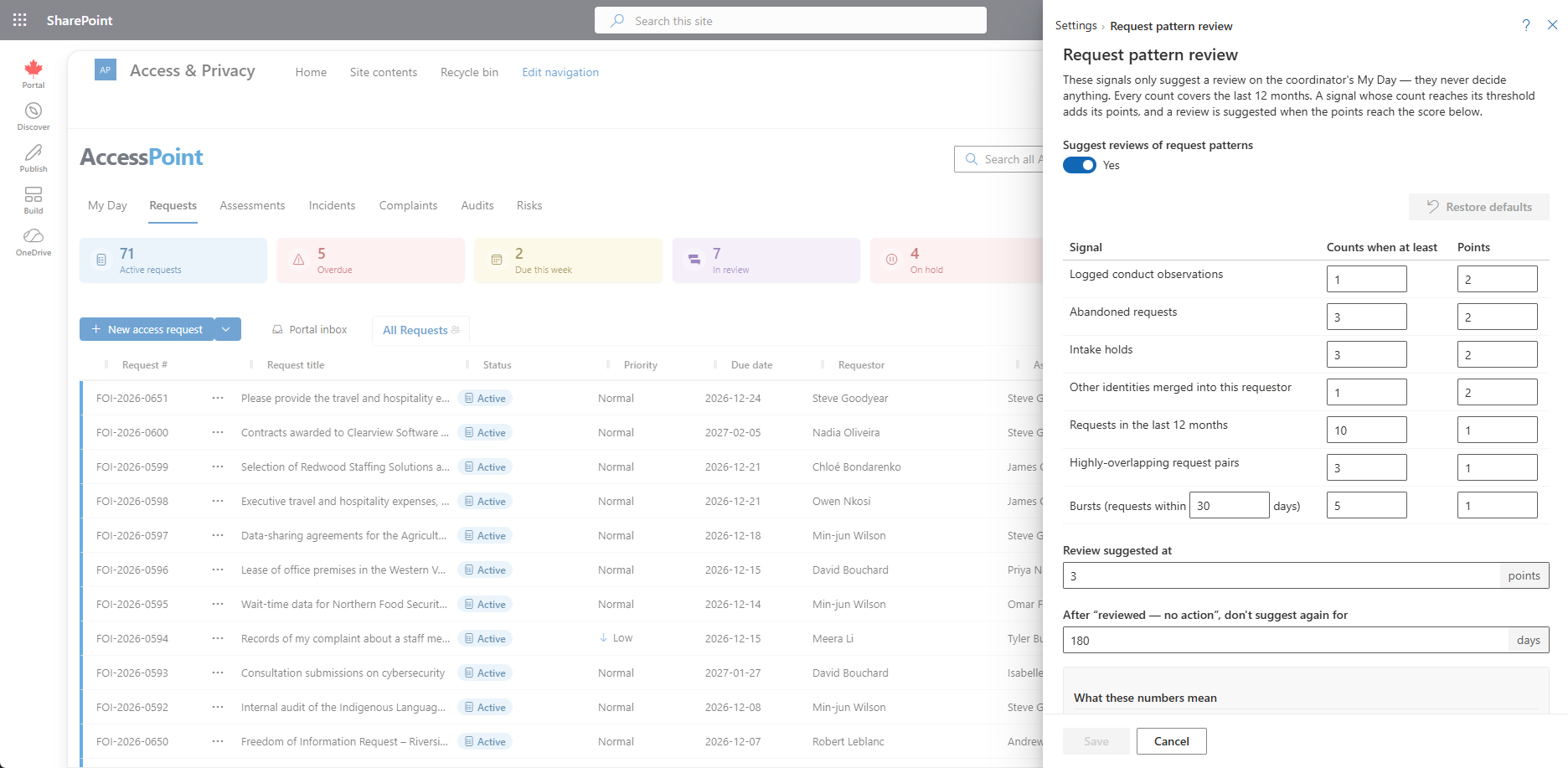
Settings → Request pattern review controls when My Day suggests Review request pattern for for a requestor. The suggestion is a prompt to look, never a determination. It sits beside the frivolous-or-vexatious tools under the Conduct tab of a requestor's profile, and the values you set here are the same ones the Conduct signals card and the conduct memos read.
How the Score Works
AccessPoint scores each requestor's last 12 months. Each signal that reaches its threshold adds its points. When the total reaches the score that suggests a review, My Day suggests one and names the signals that counted. Because heavy use alone carries few points, a frequent requestor with overlapping requests is not flagged unless a burst or one of the conduct signals is also present.
The settings page shows a table of seven signals, each with the count at which it counts and the points it adds:
| Signal | Counts when | Points by default |
|---|---|---|
| Conduct observation | A conduct observation was logged | 2 |
| Abandoned requests | Requests were closed as abandoned (threshold 3) | 2 |
| Intake holds | Intake holds under the active-request limit began (threshold 3) | 2 |
| Several identities | Other contacts were merged into this requestor, meaning the same person under another name or address | 2 |
| Volume | Requests were received (threshold 10) | 1 |
| Overlap | Pairs of highly-overlapping requests were found (threshold 3) | 1 |
| Bursts | Requests were received within the burst window (threshold 5, window 30 days) | 1 |
A review is suggested at 3 points by default. Every count covers the last 12 months. Overlap is measured on the words that describe the scope. The words every request uses, such as kinds of records, months, years and request boilerplate, do not count, so ordinary requests from a frequent requestor are not read as one pattern.
The Settings
- On/off switch. Turn the suggestions on or off.
- Threshold and points for each signal. Setting a signal's points to 0 switches it off, and it then reads not counted. Thresholds run from 1 to 1000 (bursts from 2 to 1000) and points from 0 to 10.
- Burst window. The number of days in which a burst of requests is counted, 1 to 365.
- Score that suggests a review. 1 to 100.
- Pause after a reviewed — no action outcome. When a coordinator uses Log review outcome on the Conduct tab to record that they looked and decided no action was warranted, the suggestion for that requestor is paused for this many days, 0 to 3650. 0 means no pause. The default is 180 days.
- Examples box. It recomputes as you type, for example A logged observation alone: 2 — no suggestion or Requests + overlap + burst: 3 — suggestion, and warns when no combination of signals can reach the score.
- Restore defaults. Brings back the shipped values. Save still applies them.
A setting saved before 2.5.0 keeps its thresholds. Every change is audited. In train mode the page is read-only.
Who Sees the Suggestion
The suggestion goes to the coordinator of the requestor's open request, or to the people who triage intake while that request has no coordinator. A requestor with nothing open waits until their next request.
What the Signals Do Not Do
These signals only suggest a review. They never decide anything, and they do not block a request. A frivolous-or-vexatious determination is a separate, deliberate record made on the Conduct tab, with its legal basis and grounds. See Frivolous and Vexatious Reasons.
Related Pages
- Requestor Flow Control — active-request limits and intake holds, which feed one of the signals.
- Frivolous and Vexatious Reasons — the grounds offered when a determination is made.
- Requestor Contact — the contact profile and its Conduct tab.
- My Day — where the suggestion appears.