
Access requests
Work a request end to end
Open a live request, redact a record under the Act's own exemptions, and send the decision — guided step by step.
Work a request (opens the demo in a new tab)Solutions · By capability
A training copy of your organization — your request types, templates, letters and settings, holding only fictional cases — where new coordinators and analysts practise until the work is second nature. The people around them answer as the scenario scripts them, a coach explains the key decisions, and learning paths, certificates and breach tabletops make onboarding a morning's work, with nothing ever sent.
Access and privacy offices turn over, and the work does not wait. A new coordinator learns the statute, the request types, the letters and the exemptions on live files — with a real requestor's personal information on the screen and a statutory clock running — usually by shadowing whoever has been there longest. When that person leaves, much of what they knew leaves with them. And the breach plan in the binder is rehearsed, if at all, around a meeting-room table rather than in the system the team would actually use.
Lab mode gives every AccessPoint organization a training copy of itself. It carries your real configuration — request types, statuses, templates, letters, languages and settings, copied from your live setup every week by default — and holds only fictional training cases, with invented people, organizations and records. People work in it with their real role, on the real screens, under a band that always says they are training. Letters are simulated; nothing is sent, delivered, paid for or published.
Since AccessPoint 2.6.0, the people around a trainee answer back. In a training case the requestor, a consulted third party, a complainant and the regulator's contact reply as the scenario scripts them, and simulated colleagues — people who exist only in the training copy — search, review, advise, sign off and give opinions. Beside twelve decisions people make on a real case, How we decide coaching sets out the rule in plain language, with your organization's own notes on how you apply it.
Around it sits the rest of a training program: Get started on My Day and Guide me tours that highlight the real control on the real screen; training cases whose guides tick themselves as the work is done; learning paths a lead assigns with due dates; team exercises with roles, injects, debriefs and an exercise clock that can run a breach notification deadline forward; finished DPIA examples to read; and readiness reports that show totals, never a figure about one person.
Three moments every access and privacy office recognizes — whether the team is two people or twenty.
A new analyst's first file is a live one: a real requestor, real records, a real deadline. The letter goes out on the wrong template, the exemption is cited from memory, and the senior coordinator spends the week checking work instead of doing it.
There is a training environment, technically — versions behind, with request types nobody uses any more and someone's half-finished test cases. New staff learn from screenshots in a slide deck instead.
The notification deadline is written into the policy. Nobody on the team has ever worked a breach against it in the system, so the first run-through is the real one — late on a Friday, with the clock already running.
Whatever you buy — including if it isn't AccessPoint — these are the capabilities that separate a demo site from training that actually shortens the time to a confident first file.
Practice, guidance and team drills in one place — these are the load-bearing pieces.
Your configuration, copied in weekly by default — or monthly, or on demand — holding only fictional cases numbered TR-. Lab mode belongs to one browser tab, says so in a band across the top and in the page title, and returns to your real work after 30 minutes without activity.
Get started on My Day lists the first tasks for each person's kind of work and ticks them off as they do the real thing. Guide me highlights the real control on the real screen in at most four short steps — from a record's name into the redaction viewer, all the way to the exemption.
Fictional requests, assessments, breaches, complaints and risks from your packs, each with a guide whose steps tick themselves as the work is done, and a Training library of fictional records to add, review and redact. Uploading your own files is off by default.
Requestors, third parties, complainants and the regulator reply on cue, and simulated colleagues search, review and sign off — so a trainee practises the whole file, not only their own part of it.
Packs provide paths for a new coordinator, analyst, privacy officer, administrator, custodian and breach team member. Leads copy them or build their own, assign them with a due date and a note, and follow a team progress table with CSV export.
Coaching beside key decisions, learning paths assigned by hand or by audience rules, checks with model answers, completion records with reminders and a CSV export, and certificates with recertification. Write your own modules in the Studio with the AccessPoint Learning add-on.
Run a breach tabletop on one shared training case: assign participants to roles, release injects as the scenario unfolds, move the exercise clock forward by hours or to the next deadline, and collect each person's debrief.
Training readiness and Exercise activity show completion, overdue assignments, how many people practised, the exercises held and when each scenario was last drilled — totals only, never a figure about one person — plus the median days from first sign-in to first real case.
Real screens from the product, running in a Microsoft 365 tenant. Click any one to enlarge.
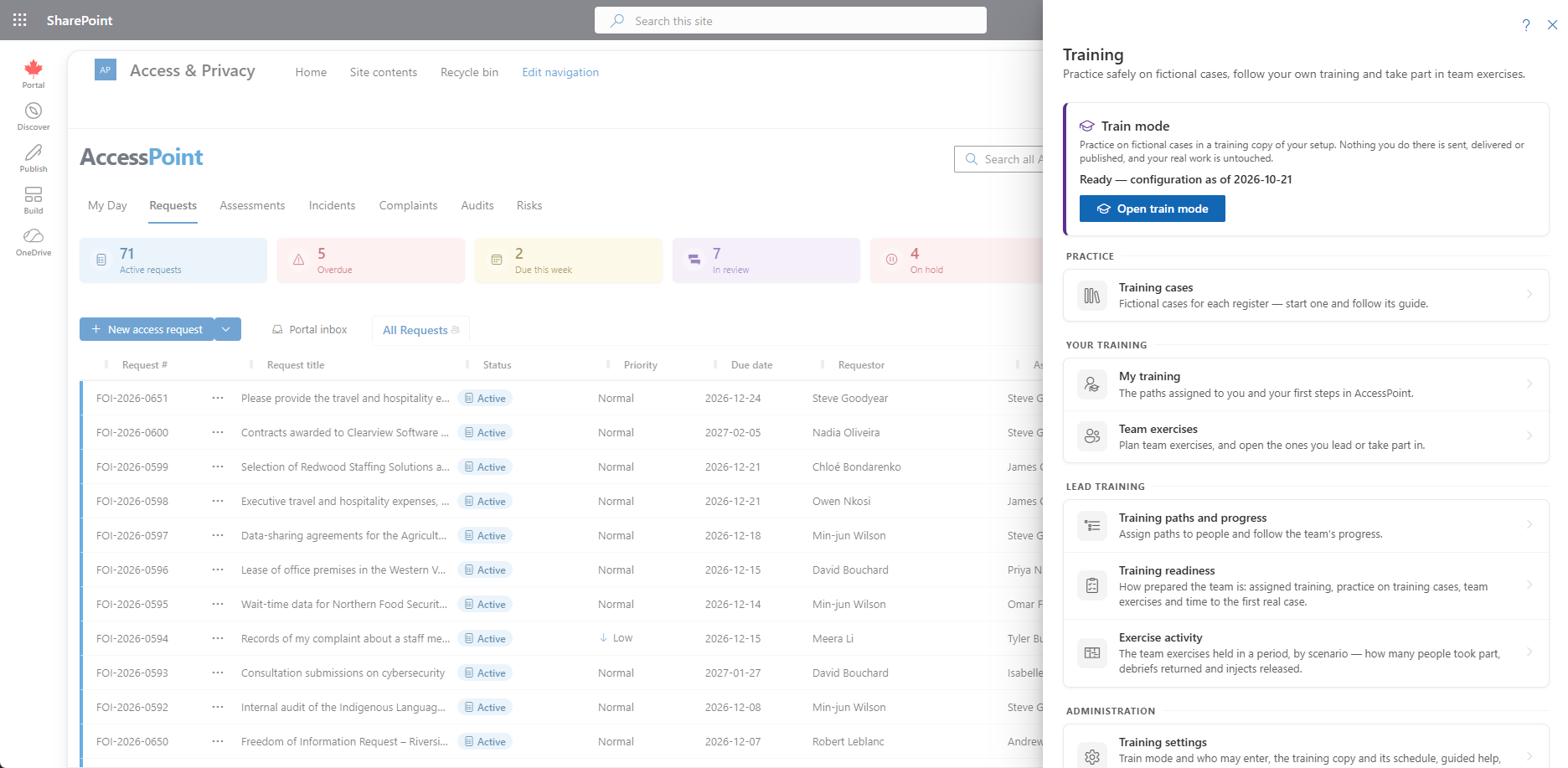
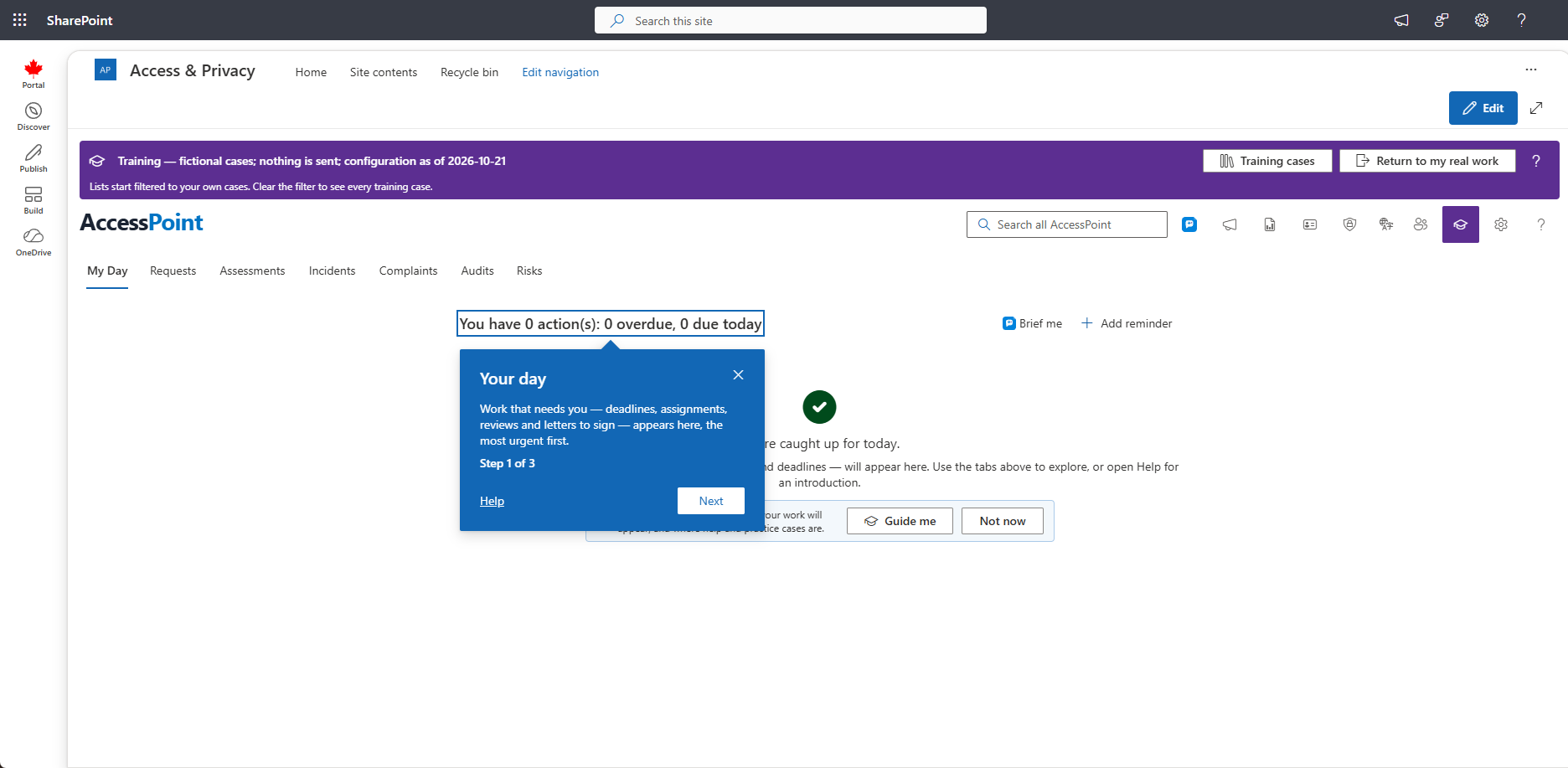
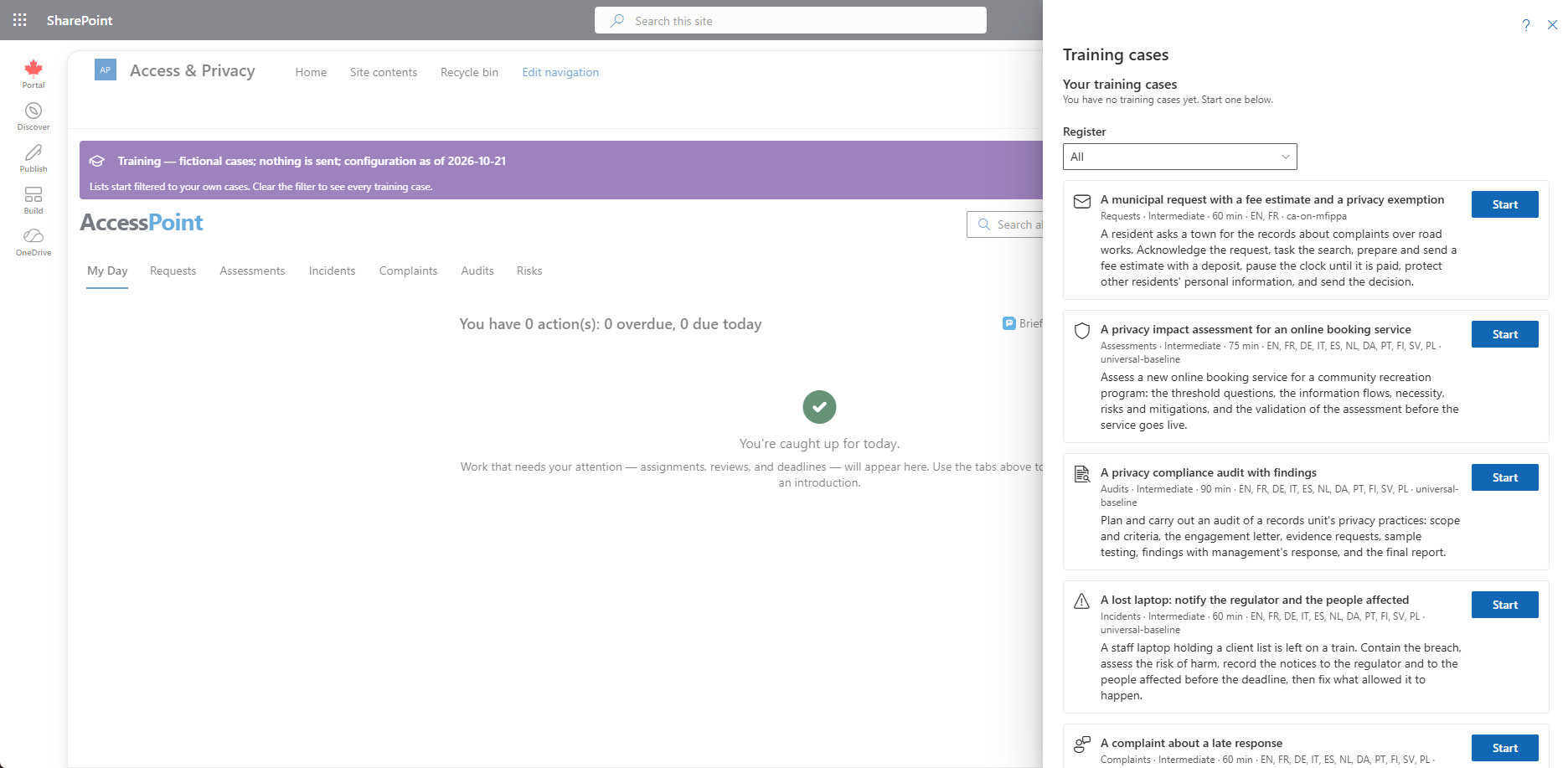
The structural difference
Training on case-management software often happens somewhere else: a vendor's demo site with someone else's request types, a test installation that drifts out of date, or a slide deck. AccessPoint's training copy lives in your own deployment, in your own Azure database, kept apart from your real work by the same tenant isolation that separates one organization from another. Nothing in it appears in your real lists, reports, search, exports or My Day, and nothing in your real work appears in it. One outbound guard refuses everything that would leave — portal delivery, the reading room, payment requests, repository connectors, Microsoft 365 capture and data import — and letters are generated and filed but never sent.
The path for onboarding a new coordinator:
Interactive demo
Lab mode is a training copy inside your own AccessPoint. The demo is the closest thing outside it: the real screens, a fictional caseload, nothing saved.
Access requests
Open a live request, redact a record under the Act's own exemptions, and send the decision — guided step by step.
Work a request (opens the demo in a new tab)Privacy assessments
Answer a section of your jurisdiction's own PIA template, draw the data flow, score a risk and send it for sign-off.
Start a PIA (opens the demo in a new tab)Rather look around on your own? Open the full demo — requests, releases, assessments, breaches, complaints, risks, audits and reports, in 11 languages. Or book a live walkthrough on your own records.
Two editions, every price published. Hosted AccessPoint by the month or year, or one flat annual rate in your own Microsoft 365 tenant. Unlimited users either way, with no per-user fees.
Try AccessPoint free for 30 days in your own Microsoft 365 tenant — Lab mode, guided tours and team exercises included.
Prefer your own Microsoft 365 tenant? Deploy it there →