
Solutions · By capability
ATIP case management, rebuilt for the Microsoft 365 era
Access to Information Act and Privacy Act processing end to end — computed deadlines, records collected from your own tenant, redaction with exemption tagging, digital attestations, and statutory reporting — with your data never leaving your control.
ATIP case management software is having a forced generational turnover. AccessPro Case Management — the system much of the Government of Canada ran for two decades — was declared a legacy application effective June 2023, and every institution still on it needs a destination. That makes this the rare moment when an ATIP office gets to choose its next decade of tooling deliberately, rather than inheriting it.
The obvious move is replacing one request tracker with another. The better question is what the next system should carry: today's ATIP office doesn't just process requests — it runs Privacy Act obligations, privacy impact assessments, Algorithmic Impact Assessments under the Directive on Automated Decision-Making, breach responses, and complaint files from the commissioners. AccessPoint runs all of it on one platform with one hash-chained audit ledger, configured for federal ATIP by a jurisdiction pack.
And it does so inside your own Microsoft 365 and Azure tenant. The records under an access request are often the most sensitive a department holds; AccessPoint collects them straight from SharePoint, Outlook, and Teams and reviews them where they live, instead of copying them into a vendor's cloud.
Sound familiar?
If your institution runs ATIP on a legacy tracker and spreadsheets, these scenes are familiar.
Casework on a system declared legacy
The tracker that ran the office for twenty years is now officially end-of-life, and every workaround the team invents deepens the dependency. The migration is coming either way — the only question is whether it happens on your schedule or mid-caseload on someone else's.
Thirty days, computed by hand
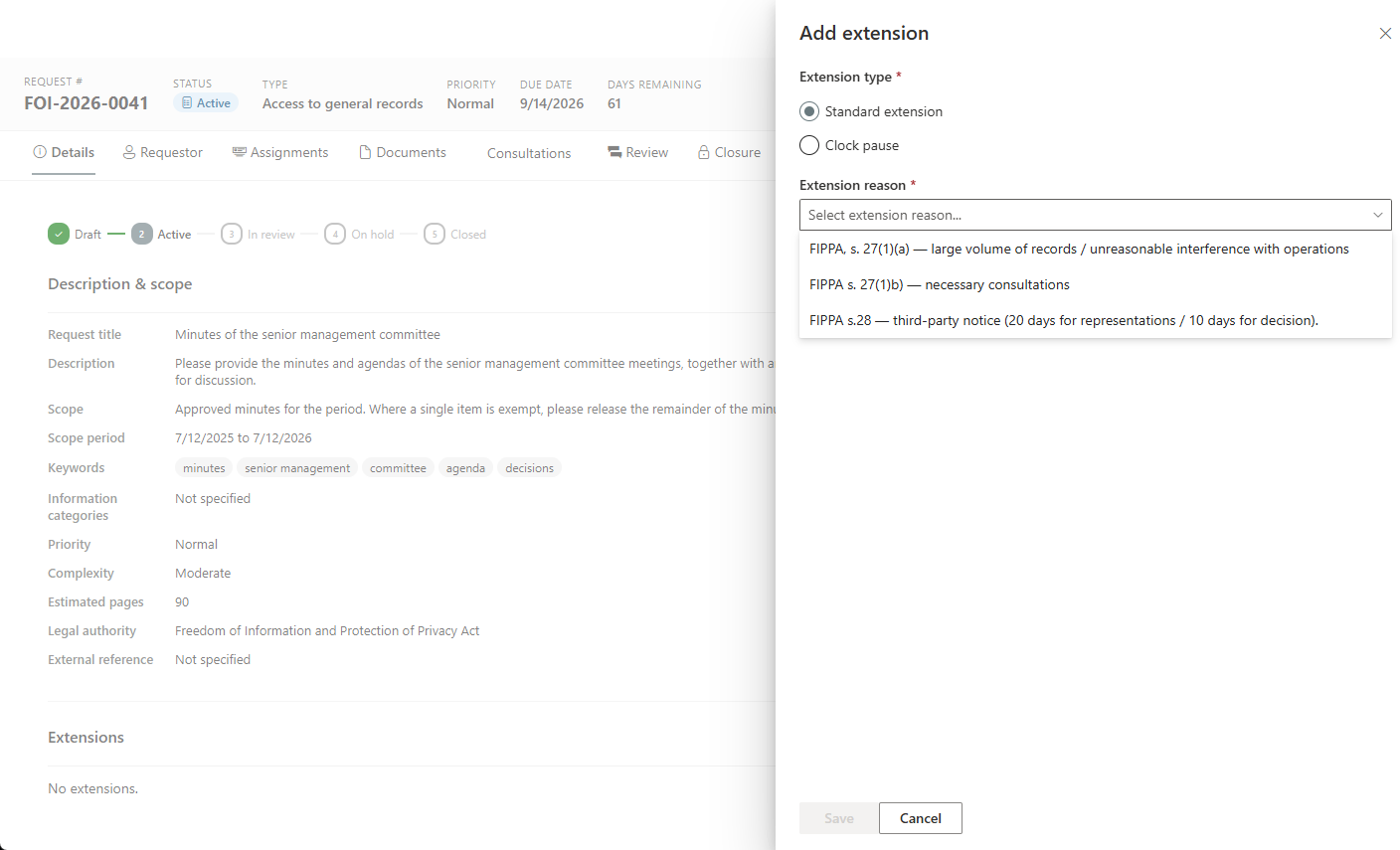
The ATIA clock runs on calendar math nobody fully trusts: section 9 extensions, consultation windows, a hold waiting on clarification — each tracked in a spreadsheet column. A date slips quietly, and the institution learns about it from a deemed-refusal complaint to the Information Commissioner.
The annual report assembled by archaeology
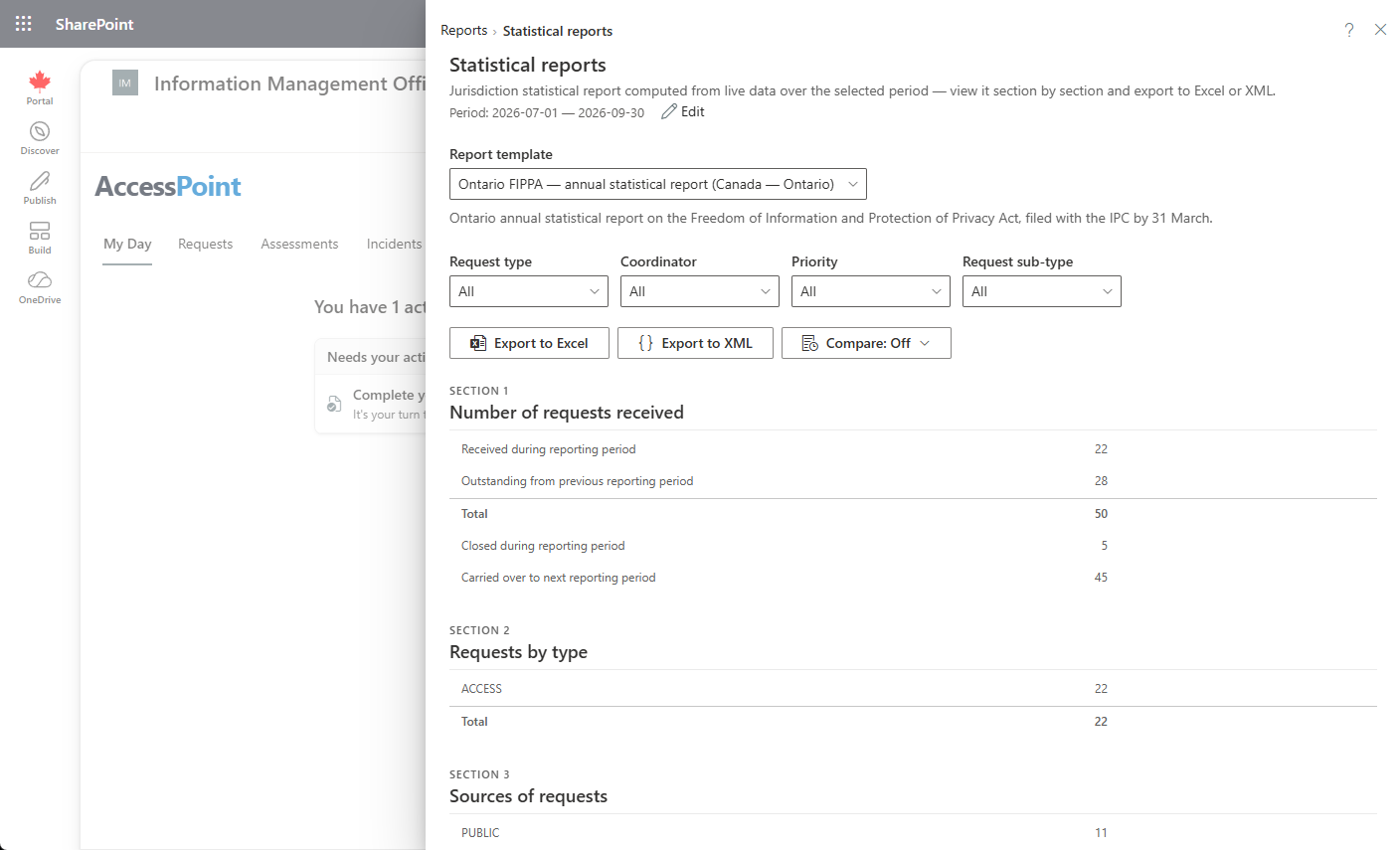
Every summer, someone rebuilds the statistical report by re-reading a year of spreadsheet rows and closed email threads, reconciling numbers that never quite match. The figures get filed anyway — and nobody in the office could reproduce them if asked.
What an ATIP office should demand from its next system
If you're replacing a legacy tracker, these are the capabilities that decide whether the next system lasts a decade — whichever vendor you choose.
How does your ATIP office score today? Take the two-minute FOI quick check →
How AccessPoint runs ATIP
The federal jurisdiction pack configures the statute; the platform operates the work.
Intake to acknowledgement in minutes
New-from-email turns an intake-mailbox message into a fully-formed request with the email attached as its first document; AI triage (optional) suggests a title, summary, scope, and clarification questions — nothing applies without a person.
Collection from the department's own M365
Search SharePoint, OneDrive, and Outlook and attach records directly — including Teams chats, OneNote pages, calendars, and Copilot interaction history — with collection tasks assigned to custodians and tracked to attestation.
Severance with statutory authority
A browser-native redaction studio where every mark carries its exemption — primary and fall-backs — with find-and-redact across documents, live patterns on new arrivals, and a defensible exemption manifest in the release package.
Consultations that keep their clocks
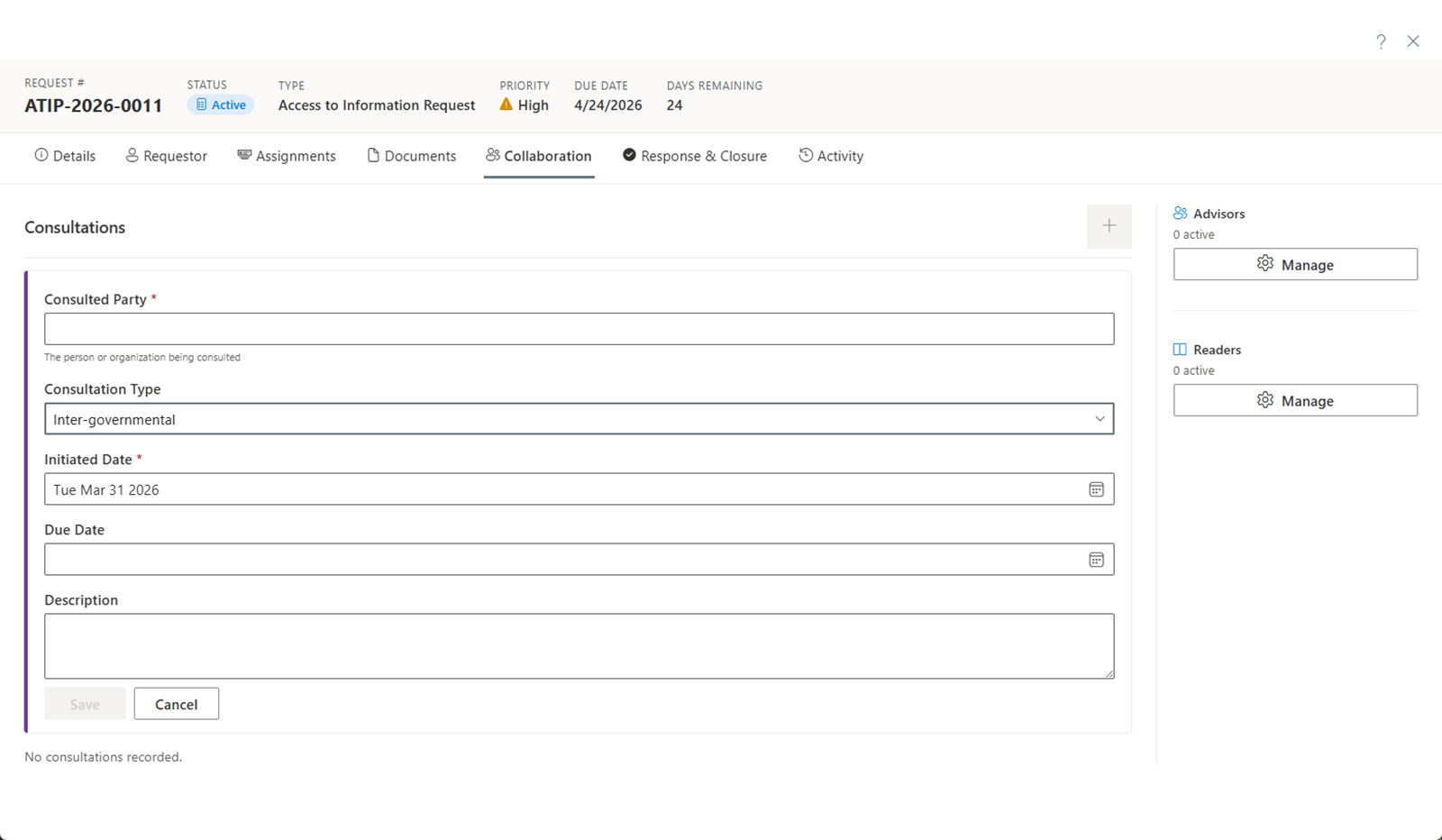
Inter-departmental and third-party consultations run with their own statutory windows, and templated bilingual correspondence flows through merge fields and the PII firewall.
An audit ledger built for challenges
Every action across every module lands in an append-only, hash-chained ledger with integrity verification, exported on demand as a court-ready case audit export.
The rest of the mandate, included
PIAs, Algorithmic Impact Assessments, breach response with a live notification calculator, complaints with statutory clocks, and an ISO 31000 privacy risk register — one platform, not five spreadsheets.
See it in AccessPoint
Real screens from the product, running in a Microsoft 365 tenant. Click any one to enlarge.
The AccessPro moment
Leaving a legacy system? Choose sovereignty this time.
The last generation of ATIP software made departments dependent on on-premises servers or vendor clouds — and its retirement forced migrations on everyone. AccessPoint's architecture is the counter-position: the platform, the data, and the exit all belong to you.
Go deeper
ATIP Case Management Questions
What is ATIP case management software?
We're migrating off AccessPro. Why consider AccessPoint over ATIPXpress?
Does AccessPoint work in French?
How does AccessPoint handle the Directive on Automated Decision-Making?
Can we bring years of ATIP history into AccessPoint?
Flat annual pricing, published in full. Every feature in every size — access requests, privacy impact assessments, breach response, complaints, video & audio redaction, and AI Assist. No per-user or per-module fees.
- Under 500 employees$2,990/yr
- 500–2,000 employees$7,990/yr
- Over 2,000 employees$14,990/yr
The Next Decade of ATIP, In Your Own Tenant.
Try AccessPoint free for 30 days — the federal jurisdiction pack configures the ATIA and Privacy Act from day one.