
Utah · Government Records Access and Management Act
Utah GRAMA, with its record classifications and the new Government Records Office appeal path built in
AccessPoint manages Government Records Access and Management Act requests under Utah Code § 63G-2-101 et seq. — the ten-business-day response, the private, controlled, and protected classifications, and the appeal path that since 2025 runs to the Government Records Office — pre-configured for Utah and running inside your own Microsoft 365 tenant.
Utah at a glance
- Response standard
- Response within 10 business days of receipt — 5 business days where the requester shows an expedited response benefits the public; extraordinary-circumstances extensions are enumerated and capped (§ 63G-2-204)
- Enforcement
- Appeal to the chief administrative officer, then to the Government Records Office director within 30 days, then to the district court (§§ 63G-2-401 to 63G-2-404)
- Exemptions
- Records classified private, controlled, or protected (§§ 63G-2-302 to 63G-2-305), against the default that a record is public (§ 63G-2-301)
- Charges
- The actual cost of providing the record; no charge for the first quarter hour of staff time (§ 63G-2-203)
- Oversight
- Government Records Office director, who replaced the State Records Committee in 2025; district court
- Languages
- English
Built for Utah
One platform for the whole access-and-privacy mandate, pre-configured for this regime and running in your own Microsoft 365 tenant.
GRAMA request lifecycle
Intake to release under the Government Records Access and Management Act (Utah Code § 63G-2-101 et seq.) — the written request, the ten-business-day response, and the classification decision on every record — all on Microsoft 365.
Ten business days — five when expedited
Respond within ten business days of receipt, or five where the requester shows an expedited response benefits the public rather than the person. When extraordinary circumstances apply, the extension is one GRAMA enumerates and caps (§ 63G-2-204) — computed and reminded for you.
The new appeal path
Since 2025 an appeal runs from the chief administrative officer to the director of the Government Records Office — the single adjudicator that replaced the State Records Committee — within 30 days, and then to the district court. AccessPoint tracks each step and keeps the file each one needs.
Classify, then redact
Tag every record public, private, controlled, or protected under §§ 63G-2-301 to 63G-2-305, then redact on a colour-coded, audit-trailed record — each redaction tied to the classification and the subsection that supports it.
GRAMA fees
Charge the actual cost of providing the record, with no charge for the first quarter hour of staff time (§ 63G-2-203), and issue the estimate on request — with the calculation kept on the file.
In your own tenant
Every request and record stays inside your own Microsoft 365 and Azure tenant — no third-party cloud, no cross-border transfers, and no per-user fees.
The Government Records Office
In 2025, Utah replaced its volunteer records committee with a single director — and rebuilt the appeal path around it.
For three decades a GRAMA appeal that survived the chief administrative officer went to the State Records Committee, a seven-member volunteer board that met periodically and heard each case in person. Senate Bill 277 (2025) abolished the committee and created the Government Records Office, headed by a director appointed by the Governor and confirmed by the Senate, who now decides those appeals alone. The steps are otherwise familiar: appeal to the governmental entity's chief administrative officer first (§ 63G-2-401), then to the Government Records Office director within 30 days (§ 63G-2-402), then to the district court (§ 63G-2-404). What changed is who reads the file — and a single professional adjudicator reads it closely. AccessPoint tracks every step and keeps the classification, the subsection relied on, and the dates on the record.
Configured out of the box
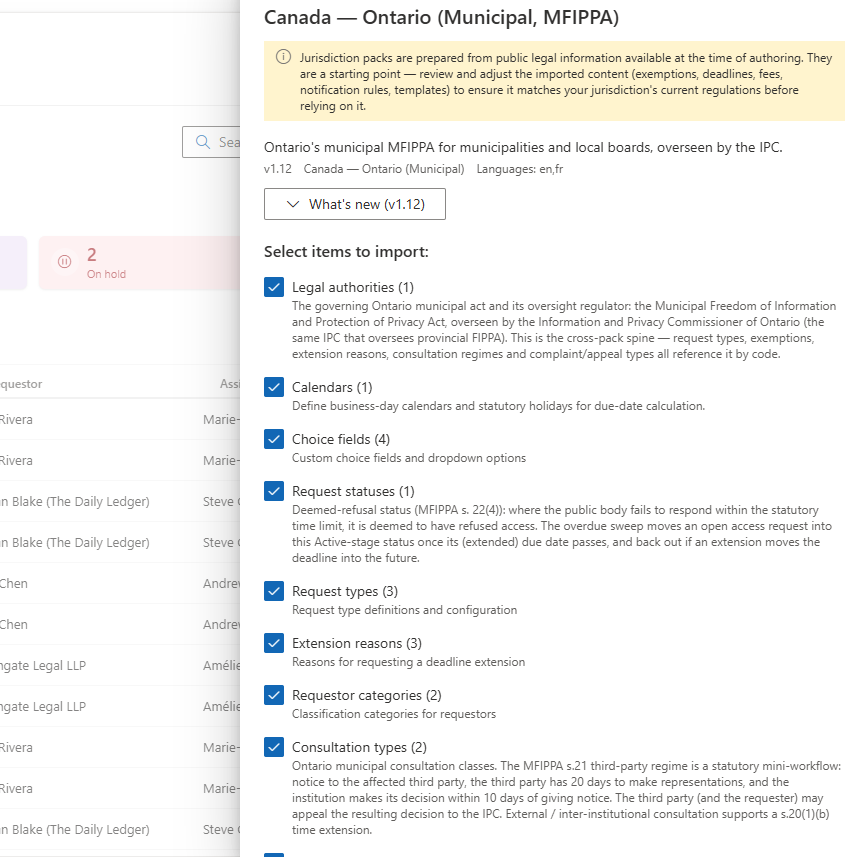
Installing the us-ut-grama jurisdiction pack seeds your tenant with everything this regime needs. It is a starting point built from public information about the legislation, not legal advice — your legal counsel validates and adjusts it for your tenant.
Pack content last reviewed: 2026-09-03
Related guide: FOI Workflow Quick Check- The Government Records Access and Management Act (Utah Code § 63G-2-101 et seq.) as the legal-authority and citation spine
- The Utah state-holiday calendar and the ten-business-day and five-business-day expedited response due-date rules under § 63G-2-204
- The enumerated extraordinary-circumstances extensions, each with its statutory cap
- The public, private, controlled, and protected classifications (§§ 63G-2-301 to 63G-2-305), colour-coded for redaction and citable line by line
- GRAMA fees — actual cost, with no charge for the first quarter hour of staff time under § 63G-2-203
- The appeal workflow — chief administrative officer, Government Records Office director within 30 days, and district court under §§ 63G-2-401 to 63G-2-404
- Utah timeliness tracking across the response, extension, and appeal clocks
- GRAMA correspondence templates with statutory wording — including the classification notice on every denial
Utah Questions
When must a Utah governmental entity respond to a GRAMA request?
What happened to the State Records Committee?
How do GRAMA's classifications work?
Where does data reside?
Go deeper
Flat annual pricing, published in full. Every feature in every size — access requests, privacy impact assessments, breach response, complaints, video & audio redaction, the public portal, repository connectors, and AI Assist. No per-user or per-module fees.
- Under 500 employees$2,990/yr
- 500–1,999 employees$7,990/yr
- 2,000–9,999 employees$14,990/yr
- 10,000+ employees$29,990/yr
Run Utah GRAMA in One Platform
Try AccessPoint free for 30 days, pre-configured for Utah. No credit card required.