
Alabama · Public Records Law
Alabama's brand-new response clock, with a fifty-year-old test still deciding what's exempt
AccessPoint manages Public Records Law requests under Ala. Code § 36-12-40 et seq. (Act 2024-278) — the 15-business-day response clock, the Stone v. Consolidated Publishing balancing test, and circuit-court enforcement — pre-configured for Alabama and running inside your own Microsoft 365 tenant.
Alabama at a glance
- Response standard
- Acknowledge, then respond within 15 business days of acknowledgment; extendable in 15-business-day increments, or up to 45 business days for time-intensive requests (Act 2024-278)
- Enforcement
- No administrative appeal — a request unanswered at 30 business days or 60 calendar days is presumed denied, clearing the way to circuit court
- Exemptions
- § 36-12-40(a) statutory grounds plus the Stone v. Consolidated Publishing (1981) common-law balancing test
- Charges
- Reasonable fee at Executive Order 734 rates — $0.50 per page, $20 per hour of preparation time
- Oversight
- No oversight body — enforcement is by circuit-court action, with no statutory filing window
- Languages
- English
Built for Alabama
One platform for the whole access-and-privacy mandate, pre-configured for this regime and running in your own Microsoft 365 tenant.
Public Records Law request lifecycle
Intake to release under Act 2024-278 (Ala. Code § 36-12-40 et seq.) — acknowledgment, the 15-business-day response, and release — all on Microsoft 365.
The Stone balancing test, applied consistently
§ 36-12-40(a)'s statutory grounds plus the 1981 Stone v. Consolidated Publishing balancing test still decide every close call. AccessPoint documents the rationale record by record.
The new response clock
Acknowledgment, a 15-business-day response, 15-business-day extension increments, and the 45-business-day time-intensive track — computed and reminded automatically.
Redaction under the Stone test
Apply § 36-12-40(a) grounds and the Stone balancing rationale line by line on a colour-coded, audit-trailed redaction record.
Executive Order 734 fee rates
Charge $0.50 per page and $20 per hour of preparation time — the rates Act 2024-278 carried over from Executive Order 734 — itemized on request.
In your own tenant
Every request and record stays inside your own Microsoft 365 and Azure tenant — no third-party cloud, no cross-border transfers, and no per-user fees.
A brand-new clock, an old balancing test
Alabama just wrote its first deadlines in fifty years — but Stone v. Consolidated Publishing still decides what's exempt.
For over fifty years, Alabama's Public Records Law had no response deadline at all. Act 2024-278 changed that: agencies must now acknowledge a request and respond substantively within 15 business days, extendable in 15-business-day increments, or up to 45 business days for time-intensive requests. What the Act didn't change is how exemptions are decided. § 36-12-40(a) sets the statutory grounds, but the real test — weighing disclosure against privacy and the public interest — still comes from Stone v. Consolidated Publishing Co., a 1981 Alabama Supreme Court case. AccessPoint runs both: the new clock and the old test.
Configured out of the box
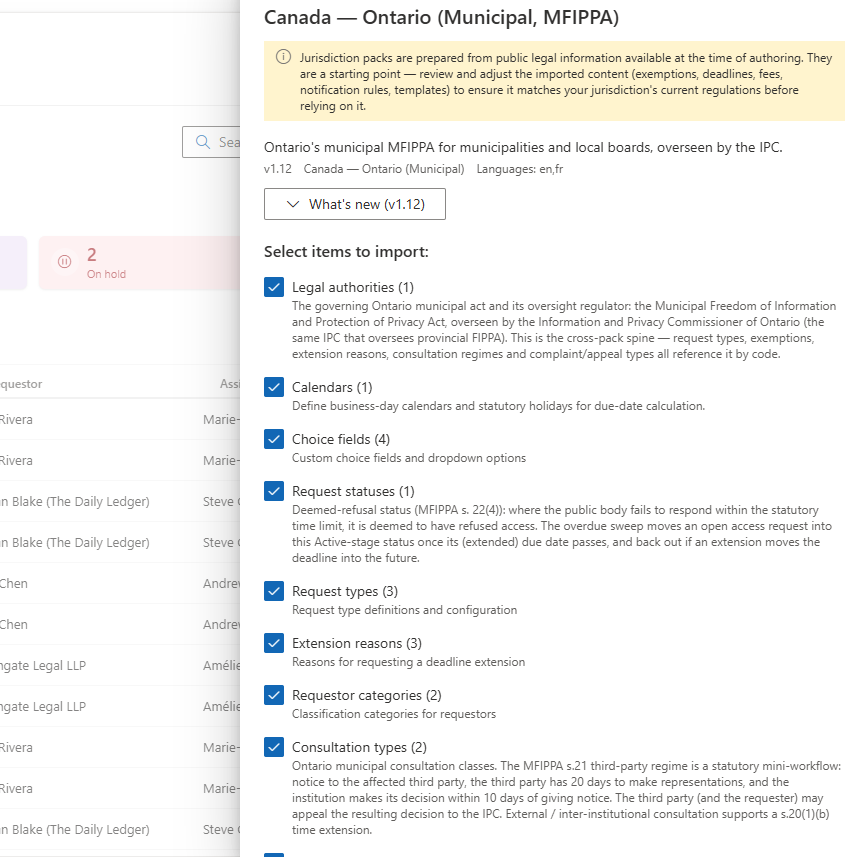
Installing the us-al-prl jurisdiction pack seeds your tenant with everything this regime needs. It is a starting point built from public information about the legislation, not legal advice — your legal counsel validates and adjusts it for your tenant.
Pack content last reviewed: 2026-09-03
Related guide: FOI Workflow Quick Check- The Alabama Public Records Law (Ala. Code § 36-12-40 et seq., as amended by Act 2024-278) as the legal-authority and citation spine
- The Alabama state-holiday calendar and the 15-business-day acknowledgment-to-response clock, with 15-business-day extension increments
- The 45-business-day time-intensive-request track, flagged and tracked separately from standard requests
- The § 36-12-40(a) exemption grounds and the Stone v. Consolidated Publishing (1981) balancing-test rationale, recorded per record
- The 30-business-day / 60-calendar-day presumed-denial trigger, tracked automatically
- Executive Order 734 fee rates — $0.50 per page and $20 per hour — computed and itemized
- The circuit-court enforcement workflow for denied requests
- Public-records correspondence templates with Act 2024-278 wording
Alabama Questions
Who can request records under Alabama's Public Records Law, and how quickly must an agency respond?
What happens if an Alabama agency stays silent, and how is a denial challenged?
What decides whether a record is exempt, and what can an agency charge?
Where does data reside?
Go deeper
Flat annual pricing, published in full. Every feature in every size — access requests, privacy impact assessments, breach response, complaints, video & audio redaction, the public portal, repository connectors, and AI Assist. No per-user or per-module fees.
- Under 500 employees$2,990/yr
- 500–1,999 employees$7,990/yr
- 2,000–9,999 employees$14,990/yr
- 10,000+ employees$29,990/yr
Run the Alabama Public Records Law in One Platform
Try AccessPoint free for 30 days, pre-configured for Alabama. No credit card required.