
Arizona · Public Records Law
The Arizona Public Records Law, balancing test and all
AccessPoint manages Public Records Law requests under A.R.S. § 39-121 et seq. — prompt access with no enumerated exemption list, withholding decided on the common-law balancing test, and the commercial-purpose surcharge — pre-configured for Arizona and running inside your own Microsoft 365 tenant.
Arizona at a glance
- Response standard
- Access promptly during regular office hours; no fixed statutory day count (A.R.S. § 39-121.01(D))
- Exemptions
- No enumerated list — withholding turns on the common-law balancing test (Carlson v. Pima County)
- Commercial purpose
- A statement of purpose and a surcharge reflecting commercial value (A.R.S. § 39-121.03)
- Charges
- A copy fee where facilities allow; free for statutory purposes; commercial value added for commercial use
- Oversight
- No administrative appeal body; special action in the superior court (A.R.S. § 39-121.02)
- Languages
- English
Built for Arizona
One platform for the whole access-and-privacy mandate, pre-configured for this regime and running in your own Microsoft 365 tenant.
Public records lifecycle
Intake to release under the Public Records Law (A.R.S. § 39-121 et seq.) — prompt access during office hours, the balancing-test review, and the commercial-purpose statement — all on Microsoft 365.
The balancing test
Arizona lists no exemptions. Records are presumed open, and a record is withheld only where confidentiality, personal privacy, or the best interests of the state outweigh disclosure. AccessPoint documents the balancing decision, record by record.
Prompt access
There is no fixed day count — records must be furnished promptly during regular office hours. AccessPoint clocks each request from intake so 'promptly' stays measurable and defensible.
Balancing and redaction
Where privacy or confidentiality competes with access, redact the specific detail rather than deny the record — on a colour-coded, audit-trailed redaction record with the balancing rationale attached.
Commercial-purpose surcharge
Commercial requesters file a statement of purpose and pay more — the cost of time, materials, and personnel plus the reproduction's value on the commercial market — computed and itemized for you.
In your own tenant
Every request and record stays inside your own Microsoft 365 and Azure tenant — no third-party cloud, no cross-border transfers, and no per-user fees.
No list, and a surcharge
Arizona hands you no exemption list — you weigh each record, and you charge commercial users more.
Most public-records laws hand custodians a numbered list of exemptions. Arizona does not. Its records are presumed open, and withholding is decided case by case on a common-law balancing test: access yields only where confidentiality, personal privacy, or the best interests of the state outweigh the strong policy of disclosure — and even then redaction is preferred to denial. Arizona also treats commercial requesters differently, requiring a statement of purpose and a surcharge that reflects the reproduction's value on the commercial market. AccessPoint documents each balancing decision and computes the commercial surcharge.
Configured out of the box
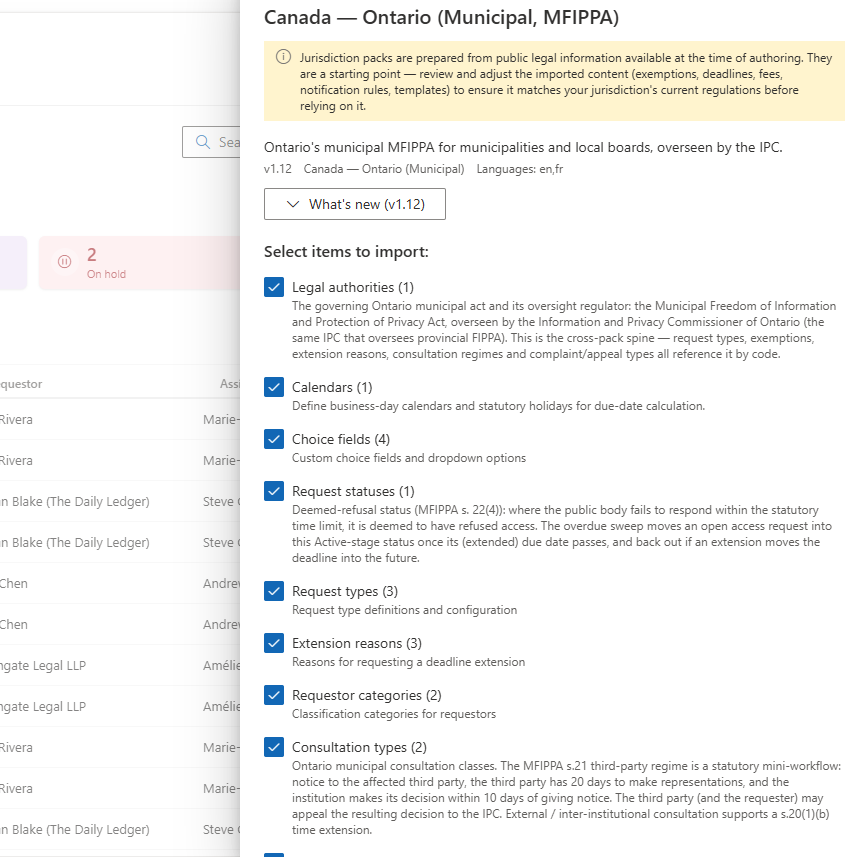
Installing the us-az-prl jurisdiction pack seeds your tenant with everything this regime needs. It is a starting point built from public information about the legislation, not legal advice — your legal counsel validates and adjusts it for your tenant.
Pack content last reviewed: 2026-07-24
Related guide: FOI Workflow Quick Check- The Arizona Public Records Law (A.R.S. § 39-121 et seq.) as the legal-authority and citation spine
- The Arizona state-holiday calendar and the prompt-access clock measured from intake
- The common-law balancing test — a documented confidentiality, privacy, and best-interests-of-the-state rationale per record
- Redaction-first handling for competing privacy and confidentiality interests, colour-coded and audit-trailed
- The commercial-purpose statement and surcharge, including the commercial-market-value component (§ 39-121.03)
- Public-records correspondence templates with statutory wording
- The superior-court special-action (§ 39-121.02) enforcement workflow
- Arizona timeliness tracking against the prompt-access standard
Arizona Questions
How quickly must an Arizona custodian respond to a records request?
What makes Arizona different — no exemption list?
What can a custodian charge?
Where does data reside?
Go deeper
Flat annual pricing, published in full. Every feature in every size — access requests, privacy impact assessments, breach response, complaints, video & audio redaction, and AI Assist. No per-user or per-module fees.
- Under 500 employees$2,990/yr
- 500–2,000 employees$7,990/yr
- Over 2,000 employees$14,990/yr
Run the Arizona Public Records Law in One Platform
Try AccessPoint free for 30 days, pre-configured for Arizona. No credit card required.