
United States · Federal FOIA
Federal FOIA, on the 20-business-day clock and in your own tenant
AccessPoint manages Freedom of Information Act requests under 5 U.S.C. § 552 — the 20-business-day determination, the unusual-circumstances extension, and the nine exemptions applied with the foreseeable-harm test — pre-configured for U.S. federal agencies and running inside your own Microsoft 365 tenant.
United States — Federal at a glance
- Response deadline
- 20 business days to make a determination (5 U.S.C. § 552(a)(6)(A))
- Extensions
- Additional 10 business days for unusual circumstances (§ 552(a)(6)(B))
- Filing fee
- None; search, review, and duplication fees vary by requester category
- Exemptions
- Nine, under 5 U.S.C. § 552(b), applied with the foreseeable-harm test
- Oversight
- OGIS at the National Archives (FOIA Ombudsman, mediation); courts review de novo
- Languages
- English
Built for United States — Federal
One platform for the whole access-and-privacy mandate, pre-configured for this regime and running in your own Microsoft 365 tenant.
FOIA request lifecycle
Intake to release on the federal clock — the 20-business-day determination under 5 U.S.C. § 552, the unusual-circumstances extension, the nine (b) exemptions, and fee-category tracking — all built on Microsoft 365.
Foreseeable-harm standard
Withhold under an exemption only where disclosure would foreseeably harm a protected interest — the presumption-of-openness test the FOIA Improvement Act of 2016 codified — recorded on every redaction decision.
Exemptions and redaction
Apply the nine FOIA exemptions line by line, with a colour-coded catalogue and a defensible, audit-trailed redaction record.
OGIS mediation and appeals
Track administrative appeals on the statutory 90-day window and referrals to the Office of Government Information Services — the FOIA Ombudsman at the National Archives — with its dispute-resolution steps mapped out.
Fees by requester category
Compute search, review, and duplication fees by requester category — commercial, news media and educational, or all others — with the statutory free search and copying allowances applied.
Privacy Act as a companion
Handling first-party requests for a person's own records too? The Privacy Act of 1974 ships as a separate configuration — the US Privacy Act pack — running on the same platform alongside your FOIA caseload.
The foreseeable-harm standard
Under federal FOIA, an exemption isn't enough — disclosure has to foreseeably harm something.
The FOIA Improvement Act of 2016 codified a presumption of openness: an agency may withhold information under one of the nine exemptions only if it reasonably foresees that disclosure would harm the interest the exemption protects, or disclosure is prohibited by law. It's no longer enough that a record technically falls within an exemption. AccessPoint records the foreseeable-harm reasoning on every redaction, tracks the minimum 90-day administrative-appeal window and OGIS referrals, and keeps the defensible file that de novo court review demands.
Configured out of the box
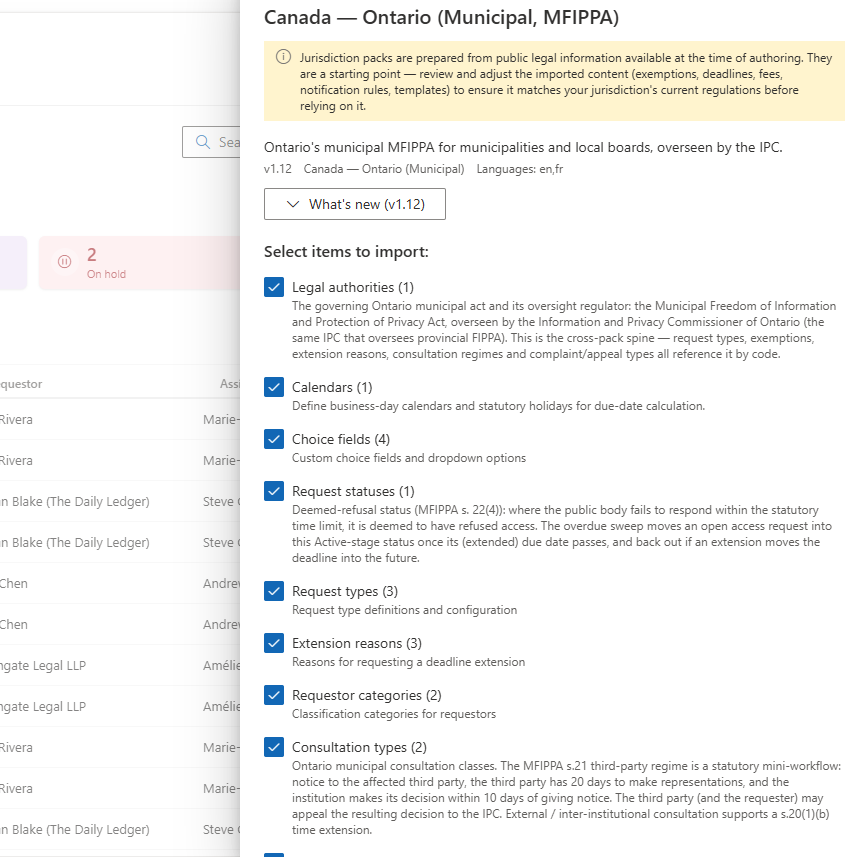
Installing the us-foia jurisdiction pack seeds your tenant with everything this regime needs. It is a starting point built from public information about the legislation, not legal advice — your legal counsel validates and adjusts it for your tenant.
Pack content last reviewed: 2026-07-24
Related guide: FOI Workflow Quick Check- The Freedom of Information Act (5 U.S.C. § 552) as the legal-authority and citation spine
- The federal statutory-holiday calendar and 20-business-day due-date rules
- The nine FOIA exemptions, colour-coded for redaction, with the foreseeable-harm test
- Unusual-circumstances extension reasons with citations and limits
- Requester fee categories — commercial, news media and educational, and all others
- OGIS dispute-resolution steps and administrative-appeal grounds and dispositions
- Federal timeliness brackets and Annual FOIA Report data points
- FOIA correspondence templates with statutory wording
United States — Federal Questions
Does AccessPoint handle Privacy Act requests too?
How does it track the 20-business-day deadline and extensions?
Does it support OGIS mediation and administrative appeals?
Where does agency data reside?
Go deeper
Flat annual pricing, published in full. Every feature in every size — access requests, privacy impact assessments, breach response, complaints, video & audio redaction, the public portal, repository connectors, and AI Assist. No per-user or per-module fees.
- Under 500 employees$2,990/yr
- 500–1,999 employees$7,990/yr
- 2,000–9,999 employees$14,990/yr
- 10,000+ employees$29,990/yr
Run Federal FOIA in One Platform
Try AccessPoint free for 30 days, pre-configured for U.S. federal agencies. No credit card required.