
Colorado · Open Records Act
The Colorado Open Records Act, with its three exemption tiers built in
AccessPoint manages Open Records Act requests under C.R.S. § 24-72-200.1 et seq. — the three-working-day response, the mandatory, permissive, and specifically-exempt exemption tiers, and district-court enforcement — pre-configured for Colorado and running inside your own Microsoft 365 tenant.
Colorado at a glance
- Response standard
- Records available within three working days of receipt; up to seven additional working days for extenuating circumstances (§ 24-72-203(3)(b))
- Enforcement
- No administrative appeal — apply to the district court for an order to show cause after 14 days' written notice (§ 24-72-204(5))
- Exemptions
- Three tiers — mandatory (§ 204(1)), discretionary / public-interest (§ 204(2)), and specifically exempt (§ 204(3))
- Charges
- Copies up to 25 cents per standard page; research and retrieval first hour free, then a capped statutory hourly rate (§ 24-72-205(5)–(6))
- Oversight
- Colorado district courts; a prevailing applicant recovers attorney fees
- Languages
- English
Built for Colorado
One platform for the whole access-and-privacy mandate, pre-configured for this regime and running in your own Microsoft 365 tenant.
CORA request lifecycle
Intake to release under the Open Records Act (C.R.S. § 24-72-200.1 et seq.) — the three-working-day response, extension notices, and inspection or copies — all on Microsoft 365.
The three exemption tiers
CORA sorts every withholding into three tiers: mandatory where other law forbids release (§ 204(1)), discretionary where disclosure would be contrary to the public interest (§ 204(2)), and the specifically exempt records the custodian shall not disclose (§ 204(3)). AccessPoint tags each record to the right tier.
The three-working-day clock
Make records available within three working days of receipt, and when extenuating circumstances apply, issue the written notice extending up to seven more working days — computed and reminded for you.
Redaction by exemption
Apply the § 24-72-204 exemptions line by line on a colour-coded, audit-trailed redaction record — each redaction tied to its mandatory, discretionary, or specific-exemption authority.
CORA charges
Charge copies at up to 25 cents per standard page and research and retrieval at the capped statutory hourly rate — first hour free — with the fee policy published as CORA requires and an estimate on request.
In your own tenant
Every request and record stays inside your own Microsoft 365 and Azure tenant — no third-party cloud, no cross-border transfers, and no per-user fees.
The three exemption tiers
In Colorado, every withholding falls into one of three tiers — and each is decided differently.
The Colorado Open Records Act does not hand custodians a single list of secrets. Instead it sorts every reason to withhold into three tiers. Section 204(1) is mandatory: inspection is denied where a court rule, a federal or state statute, or a privilege forbids it. Section 204(2) is discretionary: the custodian may deny a listed record only if disclosure would be contrary to the public interest. Section 204(3) is specific: enumerated records — medical, personnel, trade secrets — the custodian shall not disclose. AccessPoint tags each record to its tier so the right test is applied every time.
Configured out of the box
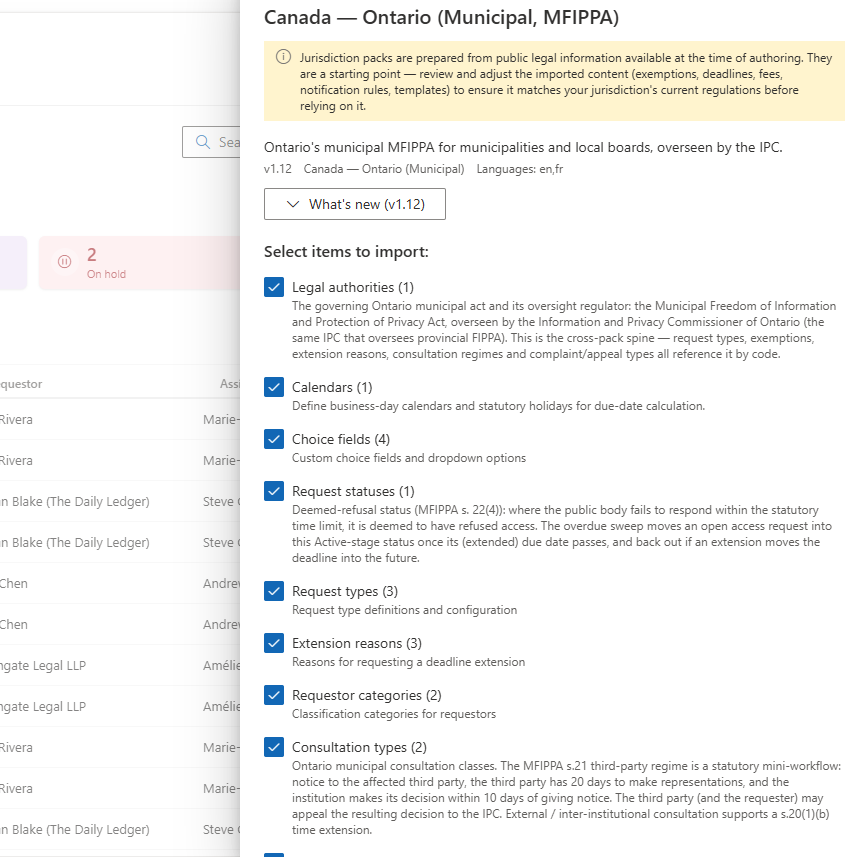
Installing the us-co-cora jurisdiction pack seeds your tenant with everything this regime needs. It is a starting point built from public information about the legislation, not legal advice — your legal counsel validates and adjusts it for your tenant.
Pack content last reviewed: 2026-07-24
Related guide: FOI Workflow Quick Check- The Colorado Open Records Act (C.R.S. § 24-72-200.1 et seq.) as the legal-authority and citation spine
- The Colorado state-holiday calendar and the three-working-day response and seven-working-day extension due-date rules
- The § 24-72-204 exemptions mapped to their three tiers — mandatory, discretionary, and specifically exempt — and colour-coded for redaction
- CORA charges — copies at up to 25 cents per standard page and research-and-retrieval at the capped hourly rate, first hour free
- The published fee policy CORA requires before research-and-retrieval charges may apply
- The district-court enforcement workflow — the 14-day written notice and order-to-show-cause path under § 24-72-204(5)
- Colorado timeliness tracking and the extenuating-circumstances extension notice
- CORA correspondence templates with statutory wording
Colorado Questions
When must a Colorado records custodian respond?
What makes Colorado different — the three exemption tiers?
What can a governmental entity charge?
Where does data reside?
Go deeper
Flat annual pricing, published in full. Every feature in every size — access requests, privacy impact assessments, breach response, complaints, video & audio redaction, and AI Assist. No per-user or per-module fees.
- Under 500 employees$2,990/yr
- 500–2,000 employees$7,990/yr
- Over 2,000 employees$14,990/yr
Run the Colorado Open Records Act in One Platform
Try AccessPoint free for 30 days, pre-configured for Colorado. No credit card required.