
California · Public Records Act
The California Public Records Act, run in one platform
AccessPoint manages California Public Records Act requests — the 10-day determination, the 14-day extension, exemptions, and direct-cost copies — pre-configured for California and running inside your own Microsoft 365 tenant.
California at a glance
- Response deadline
- 10 days to determine whether disclosable records are held (Gov. Code § 7922.535)
- Extensions
- Up to 14 days more in unusual circumstances, by written notice
- Application fee
- None; copies at the direct cost of duplication
- Enforcement
- Writ of mandate in the superior court — no AG ruling, no administrative appeal
- Oversight
- The courts; a prevailing requester recovers attorney's fees
- Languages
- English
Built for California
One platform for the whole access-and-privacy mandate, pre-configured for this regime and running in your own Microsoft 365 tenant.
Public Records Act lifecycle
Intake to production under the California Public Records Act (Gov. Code §§ 7920.000 et seq.) — the 10-day determination, the 14-day unusual-circumstances extension, exemptions, and direct-cost copies — all on Microsoft 365.
The 10-day determination
Track the statutory 10-day window to tell a requester whether you hold disclosable records — with business-day math, the written extension notice, and reminders before the clock runs out.
Exemptions and the public-interest test
Apply the Act's category exemptions and the catch-all public-interest balancing test line by line, with a colour-coded catalogue and a defensible, audit-trailed redaction record.
Writ-of-mandate readiness
California offers no AG ruling and no administrative appeal — access is enforced by writ of mandate in the superior court. Keep a complete, court-ready record of every determination and search.
Direct-cost copying
Charge only the direct cost of duplication, plus the statutory programming cost for producing electronic records — computed and logged per request.
In your own tenant
Every request and record stays inside your own Microsoft 365 and Azure tenant — no third-party cloud, no cross-border transfers, and no per-user fees.
The California clock
Ten days to decide, and the courtroom as the only appeal.
The California Public Records Act gives an agency ten days to determine whether a request seeks disclosable records and to tell the requester — extendable by fourteen days only in unusual circumstances. There is no Attorney General ruling and no administrative appeal: a requester who is refused goes straight to the superior court for a writ of mandate, and a prevailing requester recovers attorney's fees. AccessPoint keeps the clock and builds the record — every determination, exemption, and search logged — so a decision holds up if it is challenged.
Configured out of the box
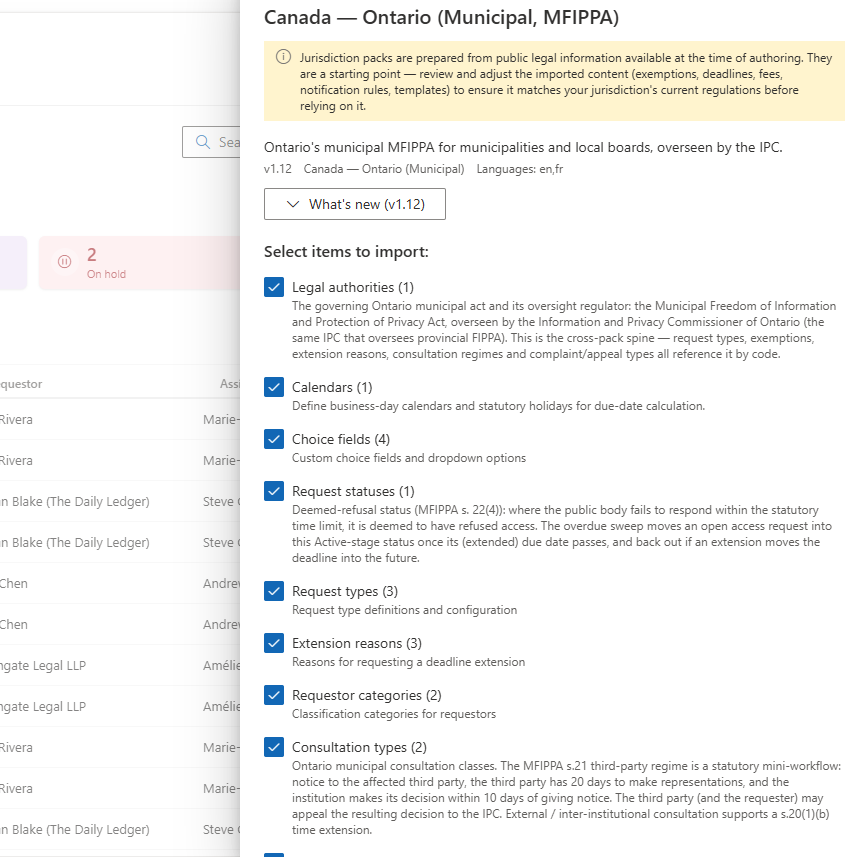
Installing the us-ca-pra jurisdiction pack seeds your tenant with everything this regime needs. It is a starting point built from public information about the legislation, not legal advice — your legal counsel validates and adjusts it for your tenant.
Pack content last reviewed: 2026-07-13
Related guide: FOI Workflow Quick Check- The California Public Records Act (Gov. Code §§ 7920.000 et seq.) as the legal-authority and citation spine
- The California court-holiday calendar and the 10-day determination due-date rules
- The Act's exemption catalogue and public-interest balancing test, colour-coded for redaction
- Unusual-circumstances extension reasons with citations and the 14-day limit
- Direct-cost duplication and electronic-record programming-cost rules
- Writ-of-mandate evidence packages and complete determination records
- California timeliness tracking across the 10-day and extended windows
- Public Records Act correspondence templates with statutory wording
California Questions
What is the deadline to respond under the California Public Records Act?
Is there an Attorney General ruling or appeal step?
What can an agency charge for copies?
Where does agency data reside?
Go deeper
Flat annual pricing, published in full. Every feature in every size — access requests, privacy impact assessments, breach response, complaints, video & audio redaction, the public portal, repository connectors, and AI Assist. No per-user or per-module fees.
- Under 500 employees$2,990/yr
- 500–1,999 employees$7,990/yr
- 2,000–9,999 employees$14,990/yr
- 10,000+ employees$29,990/yr
Run the California Public Records Act in One Platform
Try AccessPoint free for 30 days, pre-configured for California. No credit card required.