
New Zealand · Public Records Act 2005
The Act that says you may not delete this — and proves whether you did
For public offices and local authorities — AccessPoint applies the create-and-maintain duties, retention floors, and disposal-only-under-authority rules of the Public Records Act to the casework it holds, with the evidence an audit expects.
New Zealand — Public Records Act at a glance
- Core duty
- Create and maintain full and accurate records of affairs, in accordance with normal, prudent business practice
- Disposal
- Only under an authority granted by the Chief Archivist
- Retention floors
- Minimum periods applied to casework before disposal is possible
- Transfer
- Records of long-term value transferred, generally at 25 years
- Oversight
- Chief Archivist audit of public offices
- Languages
- English
Built for New Zealand — Public Records Act
One platform for the whole access-and-privacy mandate, pre-configured for this regime and running in your own Microsoft 365 tenant.
Retention across five registers
Requests, assessments, incidents, complaints, and risks each carry a retention period from their type. A closed case becomes eligible for disposition on a defined basis rather than sitting in a folder nobody is willing to touch.
Disposal only under authority
Nothing is deleted because it is old. Disposition runs as a reviewed step tied to the authority relied on, with what was disposed of, when, and by whom recorded on the ledger.
Evidence, not assertions
A hash-chained, append-only audit ledger with server-side integrity verification demonstrates that the record has not been altered — which is the difference between claiming good recordkeeping and showing it.
Transfer at 25 years
Track which records are approaching the transfer point so the obligation surfaces on a schedule rather than arriving as a discovery during an audit.
Records created as work happens
The Act's first duty is to make records in the first place. Because case activity, decisions, and correspondence are captured as the work is done, the record is a by-product rather than a separate chore.
In your own tenant
Records stay inside your own Microsoft 365 and Azure tenant, on storage you control — which matters when the retention obligation runs for decades.
Pairs with your access pack
The OIA tells you what to release. The Public Records Act tells you what has to still exist when they ask.
New Zealand's information obligations only work together. LGOIMA and the OIA create a right to information a public office holds — which presupposes that it still holds it, and that what it holds is complete. The Public Records Act supplies that half: full and accurate records made as business is conducted, kept for defined periods, disposed of only under the Chief Archivist's authority, and transferred when they reach long-term value. An organisation that runs access requests well but disposes of casework informally will eventually answer an OIA request with a gap it cannot explain, and answer an audit with a policy rather than evidence. Installing this pack alongside the OIA or LGOIMA pack puts both duties on the same cases and the same ledger.
Configured out of the box
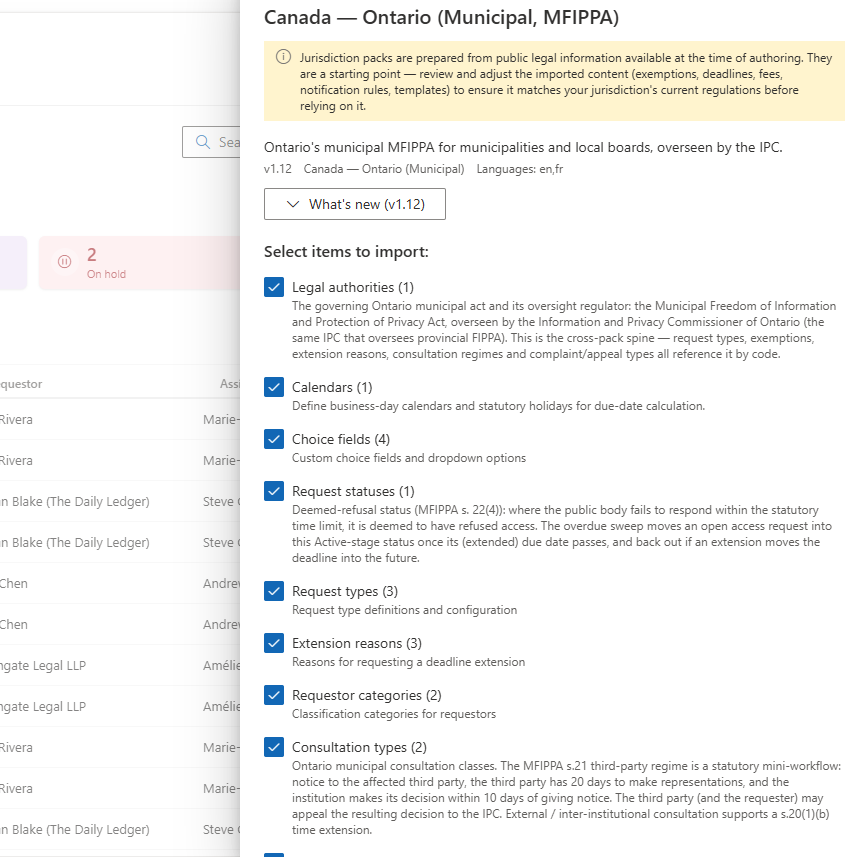
Installing the nz-public-records jurisdiction pack seeds your tenant with everything this regime needs. It is a starting point built from public information about the legislation, not legal advice — your legal counsel validates and adjusts it for your tenant.
Pack content last reviewed: 2026-08-10
Related guide: FOI Workflow Quick Check- The Public Records Act 2005 as the legal-authority spine
- Retention periods across the request, assessment, incident, complaint, and risk registers
- Retention floors preventing disposition before the minimum period has run
- Disposition as a reviewed step tied to the disposal authority relied on
- Transfer tracking for records approaching the long-term-value point
- A hash-chained, append-only audit ledger with server-side integrity verification
- Recordkeeping reporting for Chief Archivist audit readiness
- Designed to install alongside the OIA or LGOIMA pack rather than replace it
New Zealand — Public Records Act Questions
Is this a full records management system?
How does disposal work?
Why install this alongside an access pack?
Where do the records reside?
Go deeper
Flat annual pricing, published in full. Every feature in every size — access requests, privacy impact assessments, breach response, complaints, video & audio redaction, and AI Assist. No per-user or per-module fees.
- Under 500 employees$2,990/yr
- 500–2,000 employees$7,990/yr
- Over 2,000 employees$14,990/yr
Run Public Records Act Duties in Your Own Tenant
Try AccessPoint free for 30 days, configured for New Zealand public offices. No credit card required.