
Australian Capital Territory · Health Records (Privacy and Access) Act 1997
Two weeks to answer, 30 days to give access — both clocks, tracked
For ACT health service providers and every record keeper of a health record, public or private — AccessPoint runs Part 3 access on both statutory clocks, the determined fees, the nominated health service provider process, principle 7 correction, and complaints to the ACT Human Rights Commission.
Australia — ACT Health Records Act at a glance
- First response
- Within 2 weeks — written notice of a refusal or of the fee, or access itself (s.13(2))
- Access deadline
- No later than 30 days after the request, or 1 week after the fee is paid if that is later (s.13B)
- Extensions
- Only a longer period agreed with the consumer (s.9); a missed step is taken to be a refusal (s.13D)
- Fees
- Set by ministerial determination — $18.95 to inspect, $52.10 for a hard copy of up to 50 pages
- Breach duty
- None in the Act
- Review
- ACT Human Rights Commission complaint; Magistrates Court orders
Built for Australia — ACT Health Records Act
One platform for the whole access-and-privacy mandate, pre-configured for this regime and running in your own Microsoft 365 tenant.
Two clocks, not one
Within 2 weeks the record keeper must refuse in writing, state the fee, or give access; access itself is due within 30 days. AccessPoint computes both dates on receipt and tracks the 2-week notice as closely as the access date.
Determined fees, stated up front
A fee can be charged only by stating it in the 2-week notice, and it cannot exceed the determined fee. The pack carries the current determination's fees, the hardship waiver and the health card discount, and moves the access date to 1 week after a late payment.
Grounds and prohibitions, kept apart
Section 14 sets the grounds for nonproduction; sections 14A, 15 and 17 prohibit access outright. Each notice must state the ground or the section relied on, and give access to the rest of the record. The catalogue keeps the two kinds distinct and citable.
Nominated health service providers
After a refusal for significant risk to the consumer's own health, the consumer may nominate a health service provider, who must receive the record within 2 weeks unless the record keeper objects in writing. The consultation is a dated stage on the case.
Principle 7 correction
Information is never deleted outside a program of archival destruction. Make reasonable corrections and additions, include the consumer's written statement where you will not amend, and move harmful incorrect entries to a restricted record.
In your own tenant
Health records, requests and audit history stay inside your own Microsoft 365 and Azure tenant — no third-party cloud and no vendor access.
Agreement is the only extension
The ACT gives a record keeper no power to take longer — only a longer period the consumer agrees to.
The Health Records (Privacy and Access) Act sets two short deadlines and almost no way around them. A written answer is due within 2 weeks and access within 30 days, and a record keeper that misses either is taken to have refused access — which is itself a ground of complaint to the ACT Human Rights Commission. The one flexibility the Act allows is an agreement with the consumer to do something within a longer period (s.9); done in accordance with that agreement, the step is taken to have been done on time. That makes the agreement part of the legal record, not a courtesy email. AccessPoint records the agreed date on the case as the extension, keeps the 2-week notice and the fee on the same timeline, and shows the commission exactly what was promised and when it was met.
Configured out of the box
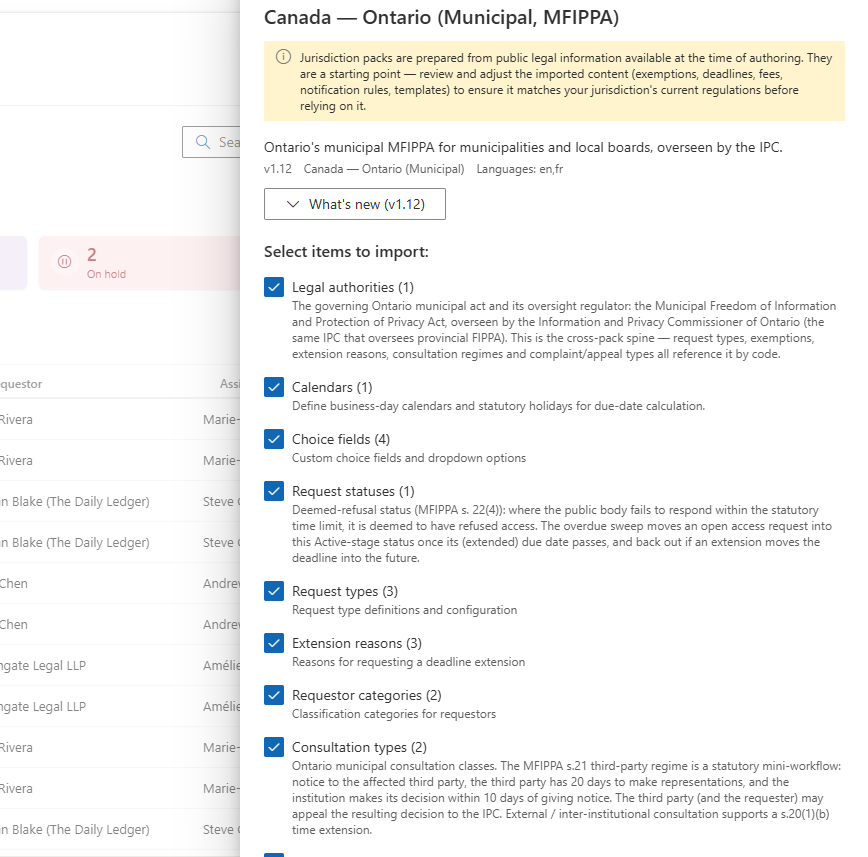
Installing the au-act-hrpa jurisdiction pack seeds your tenant with everything this regime needs. It is a starting point built from public information about the legislation, not legal advice — your legal counsel validates and adjusts it for your tenant.
Pack content last reviewed: 2026-10-20
Related guide: Business Days vs. Calendar Days: Deadline Math- The Health Records (Privacy and Access) Act 1997 as the legal-authority spine, with the Schedule 1 privacy principles
- Part 3 access on the 2-week response and 30-day access clocks, with ACT public holidays
- The s.14 grounds for nonproduction and the ss.14A, 15 and 17 prohibitions, colour-coded for redaction
- A clock pause while evidence of identity or authority is outstanding
- The s.9 agreed longer period and the 1-week-after-payment rule as extension reasons
- The determined access fees, with the hardship waiver and the health card discount
- The nominated health service provider process after a risk-to-health refusal
- Principle 7 correction, with the consumer's statement where you decline to amend
- Human Rights Commission complaints and Magistrates Court applications
- Letters for acknowledgement, fee notice, access given or not given, correction decisions and an agreed longer period
Australia — ACT Health Records Act Questions
Who does the Act apply to?
What are the deadlines for an access request?
What can we charge for access?
Does the Act require us to notify data breaches?
How does this pack relate to the ACT FOI pack?
Where does health information reside?
Go deeper
Flat annual pricing, published in full. Every feature in every size — access requests, privacy impact assessments, breach response, complaints, video & audio redaction, the public portal, repository connectors, and AI Assist. No per-user or per-module fees.
- Under 500 employees$2,990/yr
- 500–1,999 employees$7,990/yr
- 2,000–9,999 employees$14,990/yr
- 10,000+ employees$29,990/yr
Run the ACT Health Records Act in Your Own Tenant
Try AccessPoint free for 30 days, configured for ACT health records. No credit card required.