
Australian Capital Territory · FOI Act 2016
The push model, taken seriously — and no fees to hide behind
For ACT directorates, agencies, and territory authorities — AccessPoint runs 30-working-day access decisions with no application fee, supports the open access information scheme, and covers Territory Privacy Principles and health records.
Australia — ACT at a glance
- Decision deadline
- 30 working days under s. 40(1) (as amended in 2023), plus 15 working days where a third party is consulted; extendable by agreement
- Fees
- No application fee and no processing charges
- Model
- Push model — an open access information scheme with proactive publication
- Test
- A public interest test with a presumption in favour of disclosure
- Review
- Ombudsman review, then ACAT
- Languages
- English
Built for Australia — ACT
One platform for the whole access-and-privacy mandate, pre-configured for this regime and running in your own Microsoft 365 tenant.
The open access information scheme
The ACT expects information to be published proactively, with applications as the exception. Track what has been published under the scheme, when, and by whom, so the proactive duty is managed rather than aspirational.
30 working days; no application fee
Computed on receipt over the ACT public-holiday calendar. With no application fee or processing charges to negotiate, the deadline is the only lever — which makes tracking it the whole discipline.
The public interest test
The ACT Act presumes disclosure and requires factors favouring and against to be weighed. AccessPoint records both sides against the specific information, in the form an Ombudsman review reads.
Decisions with reasons
Grounds are applied to specific passages and carried onto the redaction and into the notice of decision, rather than asserted across a document.
Privacy and health records
Run Territory Privacy Principles matters and Health Records Act access and privacy on the same platform as FOI, with one audit ledger across all three.
In your own tenant
Information, applications, and audit history stay inside your own Microsoft 365 and Azure tenant — no third-party cloud and no vendor access.
No fee, no filter
The ACT removed the price of asking. That is a service-design decision, not just a policy one.
Application fees and processing charges do more than recover cost — they suppress and shape demand, and they give an agency a negotiating step partway through a difficult request. The ACT removed both. Anyone may apply, at no cost, and the agency has twenty working days regardless of how broad the request turns out to be. The practical effect is that ACT agencies cannot manage volume at the door; they can only manage it through how well the work runs — early scoping conversations with applicants, genuine use of the open access scheme so information is already published, and a queue where nothing sits unassigned. Those are exactly the levers a case platform provides, which is why fee-free jurisdictions tend to feel the absence of one soonest.
Configured out of the box
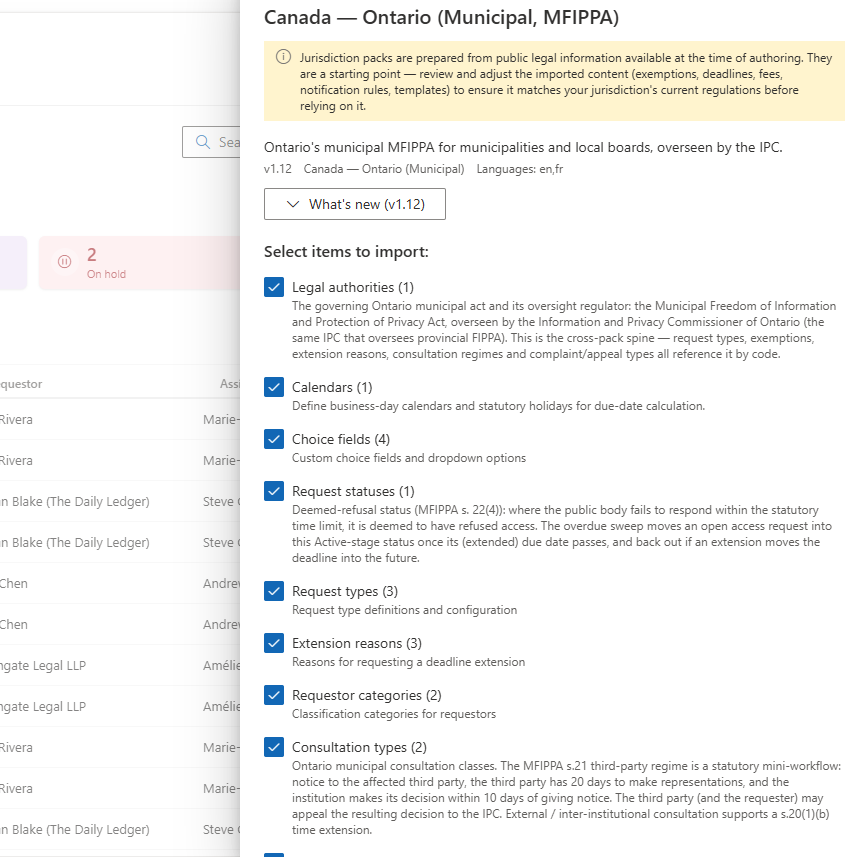
Installing the au-act jurisdiction pack seeds your tenant with everything this regime needs. It is a starting point built from public information about the legislation, not legal advice — your legal counsel validates and adjusts it for your tenant.
Pack content last reviewed: 2026-09-07
Related guide: FOI Workflow Quick Check- The ACT FOI Act 2016 as the legal-authority spine, with the Information Privacy Act 2014 alongside
- The 30-working-day decision clock with ACT public holidays, the Christmas shutdown days and the Act's extensions
- A fee-free configuration matching the ACT model
- Open access information scheme publication tracking
- A structured public interest test recording factors favouring and against disclosure
- Ombudsman review and ACAT tracking with grounds and outcomes
- Territory Privacy Principles handling and privacy complaints
- Health Records (Privacy and Access) Act 1997 access and privacy on the same platform
Australia — ACT Questions
Does the ACT really charge nothing for FOI?
What is the open access information scheme?
Who reviews an ACT access decision?
Where does the information reside?
Go deeper
Flat annual pricing, published in full. Every feature in every size — access requests, privacy impact assessments, breach response, complaints, video & audio redaction, and AI Assist. No per-user or per-module fees.
- Under 500 employees$2,990/yr
- 500–2,000 employees$7,990/yr
- Over 2,000 employees$14,990/yr
Run ACT FOI in Your Own Tenant
Try AccessPoint free for 30 days, configured for the Australian Capital Territory. No credit card required.