
Kansas · Open Records Act
The Kansas Open Records Act, with its permissive exceptions built in
AccessPoint manages Open Records Act requests under K.S.A. 45-215 et seq. — the third-business-day standard, the K.S.A. 45-221 permissive exceptions, and Attorney General enforcement — pre-configured for Kansas and running inside your own Microsoft 365 tenant.
Kansas at a glance
- Response standard
- Act on a request by the third business day after receipt, with a written denial citing the specific K.S.A. 45-221 provision relied on
- Enforcement
- Sworn Attorney General complaint, or district-court action
- Exemptions
- K.S.A. 45-221 — permissive exceptions an agency 'shall not be required' to disclose, including the (a)(10) criminal-investigation and (a)(30) personal-privacy exceptions
- Charges
- Fees at actual cost
- Oversight
- Kansas Attorney General; civil penalties up to $500 per violation
- Languages
- English
Built for Kansas
One platform for the whole access-and-privacy mandate, pre-configured for this regime and running in your own Microsoft 365 tenant.
KORA request lifecycle
Intake to release under the Kansas Open Records Act (K.S.A. 45-215 et seq.) — the third-business-day standard, the written denial, and inspection or copies — all on Microsoft 365.
Permissive, not mandatory, exceptions
K.S.A. 45-221 doesn't compel secrecy — it lists what an agency 'shall not be required to disclose.' AccessPoint tracks which permissive exception a custodian is relying on and requires the citation on every denial.
The third-business-day standard
Act on a request no later than the third business day after receipt, with a written denial that cites the specific provision relied on — computed and reminded for you.
Redaction by exception
Apply the K.S.A. 45-221 exceptions line by line, including the (a)(10) criminal-investigation closure factors and the (a)(30) personal-privacy exception, on a colour-coded, audit-trailed redaction record.
KORA charges
Charge fees at actual cost, with the calculation and any estimate handled for you.
In your own tenant
Every request and record stays inside your own Microsoft 365 and Azure tenant — no third-party cloud, no cross-border transfers, and no per-user fees.
Permissive exceptions, not mandatory secrecy
In Kansas, KORA never says an agency must withhold a record — only that it isn't required to disclose one.
Most states' exemption statutes bar disclosure outright. Kansas is built differently: K.S.A. 45-221 lists categories of records a public agency 'shall not be required to disclose' — a permissive standard, not a mandatory prohibition. That distinction matters at the margins, particularly for the (a)(10) criminal-investigation exception, which turns on multiple closure factors rather than a blanket rule, and the (a)(30) personal-privacy exception, which balances the public interest against an individual's privacy. AccessPoint tracks which permissive exception a custodian is invoking and which factors support it, and requires the citation on every written denial KORA demands.
Configured out of the box
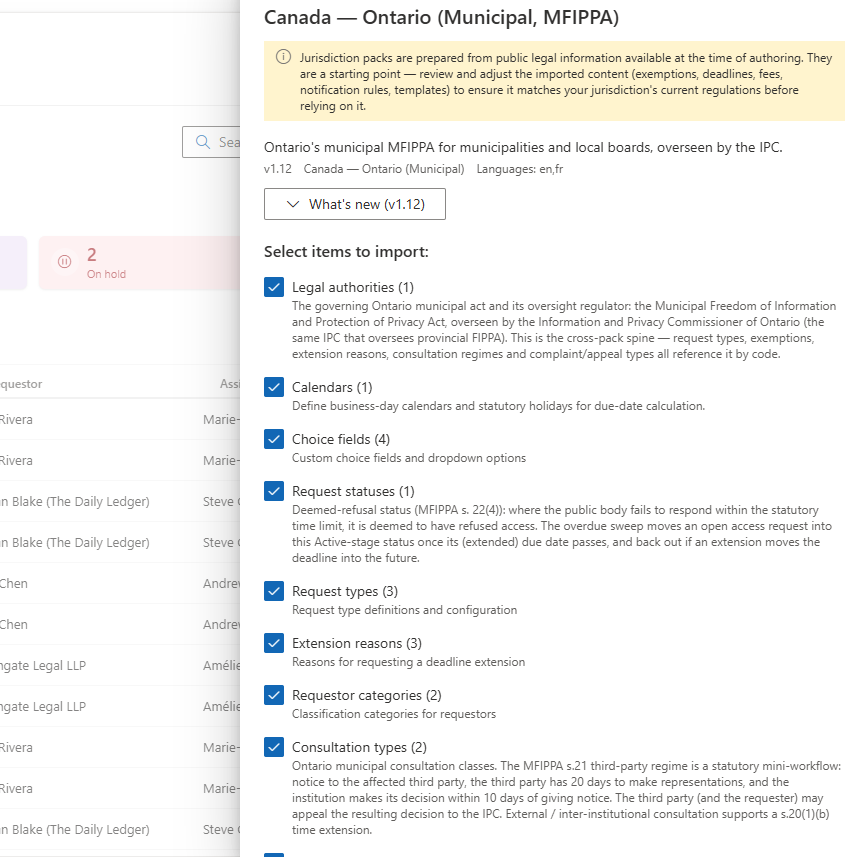
Installing the us-ks-kora jurisdiction pack seeds your tenant with everything this regime needs. It is a starting point built from public information about the legislation, not legal advice — your legal counsel validates and adjusts it for your tenant.
Pack content last reviewed: 2026-09-03
Related guide: FOI Workflow Quick Check- The Kansas Open Records Act (K.S.A. 45-215 et seq.) as the legal-authority and citation spine
- The Kansas state-holiday calendar and the third-business-day response rule
- The K.S.A. 45-221 permissive exceptions, including the (a)(10) criminal-investigation factors and the (a)(30) personal-privacy exception, mapped for redaction
- The written-denial requirement — every refusal cites the specific K.S.A. 45-221 provision relied on
- KORA charges — fees at actual cost
- The Attorney General complaint workflow — the sworn-complaint process and civil penalties up to $500 per violation
- Kansas timeliness tracking against the third-business-day standard
- KORA correspondence templates with statutory wording
Kansas Questions
When must a Kansas agency respond to a records request?
What makes Kansas different — permissive exceptions?
What can a Kansas agency charge?
Where does data reside?
Go deeper
Flat annual pricing, published in full. Every feature in every size — access requests, privacy impact assessments, breach response, complaints, video & audio redaction, the public portal, repository connectors, and AI Assist. No per-user or per-module fees.
- Under 500 employees$2,990/yr
- 500–1,999 employees$7,990/yr
- 2,000–9,999 employees$14,990/yr
- 10,000+ employees$29,990/yr
Run the Kansas Open Records Act in One Platform
Try AccessPoint free for 30 days, pre-configured for Kansas. No credit card required.