
Idaho · Public Records Act
The Idaho Public Records Act, with its residency-split clock built in
AccessPoint manages Public Records Act requests under Idaho Code § 74-101 et seq. — the residency-split response clock, the §§ 74-104 to 74-109 exemptions, and district-court enforcement — pre-configured for Idaho and running inside your own Microsoft 365 tenant.
Idaho at a glance
- Response standard
- Idaho residents: 3 working days, extendable to 10; non-residents: 21 days, extendable to 35 — a residency split introduced in 2025
- Enforcement
- No oversight agency — petition the district court for the county where the record is located within 180 days of denial
- Exemptions
- Idaho Code §§ 74-104 to 74-109, plus the § 74-124 law-enforcement and investigatory-records standards
- Charges
- Idaho residents get the first two hours of labour free; additional labour and copying charged at actual cost
- Oversight
- Idaho district courts; no administrative appeal or ombudsman
- Languages
- English
Built for Idaho
One platform for the whole access-and-privacy mandate, pre-configured for this regime and running in your own Microsoft 365 tenant.
IPRA request lifecycle
Intake to release under the Idaho Public Records Act (Idaho Code § 74-101 et seq.) — the residency-split clock, extension notices, and inspection or copies — all on Microsoft 365.
Residency-aware exemptions
The Idaho Code §§ 74-104 to 74-109 exemptions and the § 74-124 law-enforcement and investigatory-records standards, applied consistently regardless of who is asking.
The residency-split clock
Since 2025, Idaho runs two clocks side by side: 3 working days for Idaho residents (extendable to 10), and 21 days for everyone else (extendable to 35). AccessPoint detects the requester's residency and starts the right clock automatically.
Redaction by exemption
Apply the §§ 74-104 to 74-109 exemptions and the § 74-124 law-enforcement standards line by line on a colour-coded, audit-trailed redaction record.
IPRA charges
Idaho residents get the first two hours of labour free; AccessPoint tracks the free-hours balance and computes labour and copying charges at actual cost from there.
In your own tenant
Every request and record stays inside your own Microsoft 365 and Azure tenant — no third-party cloud, no cross-border transfers, and no per-user fees.
The residency-split clock
Since 2025, Idaho runs on two clocks — and the requester's address decides which one applies.
Idaho used to give every requester the same response window. Since 2025, the Public Records Act splits the clock by residency: an Idaho resident is owed a response within three working days, extendable to ten for a voluminous or complex request, while a non-resident's request runs on a twenty-one-day clock, extendable to thirty-five. Getting the classification wrong at intake means missing the deadline that actually applies. AccessPoint captures the requester's residency at intake and starts the correct clock automatically, with the matching extension path built in.
Configured out of the box
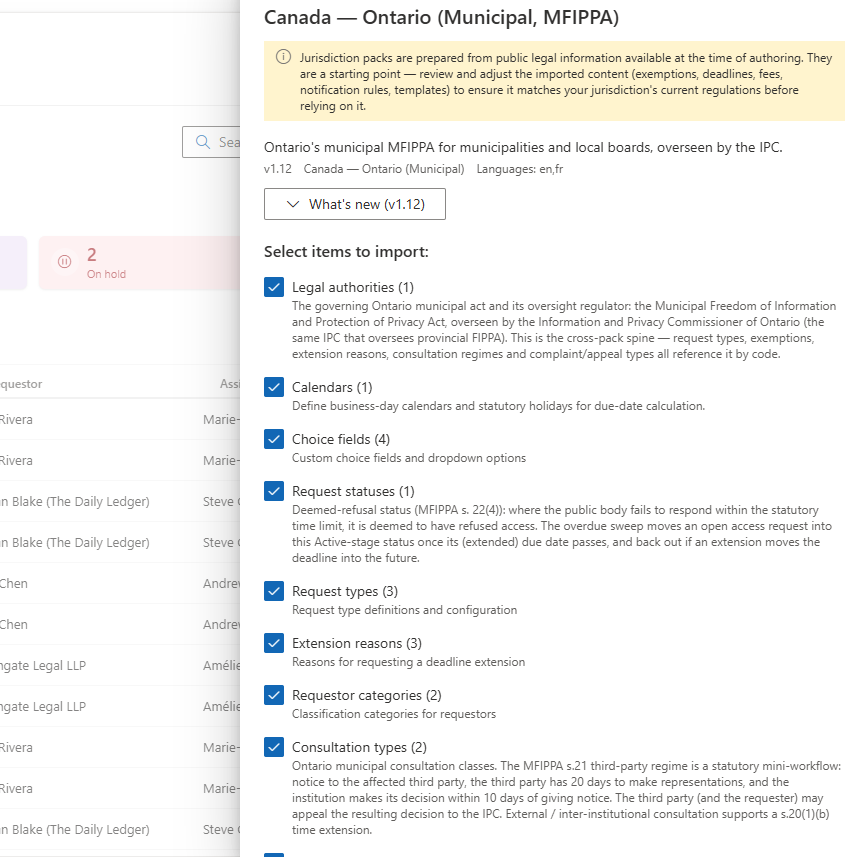
Installing the us-id-pra jurisdiction pack seeds your tenant with everything this regime needs — a starting point you can adjust, not a lock-in.
Pack content last reviewed: 2026-09-03
Related guide: FOI Workflow Quick Check- The Idaho Public Records Act (Idaho Code § 74-101 et seq.) as the legal-authority and citation spine
- The Idaho state-holiday calendar and the residency-split due-date rules — 3/10 working days for residents, 21/35 days for non-residents
- Residency detection at intake, so the correct statutory clock starts automatically
- The §§ 74-104 to 74-109 exemptions, plus the § 74-124 law-enforcement and investigatory-records standards, mapped for redaction
- IPRA charges — the first two hours of labour free for Idaho residents, then actual-cost labour and copying
- The district-court petition workflow — the 180-day filing window when no oversight agency is available
- Idaho timeliness tracking across both statutory clocks and their extensions
- IPRA correspondence templates with statutory wording
Idaho Questions
When must an Idaho agency respond to a records request?
What makes Idaho different — the residency-split clock?
What can an Idaho agency charge?
Where does data reside?
Go deeper
Flat annual pricing, published in full. Every feature in every size — access requests, privacy impact assessments, breach response, complaints, video & audio redaction, and AI Assist. No per-user or per-module fees.
- Under 500 employees$2,990/yr
- 500–2,000 employees$7,990/yr
- Over 2,000 employees$14,990/yr
Run the Idaho Public Records Act in One Platform
Try AccessPoint free for 30 days, pre-configured for Idaho. No credit card required.