
Wisconsin · Public Records Law
Run Wisconsin's balancing test as a documented decision
For Wisconsin state agencies, counties, municipalities, and school districts — AccessPoint tracks the as-soon-as-practicable standard and records the balancing analysis that Wisconsin, unusually, requires in place of a closed exemption list.
Wisconsin — Public Records Law at a glance
- Response standard
- As soon as practicable and without delay — no fixed statutory day count
- Withholding test
- The common-law balancing test, applied record by record
- Statutory limits
- Wis. Stat. § 19.36 and other statutory exceptions
- Fees
- Location, reproduction, and mailing costs on the statutory basis
- Enforcement
- Mandamus, with costs and attorney fees available to a prevailing requester
- Languages
- English
Built for Wisconsin — Public Records Law
One platform for the whole access-and-privacy mandate, pre-configured for this regime and running in your own Microsoft 365 tenant.
The balancing test, recorded
Wisconsin has no closed exemption list. Withholding rests on weighing the public interest in disclosure against the harm, record by record — and AccessPoint captures that analysis on the file rather than leaving it in the author's head.
Written denials that hold up
A Wisconsin denial must state the reasons. Build it from the balancing analysis already recorded, so the letter and the reasoning behind it are the same document rather than two different accounts.
As soon as practicable
Where the statute sets no day count, your own responsiveness becomes the standard. Age every open request against an internal target and show a court exactly how the request moved.
The § 19.36 limits
The statutory limitations ship as citable grounds alongside the balancing analysis, so a denial can rest on the right basis and say so.
Records from Microsoft 365
Collect responsive records straight from SharePoint, Teams, and Exchange with custodian attestations and a chain of custody.
In your own tenant
Requests, records, and audit history stay inside your own Microsoft 365 and Azure tenant — no third-party cloud and no vendor access.
No exemption list to hide behind
Wisconsin makes you weigh each record — and then makes you pay the requester's lawyer if you weighed it wrong.
Most public records statutes hand a custodian a list: find the exemption, cite it, withhold. Wisconsin largely does not. Beyond the § 19.36 limits and other specific statutes, withholding rests on a common-law balancing test applied to the particular record — the public interest in disclosure against the harm that disclosure would cause. That is a judgment, and judgments are only as defensible as the reasoning recorded at the time. It matters more in Wisconsin than almost anywhere else, because enforcement runs by mandamus and a prevailing requester may recover costs and reasonable attorney fees. AccessPoint makes the balancing analysis a required, recorded step attached to the record it concerns, so the denial letter is a summary of real reasoning rather than a conclusion in search of one.
Configured out of the box
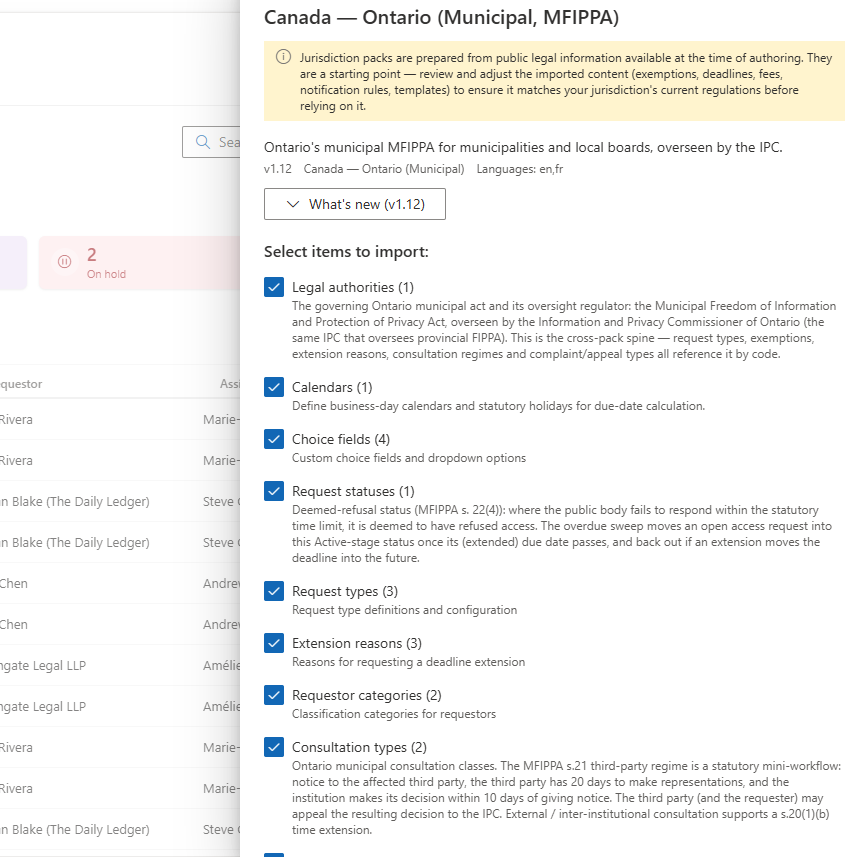
Installing the us-wi-prl jurisdiction pack seeds your tenant with everything this regime needs. It is a starting point built from public information about the legislation, not legal advice — your legal counsel validates and adjusts it for your tenant.
Pack content last reviewed: 2026-08-10
Related guide: FOI Workflow Quick Check- The Wisconsin Public Records Law as the legal-authority spine
- An as-soon-as-practicable response model with configurable internal service targets and ageing
- A structured balancing-test analysis recorded against each withheld record
- The Wis. Stat. § 19.36 limitations and other statutory exceptions, colour-coded for redaction
- Written denial templates that draw on the recorded balancing analysis
- Location, reproduction, and mailing fees on the statutory basis
- Mandamus and litigation tracking linked to the originating request
- A timestamped audit trail for every decision on the request
Wisconsin — Public Records Law Questions
How quickly must a Wisconsin authority respond?
How does the balancing test work in AccessPoint?
Is there an administrative appeal?
Where do the records reside?
Go deeper
Flat annual pricing, published in full. Every feature in every size — access requests, privacy impact assessments, breach response, complaints, video & audio redaction, and AI Assist. No per-user or per-module fees.
- Under 500 employees$2,990/yr
- 500–2,000 employees$7,990/yr
- Over 2,000 employees$14,990/yr
Run the Wisconsin Public Records Law in Your Own Tenant
Try AccessPoint free for 30 days, configured for Wisconsin. No credit card required.