
United States · State consumer privacy laws
One configuration for the states that all copied the same template
Virginia, Colorado, Connecticut, Texas, Oregon and the rest of the state consumer privacy wave share a common shape — the same rights, the same 45+45-day clock, and a consumer appeal step California does not have. AccessPoint ships that shape as one pack.
United States — State Consumer Privacy at a glance
- Rights deadline
- 45 days, extendable once by a further 45 days on notice
- Appeal
- An internal appeal of a refusal, answered within the statutory window
- Rights covered
- Access, deletion, correction, portability, and opt-out of targeted advertising, sale, and profiling
- Assessments
- Data protection assessments for higher-risk processing
- Enforcement
- State Attorneys General, most with a cure period
- Languages
- English
Built for United States — State Consumer Privacy
One platform for the whole access-and-privacy mandate, pre-configured for this regime and running in your own Microsoft 365 tenant.
One shape, many states
The state acts differ in their thresholds and their details, but they share a structure. One configuration runs them, with the applicable state recorded on each request rather than a separate system per jurisdiction.
The appeal step, built in
The feature that most distinguishes these acts from California's: a consumer may appeal a refusal, and the controller must respond within the statutory window. AccessPoint tracks the appeal as its own stage with its own clock and outcome.
Every right on the 45-day clock
Access, deletion, correction, and portability run on the common 45-day clock with the single 45-day extension, with the state that governs each request recorded.
Data protection assessments
Run the assessments these acts require for higher-risk processing — targeted advertising, sale, sensitive data, and profiling — as full cases with risks, mitigations, and sign-off.
Reporting across states
See volumes, timeliness, refusals, and appeals across every state you operate in at once, instead of assembling a picture from separate trackers.
In your own tenant
Consumer personal information stays inside your own Microsoft 365 and Azure tenant — no third-party privacy cloud holding the very data the requests are about.
The appeal nobody plans for
The state acts gave consumers a second bite. Most programs are built as though they didn't.
Virginia's act set the template and roughly twenty states have followed it, and one feature runs through nearly all of them: if a controller declines a request, the consumer may appeal, and the controller must respond within a defined window — and, if the appeal is denied, must tell the consumer how to complain to the Attorney General. That last step is why appeals matter out of proportion to their volume. They are the documented moment a refusal was tested internally, and they are the handoff point to a regulator. Programs that treat a refusal as the end of the matter discover the appeal window has run while the email sat unread. AccessPoint models the appeal as a real stage with its own clock, its own reviewer, and its own recorded outcome.
Configured out of the box
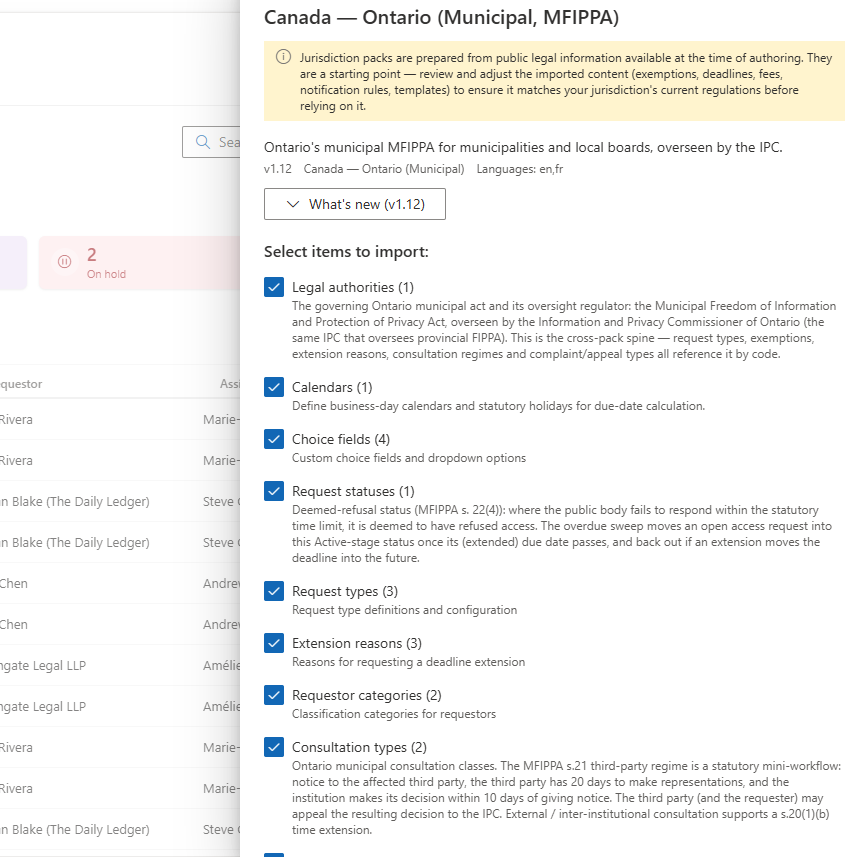
Installing the us-state-privacy jurisdiction pack seeds your tenant with everything this regime needs. It is a starting point built from public information about the legislation, not legal advice — your legal counsel validates and adjusts it for your tenant.
Pack content last reviewed: 2026-08-10
Related guide: FOI Workflow Quick Check- A rebindable state consumer privacy authority, set to the states you operate in
- The 45-day rights clock with its single 45-day extension
- Request types for access, deletion, correction, portability, and the opt-out rights
- The consumer appeal stage with its own statutory window and recorded outcome
- Attorney General complaint information where an appeal is denied
- Data protection assessments for targeted advertising, sale, sensitive data, and profiling
- Refusal grounds and exceptions, cited on the response
- Cross-state reporting on volumes, timeliness, refusals, and appeals
United States — State Consumer Privacy Questions
Which states does this pack cover?
Why is California separate?
How are the differences between states handled?
Where does consumer personal information reside?
Go deeper
Flat annual pricing, published in full. Every feature in every size — access requests, privacy impact assessments, breach response, complaints, video & audio redaction, and AI Assist. No per-user or per-module fees.
- Under 500 employees$2,990/yr
- 500–2,000 employees$7,990/yr
- Over 2,000 employees$14,990/yr
Run Multi-State Consumer Privacy in Your Own Tenant
Try AccessPoint free for 30 days, configured for the states you operate in. No credit card required.