
Solutions · By capability
PIA software that runs the assessment, not just the form
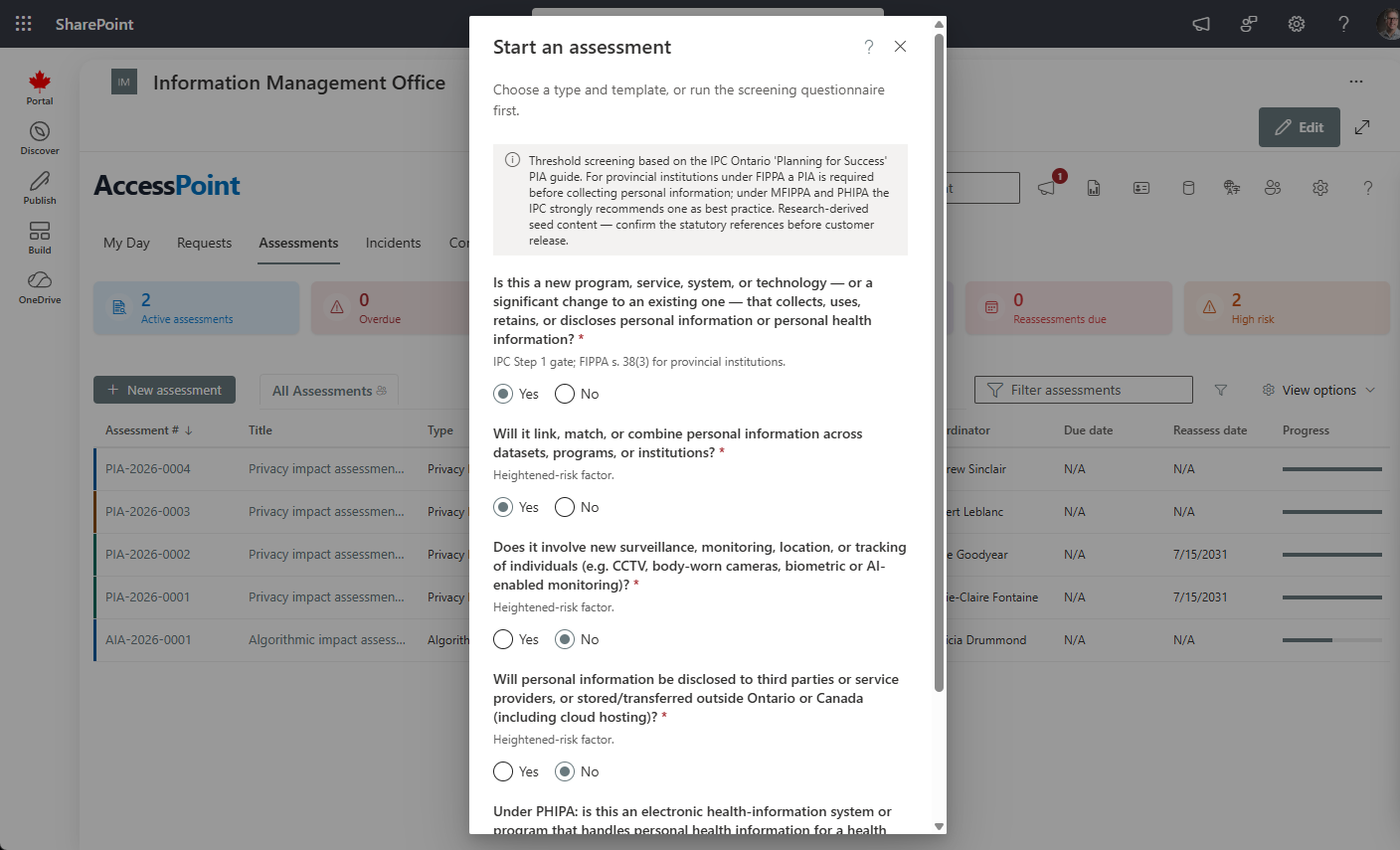
Screeners that decide whether a full PIA is needed, questionnaires with section assignment to the experts who actually know the answers, an embedded risk register, and a regulator-ready summary — every step reviewed, versioned, and auditable.
Most privacy impact assessments live and die in Word. A template gets emailed around, subject-matter experts paste answers into the wrong versions, the risk table is a screenshot, and two years later nobody can say which version the sign-off applied to. PIA software exists to replace that ritual with a process — and the bar for 'process' has risen sharply now that jurisdictions like Ontario mandate written PIAs by law (FIPPA institutions since July 1, 2025, under Bill 194).
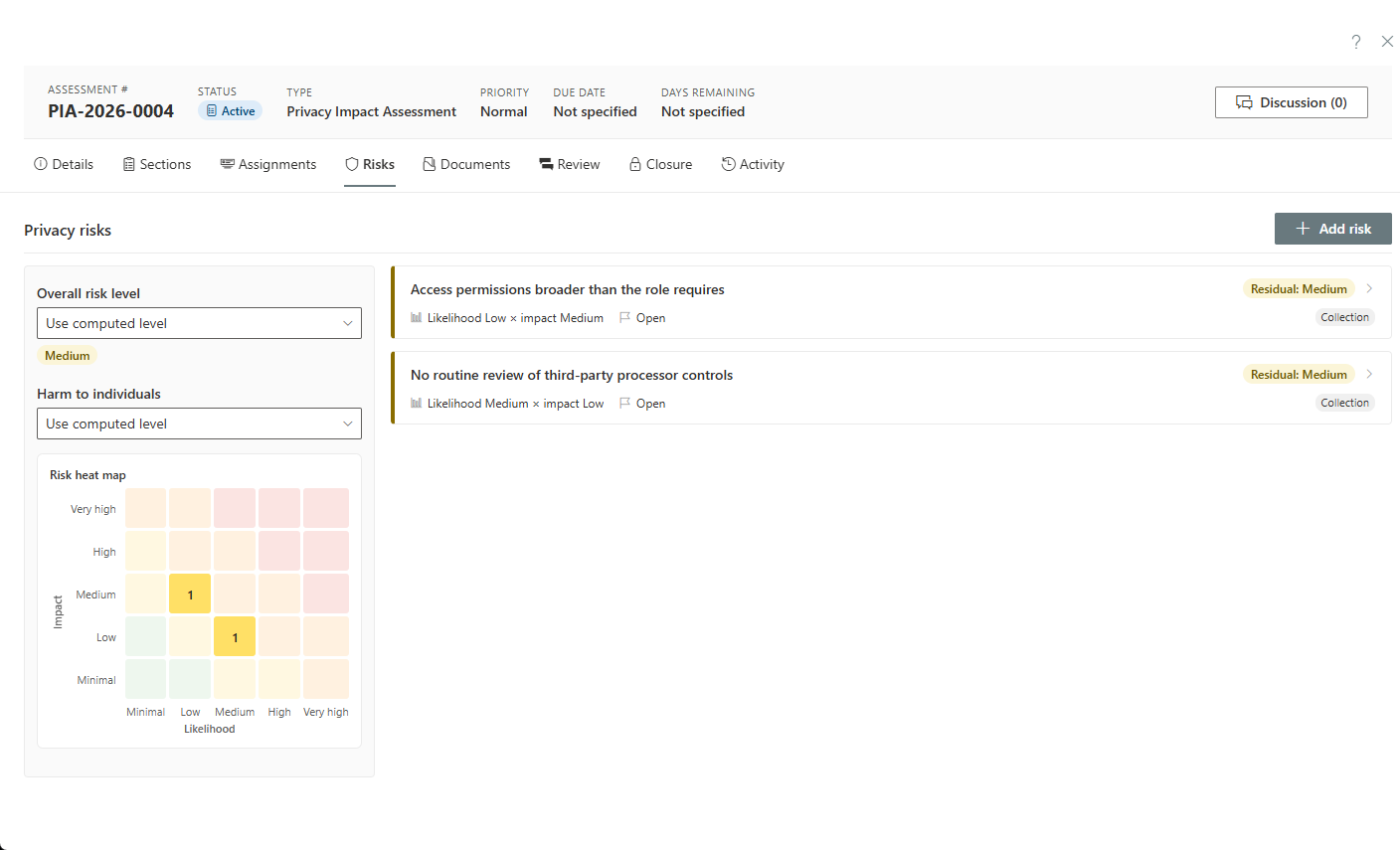
AccessPoint treats a PIA as an operating workflow: a preliminary screener determines whether a full assessment is even needed; a configurable questionnaire engine runs typed questions with autosave; individual sections are assigned to subject-matter experts who see only their part; risks land in an embedded likelihood-times-impact register rather than prose; and closure produces a regulator-ready summary with review sign-off — all against a durable privacy subject that accumulates its assessment history, its GDPR Article 30 record, and its incidents over time.
The same engine runs Algorithmic Impact Assessments, which matters practically: as privacy programs absorb AI-governance obligations, running PIAs and AIAs as two templates on one governed engine — with one audit ledger and one reporting spine — beats managing parallel tools.
Where PIA programs actually break
Three failure modes show up in almost every document-based PIA program.
The assessment that lives in Word
The PIA is a document, so it behaves like one: versions accumulate by filename — v4, v7-FINAL, v7-FINAL-legal-edits — and status exists only in the coordinator's memory. When the regulator asks for the approved assessment, the office sends its best guess at which file that was.
Findings that go nowhere
The assessment names real risks, proposes mitigations, collects its sign-off — and gets filed. The risks never reach a maintained register, and the breach that should have reopened the assessment never does. The same exposure surfaces in the next incident, unowned and untreated.
Sections chased through inboxes
Program areas answer the questionnaire in attachments, tracked changes, and reply-all threads, and the privacy office re-assembles the assessment by hand. Weeks go to coordination instead of analysis — and no one recorded who actually answered what, which is the first question a review asks.
What to look for in PIA management software
Whether you buy AccessPoint or anything else, these capabilities separate a PDF form in the cloud from software that actually manages assessments.
How does your program score today? Take the ten-question PIA readiness check →
How AccessPoint runs a PIA
From screener to in-effect, on one governed engine.
Configurable questionnaire engine
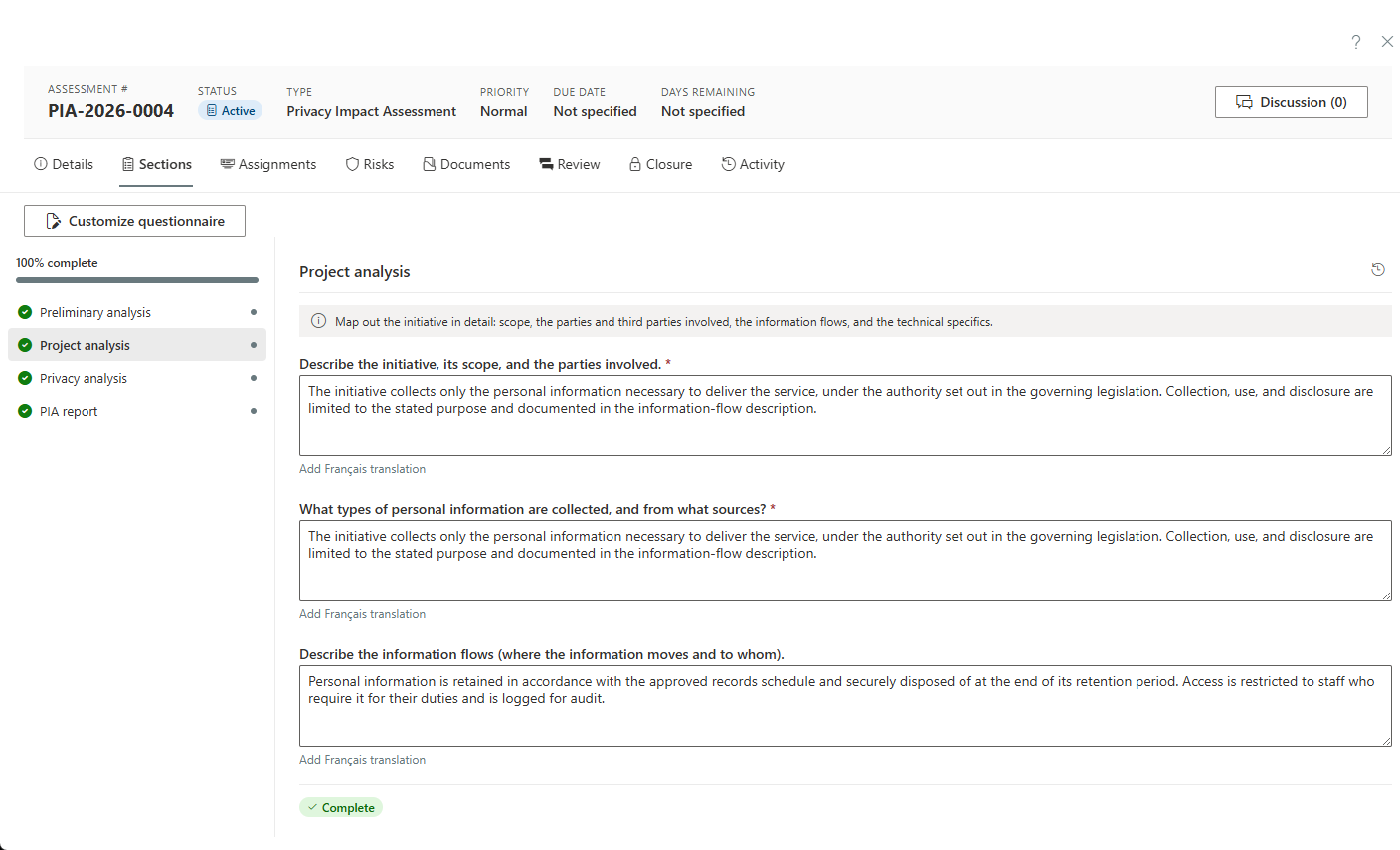
Typed questions, conditional sections, and templates configured to the assessment mandate that applies to you — seeded by your jurisdiction pack, adjustable to your own methodology.
Screeners & section assignment
A preliminary screener decides whether a full assessment is needed; sections go to subject-matter experts who fill in only their part, with the coordinator merging on approval.
Embedded risk register
A likelihood-times-impact register inside every scored assessment, feeding the program-wide ISO 31000 risk register — with treatments, KRIs, and commitments tracked to completion.
AI answer suggestions, human decisions
Optional AI Assist drafts grounded answers for unanswered questions from the assessment's own documents and your organization profile — accepted or dismissed per question, with a consistency check across the set.
Durable privacy subjects & ROPA
Every assessment attaches to a reusable program or system carrying its Article 30 record, vendor links, and full assessment and incident history.
Closure that stands up later
Regulator-ready summary exports, closure summaries translatable per record, review sign-off on the ledger, and retention applied by policy — with In-Effect assessments excluded from purge by construction.
See it in AccessPoint
Real screens from the product, running in a Microsoft 365 tenant. Click any one to enlarge.
The regulatory moment
Mandatory PIAs are here — Ontario was first, not last
Since July 1, 2025, Ontario FIPPA institutions must complete written privacy impact assessments before collecting personal information, with Bill 194 adding the first public-sector AI rules. Obligations like these turn PIA capacity from good practice into compliance infrastructure.
Go deeper
Privacy Impact Assessment (PIA) Software Questions
What is PIA management software?
How is AccessPoint different from OneTrust for PIAs?
Does AccessPoint cover Ontario's Bill 194 PIA requirements?
Can subject-matter experts fill in their sections without seeing the whole assessment?
Can AI fill in the PIA for us?
We have years of completed PIAs in Word. Do they come with us?
Flat annual pricing, published in full. Every feature in every size — access requests, privacy impact assessments, breach response, complaints, video & audio redaction, and AI Assist. No per-user or per-module fees.
- Under 500 employees$2,990/yr
- 500–2,000 employees$7,990/yr
- Over 2,000 employees$14,990/yr
Run PIAs Like a Program, Not a Paper Chase.
Try AccessPoint free for 30 days in your own Microsoft 365 tenant — assessment templates included in your jurisdiction pack.