
South Dakota · Public Records (SDCL Chapter 1-27)
South Dakota's public records law, with the Office of Hearing Examiners built in
AccessPoint manages public records requests under SDCL chapter 1-27 — the ten-business-day answer to a written request, the §§ 1-27-1.5 to 1-27-1.9 exemptions, and the Office of Hearing Examiners review path — pre-configured for South Dakota and running inside your own Microsoft 365 tenant.
South Dakota at a glance
- Response standard
- A written request is answered within 10 business days — the record is produced, the request is denied with written reasons, or a time estimate is given; silence is a deemed denial (§ 1-27-37)
- Enforcement
- Within 90 days of a denial, a civil action or a notice of review filed with the Office of Hearing Examiners (§ 1-27-38); the decision binds unless appealed within 30 days
- Exemptions
- Records not open to inspection and copying under §§ 1-27-1.5 to 1-27-1.9, led by the enumerated § 1-27-1.5 categories
- Charges
- Actual cost of reproduction and mailing; the first hour of staff time free
- Oversight
- Office of Hearing Examiners — a quasi-judicial administrative tribunal — with appeal to the circuit court
- Languages
- English
Built for South Dakota
One platform for the whole access-and-privacy mandate, pre-configured for this regime and running in your own Microsoft 365 tenant.
Chapter 1-27 request lifecycle
Intake to release under SDCL chapter 1-27 — the written request, the ten-business-day answer, and inspection or copies — all on Microsoft 365, through the public record officer who answers each request.
Ten business days, three answers
Within ten business days of a written request, produce the record, deny it with written reasons, or give a time estimate for producing it — because under § 1-27-37 silence is a denial. AccessPoint computes the date on receipt over South Dakota's holiday calendar and drafts whichever answer you choose.
The Office of Hearing Examiners
A denial, or a fee or time estimate the requester objects to, can go to the Office of Hearing Examiners on a notice of review within ninety days (§ 1-27-38). The entity has ten business days to reply. AccessPoint assembles that reply from the request file — the record, the exemption relied on, and the dates.
Redaction by exemption
Apply the §§ 1-27-1.5 to 1-27-1.9 categories line by line on a colour-coded, audit-trailed redaction record — each redaction tied to the numbered category it relies on, and the citation carried into the written denial.
Actual-cost charges
Charge the actual cost of reproduction and mailing, and staff time only after the first free hour, with the estimate issued on request — and the calculation kept on the file, because a fee estimate is itself reviewable by the Office of Hearing Examiners.
In your own tenant
Every request and record stays inside your own Microsoft 365 and Azure tenant — no third-party cloud, no cross-border transfers, and no per-user fees.
The Office of Hearing Examiners
In South Dakota, a records dispute goes to a hearing examiner before it goes to a judge.
Most states leave a denied requester with a court, an attorney general, or nothing. South Dakota built an administrative tribunal into chapter 1-27. When a public record officer denies a written request — or gives a fee or time estimate the requester objects to — the requester has ninety days to choose: commence a civil action, or file a written notice of review with the Office of Hearing Examiners (§ 1-27-38). The Office forwards the notice to the entity, which has ten business days to respond. The hearing examiner may rule on the papers alone, holding a hearing only where one is needed, and the written decision binds the entity unless it is appealed within thirty days. Because the examiner sees the file rather than the people, the file is the case — and AccessPoint writes it as the work happens.
Configured out of the box
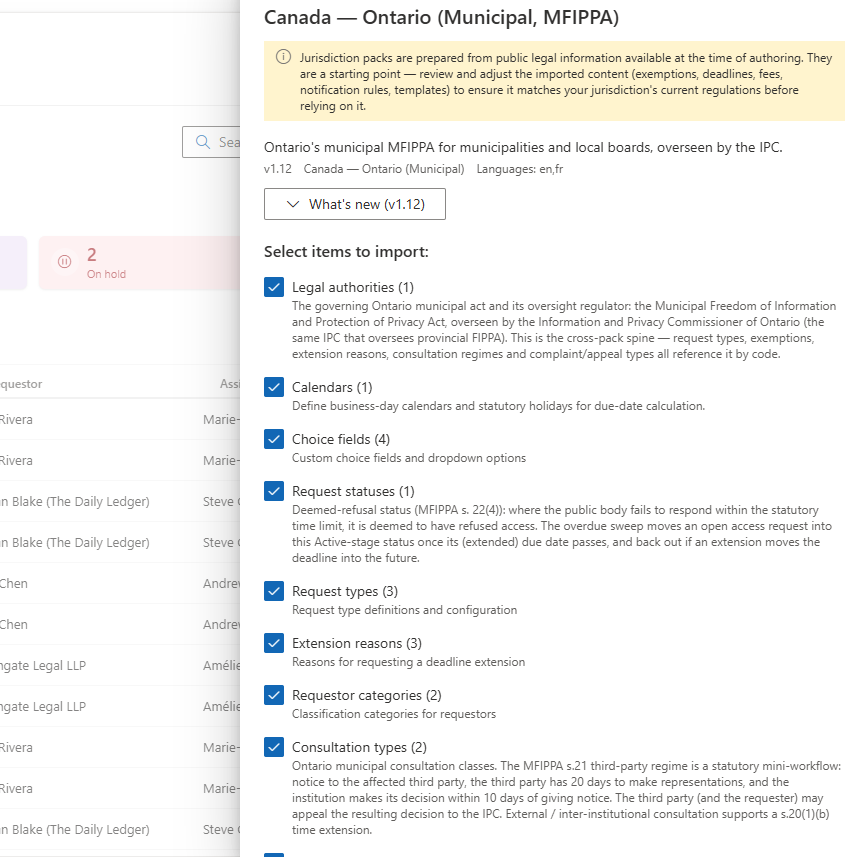
Installing the us-sd-ora jurisdiction pack seeds your tenant with everything this regime needs. It is a starting point built from public information about the legislation, not legal advice — your legal counsel validates and adjusts it for your tenant.
Pack content last reviewed: 2026-09-03
Related guide: FOI Workflow Quick Check- South Dakota's public records law (SDCL chapter 1-27) as the legal-authority and citation spine
- The South Dakota state-holiday calendar and the ten-business-day answer due-date rule under § 1-27-37
- The three statutory answers — produce, deny with written reasons, or give a time estimate — with the estimate tracked as its own commitment
- The §§ 1-27-1.5 to 1-27-1.9 records not open to inspection and copying, colour-coded for redaction and citable line by line
- Actual-cost charges for reproduction and mailing, with the first hour of staff time free and the calculation kept on the file
- The Office of Hearing Examiners workflow — the ninety-day notice-of-review window, the ten-business-day entity response, and the thirty-day appeal clock under § 1-27-38
- Public-record-officer assignment and South Dakota timeliness tracking on every request
- Chapter 1-27 correspondence templates with statutory wording
South Dakota Questions
When must a South Dakota public entity respond?
What makes South Dakota different — the Office of Hearing Examiners?
What can a South Dakota public entity charge?
Where does data reside?
Go deeper
Flat annual pricing, published in full. Every feature in every size — access requests, privacy impact assessments, breach response, complaints, video & audio redaction, the public portal, repository connectors, and AI Assist. No per-user or per-module fees.
- Under 500 employees$2,990/yr
- 500–1,999 employees$7,990/yr
- 2,000–9,999 employees$14,990/yr
- 10,000+ employees$29,990/yr
Run South Dakota's Public Records Law in One Platform
Try AccessPoint free for 30 days, pre-configured for South Dakota. No credit card required.