
South Carolina · Freedom of Information Act
The South Carolina Freedom of Information Act, on a two-step clock
AccessPoint manages Freedom of Information Act requests under S.C. Code Ann. § 30-4-10 et seq. — the 10- or 20-business-day determination, then the separate 30- or 35-calendar-day production window — pre-configured for South Carolina and running inside your own Microsoft 365 tenant.
South Carolina at a glance
- Response standard
- Determination within 10 business days; 20 business days for records 24 months or older (§ 30-4-30)
- Production
- Furnished within 30 calendar days of the determination (35 for older records); a required deposit starts the clock (§ 30-4-30)
- Exemptions
- Matters exempt from disclosure (§ 30-4-40)
- Charges
- Actual cost of search, retrieval, and redaction; copies at no more than the prevailing commercial rate; deposit up to 25% (§ 30-4-30)
- Oversight
- Enforced in the circuit court (§§ 30-4-100, 30-4-110); Attorney General advisory opinions
- Languages
- English
Built for South Carolina
One platform for the whole access-and-privacy mandate, pre-configured for this regime and running in your own Microsoft 365 tenant.
FOIA request lifecycle
Intake to release under the South Carolina FOIA (§ 30-4-10 et seq.) — the written determination, the exemption review, and the production of records — all on Microsoft 365.
The two-step clock
South Carolina splits the deadline in two: a determination within 10 business days (20 for records 24 months or older), then production within 30 calendar days (35 for older records). AccessPoint runs both clocks, keyed to any required deposit.
Circuit-court enforcement
There is no binding FOIA commission. AccessPoint keeps the file a requester or public body needs for the § 30-4-100 declaratory-and-injunctive route and the § 30-4-110 hearing, with the one-year limit tracked.
Exemptions and redaction
Apply the § 30-4-40 matters exempt from disclosure line by line — law enforcement records, personal privacy, trade secrets, attorney-client, and more — on a colour-coded, audit-trailed redaction record.
Cost-based charges
Charge only the actual cost of search, retrieval, and redaction, with copies capped at the prevailing commercial rate and a deposit up to 25% of the anticipated cost — with no fee for the review to determine disclosability.
In your own tenant
Every request and record stays inside your own Microsoft 365 and Azure tenant — no third-party cloud, no cross-border transfers, and no per-user fees.
The two-step clock
In South Carolina, the deadline to decide is not the deadline to deliver.
Most records laws run one clock. South Carolina runs two. A public body first has to give its written determination — whether it will comply — within ten business days of the request, or twenty business days if the records are more than twenty-four months old. Only then does the production clock start: the records must be furnished within thirty calendar days of that determination, or thirty-five for older records, with a required deposit of up to twenty-five percent starting the count. AccessPoint tracks both deadlines from intake, so the response clock and the delivery clock never get confused.
Configured out of the box
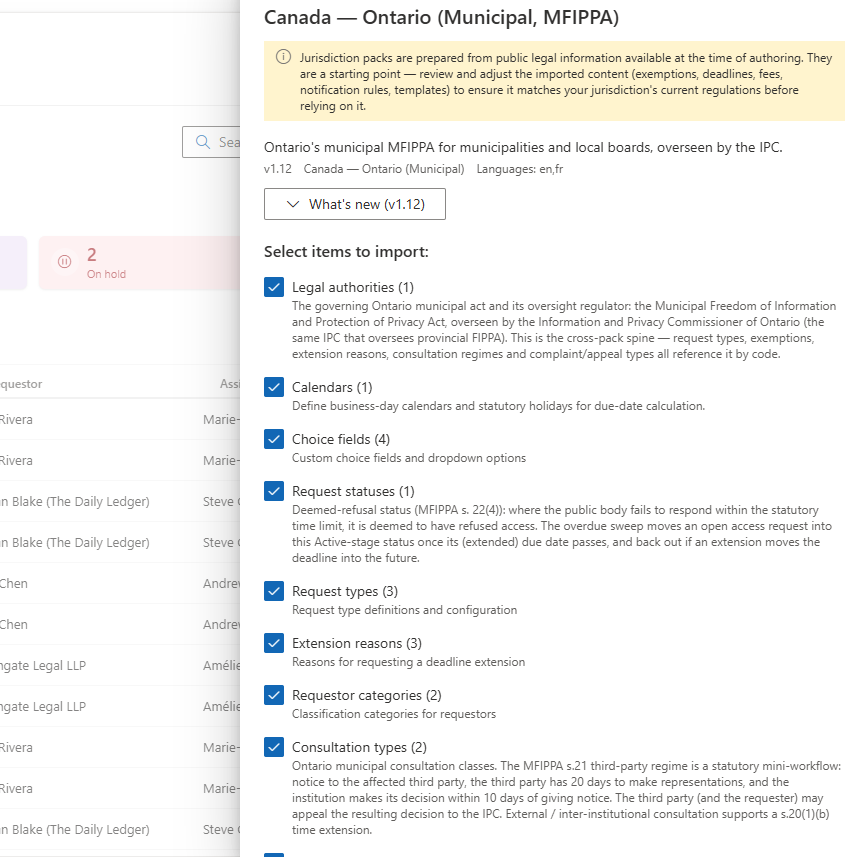
Installing the us-sc-foia jurisdiction pack seeds your tenant with everything this regime needs. It is a starting point built from public information about the legislation, not legal advice — your legal counsel validates and adjusts it for your tenant.
Pack content last reviewed: 2026-07-24
Related guide: FOI Workflow Quick Check- The South Carolina Freedom of Information Act (S.C. Code Ann. § 30-4-10 et seq.) as the legal-authority and citation spine
- The South Carolina state-holiday calendar and the two-step deadline rules — 10/20 business days to determine, 30/35 calendar days to produce
- Separate determination and production clocks, with the production clock keyed to any required deposit
- The § 30-4-40 matters exempt from disclosure, colour-coded for redaction
- Cost-based charges — search, retrieval, and redaction, with copies capped at the prevailing commercial rate and a deposit up to 25%
- Circuit-court enforcement support — the § 30-4-100 declaratory-and-injunctive route and § 30-4-110 hearings, with the one-year limit tracked
- South Carolina timeliness tracking across both the determination and production deadlines
- FOIA correspondence templates with statutory wording — determination notices, deposit requests, and exemption citations
South Carolina Questions
When must a South Carolina public body respond to a request?
What makes South Carolina different — the two-step timeline?
What can a public body charge?
Where does data reside?
Go deeper
Flat annual pricing, published in full. Every feature in every size — access requests, privacy impact assessments, breach response, complaints, video & audio redaction, and AI Assist. No per-user or per-module fees.
- Under 500 employees$2,990/yr
- 500–2,000 employees$7,990/yr
- Over 2,000 employees$14,990/yr
Run the South Carolina Freedom of Information Act in One Platform
Try AccessPoint free for 30 days, pre-configured for South Carolina. No credit card required.