
Ohio · Public Records Act
The Ohio Public Records Act, the Court of Claims path included
AccessPoint manages Public Records Act requests under R.C. 149.43 — prompt production within a reasonable time, the (A)(1) exceptions, and the R.C. 2743.75 Court of Claims complaint with its mediation and special master — pre-configured for Ohio and running inside your own Microsoft 365 tenant.
Ohio at a glance
- Response standard
- Copies promptly and within a reasonable period of time — no fixed day count (R.C. 149.43(B)(1))
- Enforcement
- By mandamus, or a R.C. 2743.75 Court of Claims complaint ($25) after a 3-business-day notice to cure
- Exceptions
- Records excepted from 'public record' under R.C. 149.43(A)(1)
- Charges
- Actual cost of copies — no profit and no statutory per-page maximum (R.C. 149.43(B)(1))
- Oversight
- Ohio Court of Claims (special docket) or the courts on mandamus
- Languages
- English
Built for Ohio
One platform for the whole access-and-privacy mandate, pre-configured for this regime and running in your own Microsoft 365 tenant.
Public records lifecycle
Intake to release under the Public Records Act (R.C. 149.43) — prompt inspection and copying, the organization-and-maintenance duty, and enforcement referrals — all on Microsoft 365.
The Court of Claims path
A dispute can go to the Court of Claims under R.C. 2743.75 for $25 — mediation first, then a special master's report. AccessPoint tracks the 3-business-day cure notice, assembles the record, and manages the file to the final order.
The reasonable-time standard
Ohio sets no fixed clock — records go out promptly and within a reasonable period of time. AccessPoint time-stamps each request and flags ageing files so 'reasonable' stays defensible.
Exceptions and redaction
Apply the R.C. 149.43(A)(1) exceptions — medical, trial-preparation, and confidential law-enforcement investigatory records among them — line by line on a colour-coded, audit-trailed redaction record.
At-cost charges
Charge only the actual cost of copies — no profit — with a requester able to ask for records on paper, on chosen media, or by email; AccessPoint itemizes the charge for you.
In your own tenant
Every request and record stays inside your own Microsoft 365 and Azure tenant — no third-party cloud, no cross-border transfers, and no per-user fees.
The Court of Claims path
In Ohio, a records dispute has a $25 path that skips the courtroom — mediation and a special master at the Court of Claims.
Ohio gives requesters an expeditious, low-cost alternative to a mandamus lawsuit. For a $25 filing fee, a requester files a complaint with the Court of Claims under R.C. 2743.75. Every case first goes to mediation with a court staff attorney or magistrate; if that does not resolve it, a special master — a lawyer of at least four years' standing — reviews the record and issues a report and recommendation, on which a judge enters a final order. Since April 2025 the requester must first give the office three business days to cure. AccessPoint tracks the cure notice, assembles the record, and manages the file to the order.
Configured out of the box
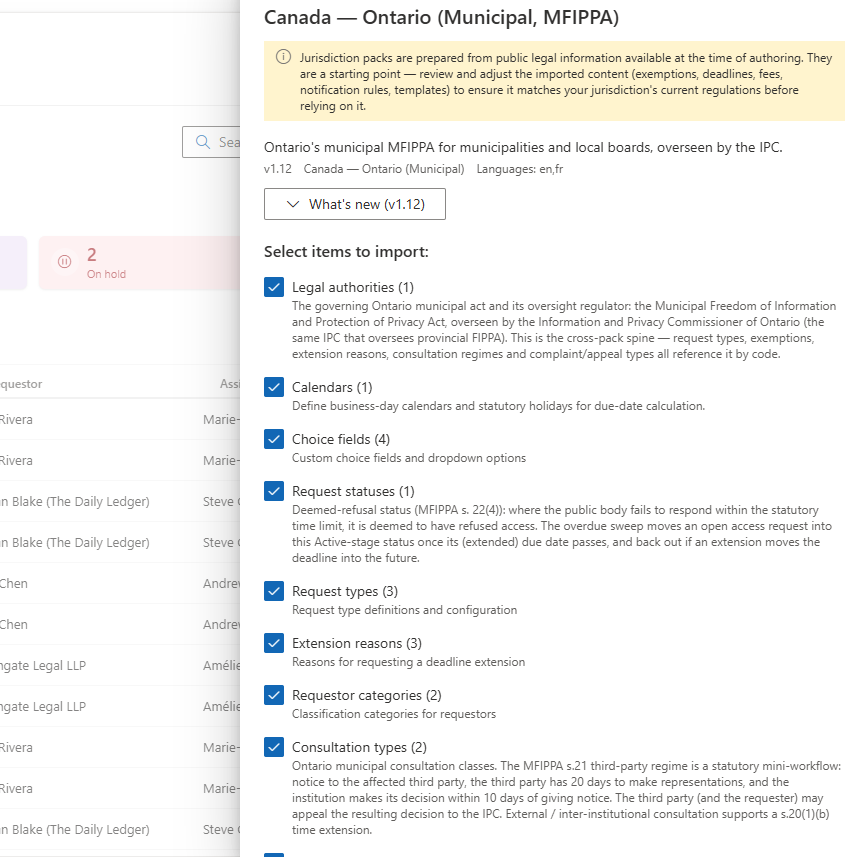
Installing the us-oh-pra jurisdiction pack seeds your tenant with everything this regime needs. It is a starting point built from public information about the legislation, not legal advice — your legal counsel validates and adjusts it for your tenant.
Pack content last reviewed: 2026-07-24
Related guide: FOI Workflow Quick Check- The Ohio Public Records Act (R.C. 149.43) as the legal-authority and citation spine
- The Ohio state-holiday calendar with prompt, reasonable-time tracking rather than a fixed statutory clock
- The R.C. 2743.75 Court of Claims workflow — the 3-business-day cure notice, the record, and tracking through mediation, special master, and final order
- The R.C. 149.43(A)(1) exceptions, colour-coded for redaction
- At-cost copy charges, itemized, with the no-profit rule built in
- Mandamus-versus-Court-of-Claims routing so the requester's single chosen path is recorded
- Ohio ageing-and-timeliness tracking so 'within a reasonable period of time' stays defensible
- Public-records correspondence templates with statutory wording
Ohio Questions
When must an Ohio public office respond to a request?
What makes Ohio different — the Court of Claims path?
What can a public office charge?
Where does data reside?
Go deeper
Flat annual pricing, published in full. Every feature in every size — access requests, privacy impact assessments, breach response, complaints, video & audio redaction, and AI Assist. No per-user or per-module fees.
- Under 500 employees$2,990/yr
- 500–2,000 employees$7,990/yr
- Over 2,000 employees$14,990/yr
Run the Ohio Public Records Act in One Platform
Try AccessPoint free for 30 days, pre-configured for Ohio. No credit card required.