
North Carolina · Public Records Act
The North Carolina Public Records Act — broad by default, mediated before court
AccessPoint manages requests under the North Carolina Public Records Act (N.C. Gen. Stat. Ch. 132) — a sweeping right of access, production as promptly as possible, and the mandatory mediation that precedes superior-court enforcement — pre-configured for North Carolina and running inside your own Microsoft 365 tenant.
North Carolina at a glance
- Response standard
- As promptly as possible; inspection during regular business hours (G.S. 132-6)
- Enforcement
- Civil action in superior court after mandatory mediation (G.S. 7A-38.3E)
- Exemptions
- Narrow, specific exceptions scattered through the General Statutes — few by design
- Charges
- No fee to inspect; uncertified copies at actual cost; special service charge for extensive IT or clerical time (G.S. 132-6.2)
- Oversight
- No central agency — the superior courts enforce the Act
- Languages
- English
Built for North Carolina
One platform for the whole access-and-privacy mandate, pre-configured for this regime and running in your own Microsoft 365 tenant.
Public records lifecycle
Intake to release under the Public Records Act (G.S. Ch. 132) — a broad-access intake that treats material as public unless a specific exception applies, produced as promptly as possible — all on Microsoft 365.
Mediation before the courthouse
There is no records commission in North Carolina — a denied requester sues in superior court, but only after the mandatory mediation of G.S. 7A-38.3E. AccessPoint keeps the record and correspondence ready for both the mediation and the hearing.
As promptly as possible
The Act sets no fixed number of days — records must be produced as promptly as possible and without unreasonable delay. AccessPoint tracks each request's age so promptness is demonstrable, not just asserted.
Narrow exemptions and redaction
North Carolina's exceptions are few and specific, spread across the General Statutes rather than a single list. AccessPoint maps them and applies each one line by line on a colour-coded, audit-trailed redaction record.
Actual-cost charges
Inspection is free; uncertified copies cost no more than the actual cost of reproduction, with a reasonable special service charge only where a request demands extensive IT resources or clerical assistance (G.S. 132-6.2).
In your own tenant
Every request and record stays inside your own Microsoft 365 and Azure tenant — no third-party cloud, no cross-border transfers, and no per-user fees.
Broad by default, mediated before court
North Carolina makes almost everything public — and routes every records fight through mediation first.
Chapter 132 declares public records the property of the people, obtainable free or at minimal cost, and defines them so broadly that the exceptions are few and specific by design. There is no records commission to appeal to. Instead, a denied requester enforces the Act by suing in superior court — but under G.S. 7A-38.3E mediation is mandatory and jurisdictional, so the dispute must be mediated before a judge will decide it. AccessPoint keeps a defensible, well-documented record so a request stands up through both the mediation and the hearing.
Configured out of the box
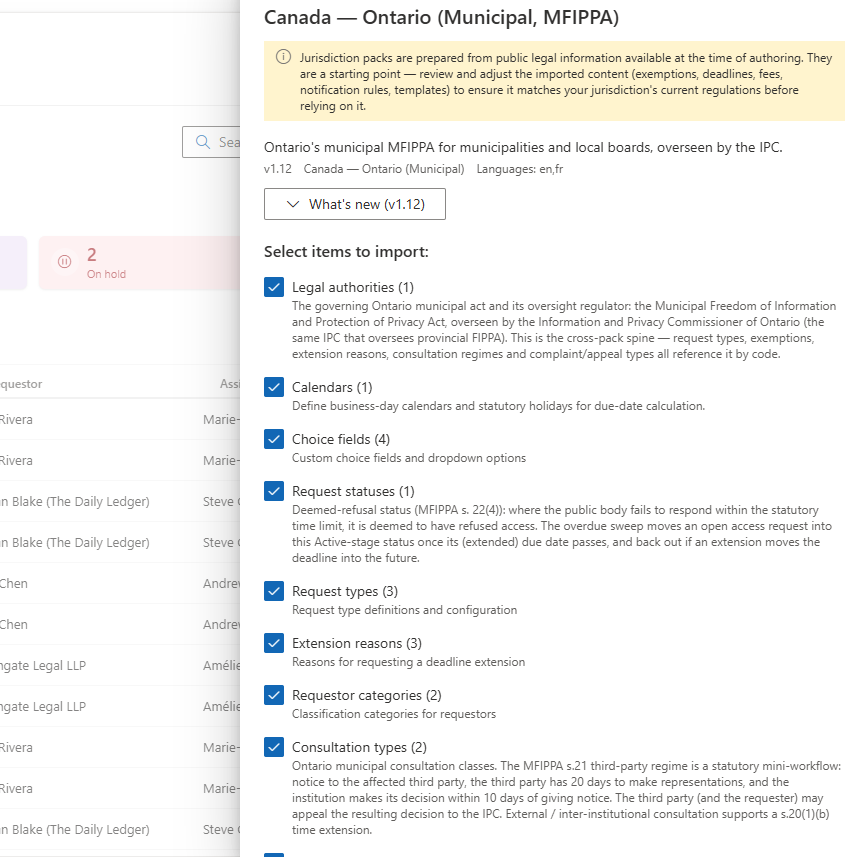
Installing the us-nc-pra jurisdiction pack seeds your tenant with everything this regime needs. It is a starting point built from public information about the legislation, not legal advice — your legal counsel validates and adjusts it for your tenant.
Pack content last reviewed: 2026-07-24
Related guide: FOI Workflow Quick Check- The North Carolina Public Records Act (G.S. Ch. 132) as the legal-authority and citation spine
- The North Carolina state-holiday calendar and the 'as promptly as possible' timeliness rules
- The narrow, statute-specific exceptions mapped and colour-coded for redaction
- The G.S. 132-6.2 fee model — free inspection, actual-cost copies, and the special service charge for extensive requests
- Public-records correspondence templates with statutory wording
- The mandatory-mediation and superior-court enforcement workflow (G.S. 7A-38.3E)
- Promptness tracking so requests are answered without unreasonable delay
- A broad-access intake that treats records as public unless a specific exception applies
North Carolina Questions
How quickly must a North Carolina agency respond to a request?
What makes North Carolina different — mediation before court?
What can an agency charge?
Where does data reside?
Go deeper
Flat annual pricing, published in full. Every feature in every size — access requests, privacy impact assessments, breach response, complaints, video & audio redaction, and AI Assist. No per-user or per-module fees.
- Under 500 employees$2,990/yr
- 500–2,000 employees$7,990/yr
- Over 2,000 employees$14,990/yr
Run the North Carolina Public Records Act in One Platform
Try AccessPoint free for 30 days, pre-configured for North Carolina. No credit card required.