
New Zealand · Local Government Official Information and Meetings Act 1987
LGOIMA, built for the councils that actually run it
For territorial authorities, regional councils, and council-controlled organisations — AccessPoint runs 20-working-day decisions with the withholding grounds and public interest balance recorded, plus the open-meetings side of the Act.
New Zealand — LGOIMA at a glance
- Decision deadline
- As soon as reasonably practicable, and no later than 20 working days
- Extension
- Permitted where the request is large or consultation is necessary, with notice within the original 20 days
- Withholding
- Sections 6, 7 and 17, most subject to a public interest balance
- Charging
- Permitted under the Ombudsman's charging guidelines
- Meetings
- Public notice, agendas, and grounds for excluding the public
- Languages
- English
Built for New Zealand — LGOIMA
One platform for the whole access-and-privacy mandate, pre-configured for this regime and running in your own Microsoft 365 tenant.
20 working days, and the notice that extends it
An extension must be notified within the original 20 working days, with the reason and the new date. AccessPoint tracks both dates and surfaces the notice inside the window that makes the extension valid.
The public interest balance
Most LGOIMA withholding grounds are not conclusive — they yield where the public interest in release outweighs them. AccessPoint records that balance against the specific information, which is what an Ombudsman investigation examines.
Charging under the guidelines
Apply the Ombudsman's charging guidelines with the free allowance first, itemize the charge, and keep the basis on the file — because charging is a frequent subject of complaint.
Elected members and the media
Councils field requests from journalists, ratepayers, and elected members, often about the same matter. Track requester type and relationship so responses stay consistent across a contested issue.
The meetings side of the Act
LGOIMA is a meetings statute too. Record public-excluded resolutions with the ground relied on, so the decision to exclude is documented as carefully as a decision to withhold.
In your own tenant
Information, requests, and audit history stay inside your own Microsoft 365 and Azure tenant — no third-party cloud and no cross-border transfers.
The half of the Act nobody systematises
LGOIMA governs your meetings as well as your requests. Most councils only track one of them.
The M in LGOIMA is meetings, and Part 7 carries real obligations: public notice, agendas available in advance, and a resolution stating the ground whenever the public is excluded from part of a proceeding. Those decisions are reviewable, and the grounds for excluding the public map closely onto the grounds for withholding information — which means a council can find itself having excluded the public from a discussion while releasing the underlying report, or the reverse, without anyone noticing the inconsistency. Councils that run requests in a case system and meetings in a separate governance workflow have no place where the two meet. AccessPoint records public-excluded resolutions against the same grounds vocabulary the request side uses, so the inconsistency becomes visible before a complaint makes it visible.
Configured out of the box
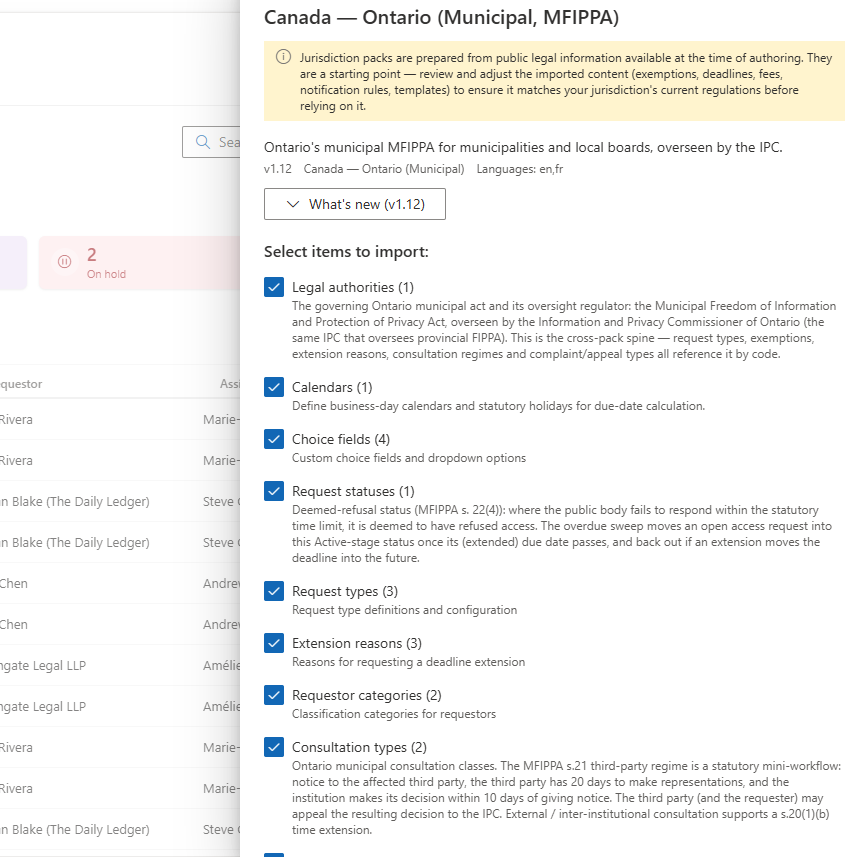
Installing the nz-lgoima jurisdiction pack seeds your tenant with everything this regime needs. It is a starting point built from public information about the legislation, not legal advice — your legal counsel validates and adjusts it for your tenant.
Pack content last reviewed: 2026-08-10
Related guide: FOI Workflow Quick Check- LGOIMA 1987 as the legal-authority spine
- The 20-working-day decision clock with New Zealand public holidays
- Extension handling with the mandatory in-window notice and new date
- The ss. 6, 7 and 17 withholding grounds with public interest balance recorded per item
- Charging under the Ombudsman's guidelines with the free allowance applied first
- Requester types covering ratepayers, media, and elected members
- Public-excluded meeting resolutions recorded against the same grounds vocabulary
- Ombudsman complaint and investigation tracking with outcomes
New Zealand — LGOIMA Questions
How does LGOIMA differ from the OIA?
How are extensions handled?
Can we track meeting obligations too?
Where does the information reside?
Go deeper
Flat annual pricing, published in full. Every feature in every size — access requests, privacy impact assessments, breach response, complaints, video & audio redaction, and AI Assist. No per-user or per-module fees.
- Under 500 employees$2,990/yr
- 500–2,000 employees$7,990/yr
- Over 2,000 employees$14,990/yr
Run LGOIMA in Your Own Tenant
Try AccessPoint free for 30 days, configured for New Zealand local government. No credit card required.