
New South Wales · GIPA, PPIP and HRIP Acts
Run GIPA's public interest test as a documented decision
For NSW agencies, councils, and universities — AccessPoint runs formal access applications on the 20-working-day clock with the public interest test recorded, plus PPIP and HRIP privacy and the Part 6A mandatory data breach scheme.
Australia — New South Wales at a glance
- Decision deadline
- 20 working days, extendable in the circumstances the GIPA Act allows
- Application fee
- $30 for a formal access application, with processing charges beyond the included hours
- Test
- The public interest test — a presumption of disclosure rebutted by overriding considerations against
- Privacy
- PPIP and HRIP, including the Part 6A mandatory data breach scheme
- Review
- Internal review, IPC review, or NCAT
- Languages
- English
Built for Australia — New South Wales
One platform for the whole access-and-privacy mandate, pre-configured for this regime and running in your own Microsoft 365 tenant.
The public interest test, recorded
GIPA does not offer exemptions to claim — it requires a balancing of considerations for and against disclosure, with the presumption favouring release. AccessPoint captures the considerations relied on against each piece of information, which is exactly what an IPC review examines.
20 working days, tracked
Computed on receipt over the NSW public-holiday calendar, with extensions for consultation or retrieval recorded with their ground and any agreed variation.
Informal release, not just formal applications
GIPA expects agencies to release information informally where they can. Log informal releases alongside formal applications, so the agency's disclosure record reflects everything it actually released.
The Part 6A breach scheme
NSW made data breach notification mandatory for public sector agencies. Assess an eligible data breach, notify the Privacy Commissioner and affected individuals, and maintain the public notification register the scheme requires.
PPIP and HRIP together
Run internal reviews of privacy conduct under the PPIP Act and health privacy under HRIP on the same platform as your GIPA work, with one audit ledger across both.
In your own tenant
Information, applications, and audit history stay inside your own Microsoft 365 and Azure tenant — no third-party cloud and no vendor access.
A test, not a list
GIPA gives you no exemptions to hide behind — only a balance you have to show your working on.
New South Wales deliberately built its access law without a conventional exemption schedule. Instead there is a presumption in favour of disclosure, a table of considerations that may weigh against it, and a requirement that the decision-maker actually weigh them for the particular information in question. That design makes NSW decisions unusually dependent on documentation: the IPC and NCAT are not asking whether an exemption was available, they are asking whether the balancing was genuinely performed and reasonably explained. Agencies that record only a conclusion — the label of a consideration, with nothing behind it — lose reviews they might have won. AccessPoint makes the considerations for and against, and the reasoning that resolved them, a recorded part of the decision.
Configured out of the box
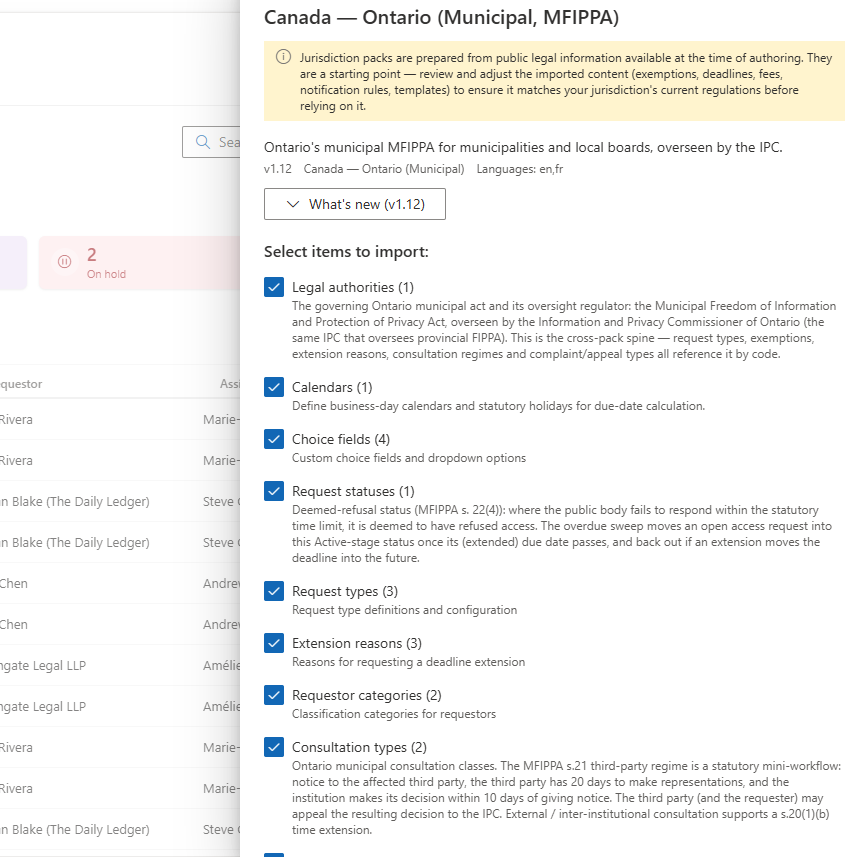
Installing the au-nsw jurisdiction pack seeds your tenant with everything this regime needs. It is a starting point built from public information about the legislation, not legal advice — your legal counsel validates and adjusts it for your tenant.
Pack content last reviewed: 2026-08-10
Related guide: FOI Workflow Quick Check- The GIPA Act as the legal-authority spine, with PPIP and HRIP alongside
- The 20-working-day decision clock with NSW public holidays and the Act's extensions
- A structured public interest test recording considerations for and against disclosure
- The $30 application fee and processing charges, with the included hours applied first
- Informal release logging alongside formal access applications
- Internal review, IPC review, and NCAT tracking with grounds and outcomes
- PPIP internal reviews and the Part 6A mandatory data breach scheme with its register
- HRIP health privacy handling on the same platform
Australia — New South Wales Questions
How is GIPA different from other Australian access laws?
Does the pack cover the Part 6A data breach scheme?
Can we track informal releases as well as formal applications?
Where does the information reside?
Go deeper
Flat annual pricing, published in full. Every feature in every size — access requests, privacy impact assessments, breach response, complaints, video & audio redaction, and AI Assist. No per-user or per-module fees.
- Under 500 employees$2,990/yr
- 500–2,000 employees$7,990/yr
- Over 2,000 employees$14,990/yr
Run the GIPA Act in Your Own Tenant
Try AccessPoint free for 30 days, configured for New South Wales. No credit card required.