
Netherlands · Open Government
The Wet open overheid, from request to proactive disclosure
AccessPoint runs Wet open overheid (Woo) requests — the four-week clock, the absolute and relative exceptions of articles 5.1 and 5.2, the active-disclosure duty, and bezwaar and beroep appeals to the Raad van State — pre-configured for the Netherlands and running inside your own Microsoft 365 tenant.
Netherlands at a glance
- Response standard
- As soon as possible, within four weeks; extendable by two weeks (art. 4.4)
- Active disclosure
- Seventeen categories must be published proactively (art. 3.1, 3.3) — not only on request
- Exemptions
- Absolute grounds (art. 5.1(1)) apply automatically; relative grounds (art. 5.1(2), 5.2) are weighed against the public interest
- Charges
- Handling a Woo request is free; at most the cost price of copies
- Oversight
- Adviescollege Openbaarheid en Informatiehuishouding (ACOI); appeals to the Council of State
- Languages
- Dutch, with English available
Built for Netherlands
One platform for the whole access-and-privacy mandate, pre-configured for this regime and running in your own Microsoft 365 tenant.
The Woo request lifecycle
Intake to disclosure under the Wet open overheid — the four-week clock, the two-week extension, the article 5.1 and 5.2 exceptions, and bezwaar handling — all built on Microsoft 365.
Active, proactive disclosure
The Woo requires seventeen categories of information to be published on the government's own initiative (art. 3.1, 3.3). AccessPoint manages the proactive-disclosure programme beside requests, so routine categories are published, not merely answered.
The four-week clock
Decide as soon as possible and within four weeks, extendable by two weeks for volume or complexity (art. 4.4). AccessPoint computes both and reminds you before either lapses.
Absolute and relative exceptions
Apply the article 5.1 and 5.2 exceptions — the absolute grounds that apply automatically and the relative grounds weighed against the public interest, plus personal policy opinions for internal deliberation — on a colour-coded, audit-trailed record.
Free handling, cost-price copies
Handling a Woo request is free of charge; at most the cost price of copies may be recovered. AccessPoint records any copy charge and itemises it for the requester.
In your own tenant
Every request and record stays inside your own Microsoft 365 and Azure tenant — no third-party cloud, no cross-border transfers, and no per-user fees.
Publish first, and know your two kinds of exception
The Woo doesn't just answer requests — it obliges the government to publish. And its exceptions come in two flavours: absolute and relative.
The Wet open overheid, in force since May 2022, went further than the Wob it replaced. It makes active disclosure a duty: seventeen categories of information must be published on the government's own initiative, not merely when someone asks (articles 3.1 and 3.3). And when information is withheld, the Woo separates absolute exceptions — which apply automatically, such as state security and confidential business data — from relative exceptions, which must be weighed against the public interest (articles 5.1 and 5.2). AccessPoint runs proactive publication and both exception tests on one platform.
Configured out of the box
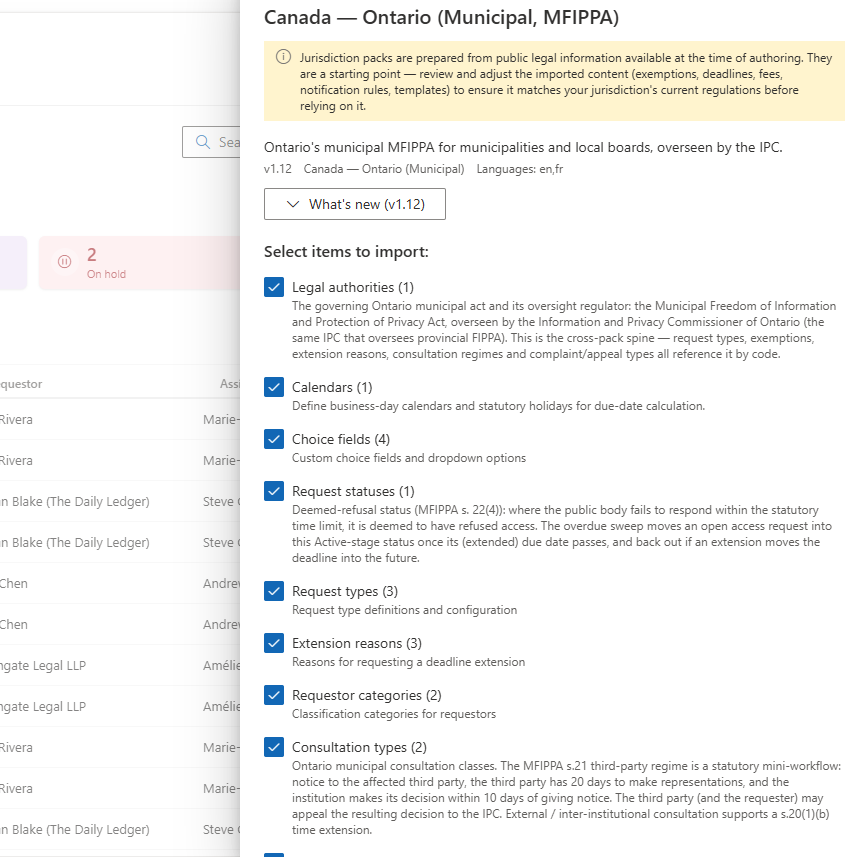
Installing the nl-woo jurisdiction pack seeds your tenant with everything this regime needs. It is a starting point built from public information about the legislation, not legal advice — your legal counsel validates and adjusts it for your tenant.
Pack content last reviewed: 2026-07-24
Related guide: FOI Workflow Quick Check- The Wet open overheid (Woo) as the legal-authority and citation spine, with the Wob mapped across
- The Dutch public-holiday calendar and the four-week clock with its two-week extension (art. 4.4)
- The active-disclosure programme — the seventeen categories published on the government's own initiative (art. 3.1, 3.3)
- The article 5.1 and 5.2 exceptions — absolute and relative — colour-coded for redaction
- Free request handling, with cost-price copy charges recorded and itemised
- The bezwaar, beroep, and Raad van State appeal workflow (Awb)
- ACOI complaint and advice tracking
- Woo correspondence templates in Dutch, with English available, and Dutch timeliness tracking
Netherlands Questions
How long does a Dutch authority have to decide a Woo request?
What makes the Woo distinctive?
What can be charged?
Where does data reside?
Go deeper
Flat annual pricing, published in full. Every feature in every size — access requests, privacy impact assessments, breach response, complaints, video & audio redaction, and AI Assist. No per-user or per-module fees.
- Under 500 employees$2,990/yr
- 500–2,000 employees$7,990/yr
- Over 2,000 employees$14,990/yr
Run the Wet open overheid in One Platform
Try AccessPoint free for 30 days, pre-configured for the Netherlands. No credit card required.