
Danmark · Offentlighedsloven
Seven working days, and an Ombudsman who publishes
For Danish ministries, regions, and kommuner — AccessPoint runs aktindsigt on the seven-working-day expectation, applies the §§ 19–35 exceptions, and tracks klager through the authority to the supervisory authority and the Folketingets Ombudsmand.
Denmark — Offentlighedsloven at a glance
- Handling time
- Seven working days as the expectation, with notice where more time is required
- Exceptions
- The §§ 19–35 catalogue, applied to specific documents and information
- Complaint
- To the authority, then the supervisory authority, then the Ombudsman
- Fees
- Access generally free; copying charges as the rules permit
- Oversight
- Folketingets Ombudsmand — published statements
- Languages
- English, Dansk
Built for Denmark — Offentlighedsloven
One platform for the whole access-and-privacy mandate, pre-configured for this regime and running in your own Microsoft 365 tenant.
The seven-working-day expectation
Denmark expects aktindsigt to be dealt with quickly, with the applicant told if it cannot be. AccessPoint computes the date over the Danish holiday calendar and prompts the notice where the expectation will not be met.
The §§ 19–35 exceptions
Each exception ships as a citable ground applied to the specific document or passage it covers, carried onto the redaction and into the decision — not claimed over a whole case file.
Klage tracked up the chain
Follow a complaint from the authority to the supervisory authority and on to the Ombudsman, each stage with its own filing date, correspondence, and outcome, linked to the request it began with.
Meroffentlighed considered
Danish practice expects an authority to consider giving access beyond what the Act strictly requires. Record that the question was asked and how it was answered, rather than leaving it implicit.
Danish throughout
AccessPoint's interface ships natively in Danish, and the pack carries Danish statutory wording, correspondence templates, and vocabulary.
In your own tenant
Documents and requests stay inside your own Microsoft 365 and Azure tenant, in the region you choose — no third-party cloud and no vendor access.
An Ombudsman with an audience
In Denmark, a poorly reasoned refusal doesn't just get overturned. It gets published.
The Folketingets Ombudsmand does not issue binding orders in the way an order-making commissioner does, and authorities occasionally take comfort in that. They should not. The Ombudsman's statements are published, they are read across the administration and by the press, and an authority criticised in one carries that criticism publicly. What draws criticism is rarely the substantive judgement about whether an exception applied; far more often it is process — a request handled slowly with no explanation to the applicant, an exception applied to a whole file rather than to specific information, or a decision whose reasons cannot be reconstructed afterwards. Those are exactly the failures a proper case record prevents, which is the practical argument for running aktindsigt on a system rather than in a mailbox.
Configured out of the box
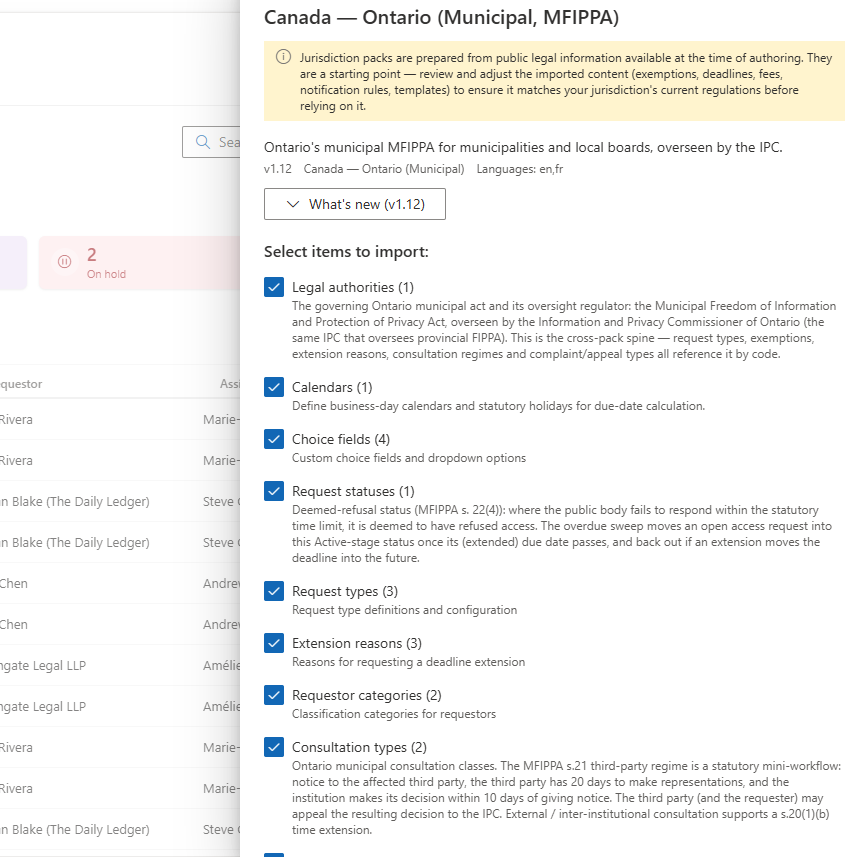
Installing the dk-offentlighed jurisdiction pack seeds your tenant with everything this regime needs. It is a starting point built from public information about the legislation, not legal advice — your legal counsel validates and adjusts it for your tenant.
Pack content last reviewed: 2026-08-10
Related guide: FOI Workflow Quick Check- Offentlighedsloven as the legal-authority spine
- The seven-working-day handling expectation with Denmark's public-holiday calendar
- Notice to the applicant where the handling time will be exceeded
- The §§ 19–35 exceptions, colour-coded for redaction and citable line by line
- Meroffentlighed consideration recorded on each partially refused request
- Klage tracking through the authority, the supervisory authority, and the Ombudsman
- Danish correspondence templates carrying the statutory wording
- A timestamped audit trail for every decision on the request
Denmark — Offentlighedsloven Questions
How quickly must a Danish authority deal with a request?
What is meroffentlighed and does the pack handle it?
Are Ombudsman statements binding?
Is the platform available in Danish?
Go deeper
Flat annual pricing, published in full. Every feature in every size — access requests, privacy impact assessments, breach response, complaints, video & audio redaction, and AI Assist. No per-user or per-module fees.
- Under 500 employees$2,990/yr
- 500–2,000 employees$7,990/yr
- Over 2,000 employees$14,990/yr
Run Offentlighedsloven in Your Own Tenant
Try AccessPoint free for 30 days, configured for Denmark. No credit card required.