
Missouri · Sunshine Law, Chapter 610
Run the Sunshine Law on its three-day clock
For Missouri state agencies, counties, cities, school districts, and other public governmental bodies — AccessPoint tracks the 3-business-day response, applies the § 610.021 closure grounds, and builds the record that answers a knowing-or-purposeful allegation.
Missouri — Sunshine Law at a glance
- Response deadline
- No later than the end of the third business day after receipt
- Extensions
- A detailed explanation and a date certain where more time is genuinely required
- Closure grounds
- The § 610.021 list, cited on each closed record
- Fees
- Search, research, and duplication at the statutory basis, itemized
- Enforcement
- Attorney General and the courts; civil penalties for knowing and purposeful violations
- Languages
- English
Built for Missouri — Sunshine Law
One platform for the whole access-and-privacy mandate, pre-configured for this regime and running in your own Microsoft 365 tenant.
The three-business-day clock
Missouri gives a custodian until the end of the third business day. AccessPoint computes that date on receipt over Missouri's holiday calendar and puts it on the coordinator's day view, where three days is short enough to matter.
The § 610.021 closure grounds
Each ground on which a record may be closed ships as a citable exemption, carried onto the redaction and into the response — because Chapter 610 permits closure rather than requiring it, and the ground relied on should be visible.
Built for the knowing-or-purposeful question
Missouri's penalties turn on the state of mind behind a violation. A timestamped record showing who decided what, when, and on which ground is the most direct answer to an allegation that a body acted knowingly or purposefully.
Itemized fees
Charge search, research, and duplication on the statutory basis with the calculation kept on the file, so a fee dispute has a documented answer.
Records from Microsoft 365
Collect responsive records straight from SharePoint, Teams, and Exchange with custodian attestations and a chain of custody.
In your own tenant
Requests, records, and audit history stay inside your own Microsoft 365 and Azure tenant — no third-party cloud and no vendor access.
Knowing, or purposeful
Missouri does not just ask whether you complied. It asks what you were thinking.
Most public records laws measure compliance by outcome — was the record released, was the deadline met. Chapter 610 goes further and grades the violation by intent: a knowing violation carries a civil penalty, and a purposeful violation carries a larger one. That makes contemporaneous documentation unusually valuable in Missouri, because intent is nearly always inferred from the record rather than proven directly. A body that can show a dated trail — the request logged on arrival, the search tasked, the closure ground identified and cited, the response sent on day three — is describing an ordinary process. A body reconstructing events from memory months later is describing something a court has to interpret. AccessPoint produces the first kind of record as a by-product of doing the work.
Configured out of the box
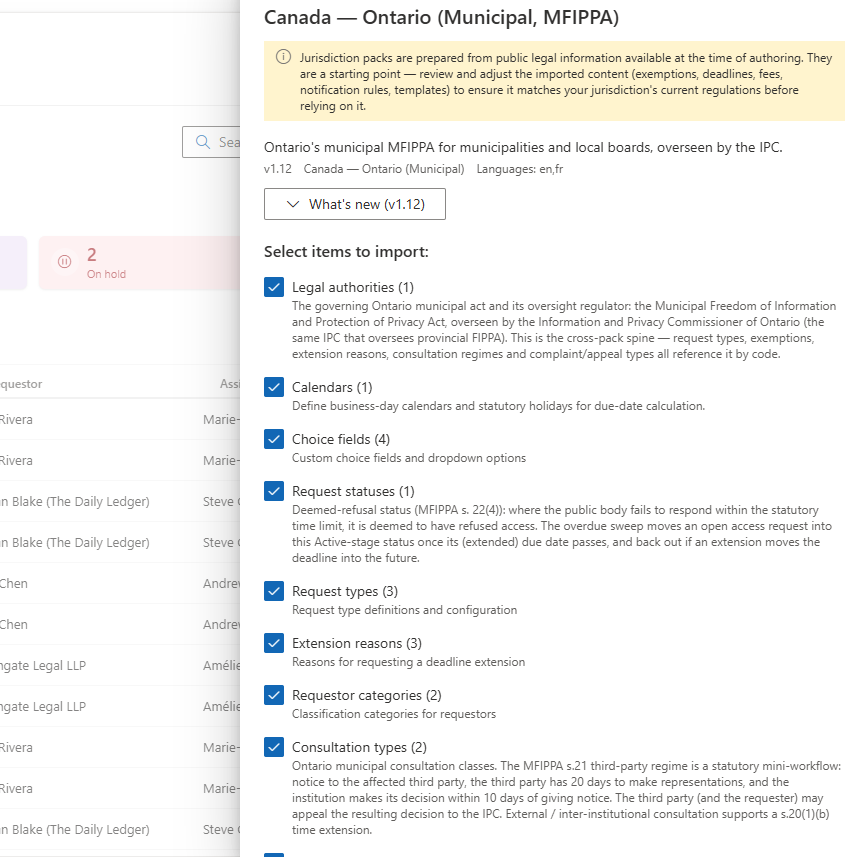
Installing the us-mo-sunshine jurisdiction pack seeds your tenant with everything this regime needs. It is a starting point built from public information about the legislation, not legal advice — your legal counsel validates and adjusts it for your tenant.
Pack content last reviewed: 2026-08-10
Related guide: FOI Workflow Quick Check- Missouri's Sunshine Law (Chapter 610) as the legal-authority spine
- The 3-business-day response clock with Missouri's statutory-holiday calendar
- The § 610.021 closure grounds, colour-coded for redaction and citable line by line
- Extension handling requiring a detailed explanation and a date certain
- Custodian-of-records assignment and duties on every request
- Search, research, and duplication fees with itemization
- Response and denial correspondence templates carrying the statutory wording
- A timestamped audit trail built for the knowing-and-purposeful standard
Missouri — Sunshine Law Questions
How fast must a Missouri public body respond?
Does the Sunshine Law require records to be closed?
How does the platform help with the penalty provisions?
Where do the records reside?
Go deeper
Flat annual pricing, published in full. Every feature in every size — access requests, privacy impact assessments, breach response, complaints, video & audio redaction, and AI Assist. No per-user or per-module fees.
- Under 500 employees$2,990/yr
- 500–2,000 employees$7,990/yr
- Over 2,000 employees$14,990/yr
Run the Missouri Sunshine Law in Your Own Tenant
Try AccessPoint free for 30 days, configured for Missouri. No credit card required.