
Mississippi · Public Records Act
The Mississippi Public Records Act, with its Ethics Commission path built in
AccessPoint manages Public Records Act requests under Miss. Code Ann. § 25-61-1 et seq. — the 7- or 14-working-day response standard, the §§ 25-61-9, 25-61-11, and 25-61-12 exemptions, and the Ethics-Commission-to-chancery-court enforcement path — pre-configured for Mississippi and running inside your own Microsoft 365 tenant.
Mississippi at a glance
- Response standard
- Production or written denial under the body's own adopted procedures — at most 7 working days, or 14 working days with a written explanation for the delay
- Enforcement
- Ethics Commission complaint (no filing deadline; mediation, compliance orders, penalties) then chancery court de novo review
- Exemptions
- The §§ 25-61-9, 25-61-11, and 25-61-12 exemptions; law-enforcement incident reports are always public
- Charges
- Fees limited to the actual cost of reproduction, search, and review, payable in advance
- Oversight
- Mississippi Ethics Commission, with de novo chancery court review on appeal
- Languages
- English
Built for Mississippi
One platform for the whole access-and-privacy mandate, pre-configured for this regime and running in your own Microsoft 365 tenant.
Public Records Act request lifecycle
Intake to release under the Mississippi Public Records Act of 1983 (Miss. Code Ann. § 25-61-1 et seq.) — the body's own adopted response procedure and the 7- or 14-working-day outer limits — all on Microsoft 365.
The § 25-61-9, -11, -12 exemptions
Track each exemption a public body relies on — investigative, personal, and personnel exemptions among them — while flagging that law-enforcement incident reports themselves remain public regardless.
The 7- or 14-working-day limit
Hold every response to the body's own adopted procedure, and to the statutory outer limit — 7 working days, or 14 with a written explanation for the delay — computed and reminded for you.
Redaction by exemption
Apply the §§ 25-61-9, 25-61-11, and 25-61-12 exemptions line by line on a colour-coded, audit-trailed redaction record, with incident-report fields flagged as always public.
Actual-cost charges
Charge only the actual cost of reproduction, search, and review, collected in advance — with the estimate documented and itemised.
In your own tenant
Every request and record stays inside your own Microsoft 365 and Azure tenant — no third-party cloud, no cross-border transfers, and no per-user fees.
Ethics Commission enforcement
In Mississippi, a denied requester complains to the Ethics Commission first — not the courthouse.
Most states route a denied public-records request straight to a judge. Mississippi routes it to the Ethics Commission instead. A requester can file a complaint at any time — there's no statutory filing deadline — and the Commission mediates, can order the public body to comply, and can impose a civil penalty of up to $100 per violation where the body acted in bad faith. Only after that does the matter move, de novo, to chancery court. AccessPoint tracks the complaint from filing through Commission order and any subsequent chancery court review.
Configured out of the box
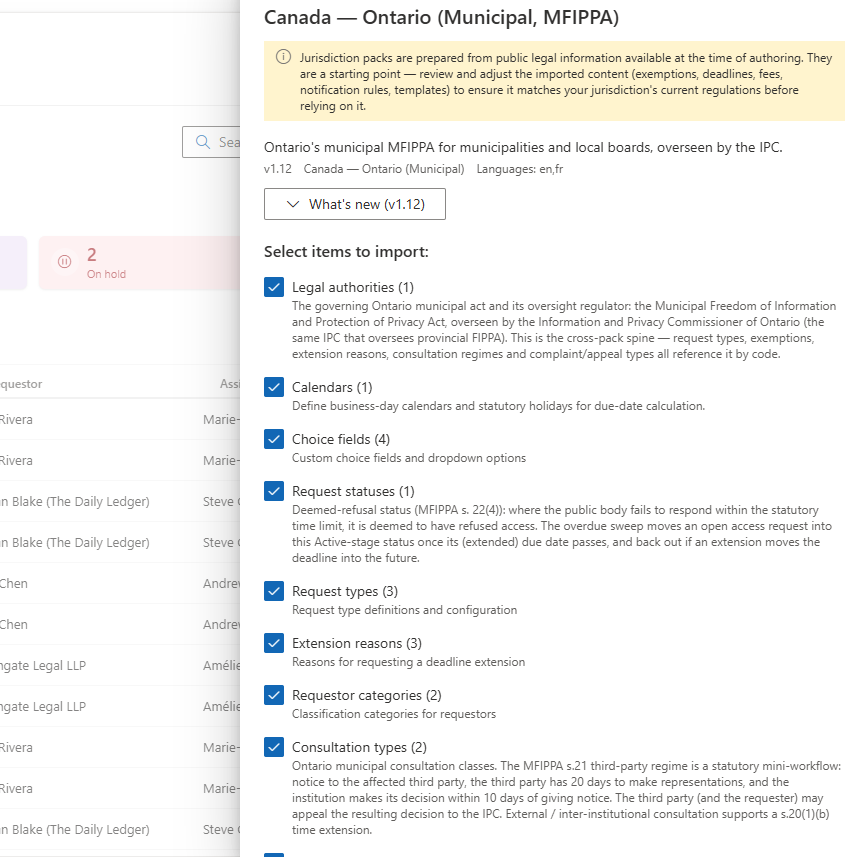
Installing the us-ms-pra jurisdiction pack seeds your tenant with everything this regime needs. It is a starting point built from public information about the legislation, not legal advice — your legal counsel validates and adjusts it for your tenant.
Pack content last reviewed: 2026-09-03
Related guide: FOI Workflow Quick Check- The Mississippi Public Records Act of 1983 (Miss. Code Ann. § 25-61-1 et seq.) as the legal-authority and citation spine
- The Mississippi state-holiday calendar and the 7- or 14-working-day response due-date rules
- The §§ 25-61-9, 25-61-11, and 25-61-12 exemptions mapped and colour-coded for redaction, with incident-report fields flagged as always public
- Actual-cost fee calculation for reproduction, search, and review, collected in advance
- The public body's own adopted response-procedure fields, tracked alongside the statutory outer limit
- The Ethics Commission complaint workflow — mediation, compliance orders, and per-violation penalty tracking
- The chancery court de novo review workflow for either party's appeal
- Public Records Act correspondence templates with statutory wording
Mississippi Questions
When must a Mississippi public body respond to a records request?
What makes Mississippi different — how a denial gets challenged?
What can a public body charge for records?
Where does data reside?
Go deeper
Flat annual pricing, published in full. Every feature in every size — access requests, privacy impact assessments, breach response, complaints, video & audio redaction, the public portal, repository connectors, and AI Assist. No per-user or per-module fees.
- Under 500 employees$2,990/yr
- 500–1,999 employees$7,990/yr
- 2,000–9,999 employees$14,990/yr
- 10,000+ employees$29,990/yr
Run the Mississippi Public Records Act in One Platform
Try AccessPoint free for 30 days, pre-configured for Mississippi. No credit card required.