
Minnesota · Government Data Practices Act
The Minnesota Data Practices Act — where you classify data, not hunt for exemptions
AccessPoint manages Government Data Practices Act requests under Minn. Stat. Ch. 13 — public data produced promptly, private data shown to its subject within ten days, and every data element classified rather than exempted — pre-configured for Minnesota and running inside your own Microsoft 365 tenant.
Minnesota at a glance
- Response standard
- Public data produced in an appropriate and prompt manner (§ 13.03, subd. 2); a data subject is shown data about themselves within 10 days (§ 13.04, subd. 3)
- Advisory opinions
- The Commissioner of Administration (IPAD) issues written opinions within 50 days — nonbinding but given deference in court (§ 13.072)
- Data classification
- Every element is public, private, confidential, nonpublic, or protected nonpublic (§ 13.02) — not an exemption list
- Charges
- 100 or fewer letter/legal pages: up to 25 cents per page; otherwise the actual cost of search, retrieval, and copying (§ 13.03, subd. 3)
- Oversight
- Commissioner of Administration (IPAD); enforcement in district court or the Office of Administrative Hearings
- Languages
- English
Built for Minnesota
One platform for the whole access-and-privacy mandate, pre-configured for this regime and running in your own Microsoft 365 tenant.
Data Practices request lifecycle
Intake to release under Chapter 13 — public data produced promptly, data-subject requests answered within ten days, and every response logged — all on Microsoft 365.
Classify, don't exempt
Minnesota has no exemption list. Every data element is classified — public, private, confidential, nonpublic, or protected nonpublic (§ 13.02) — and who may see it follows from that class. AccessPoint carries the classification on the data itself.
The ten-day data-subject clock
When an individual asks to see data about themselves, comply immediately if possible, or within ten days excluding weekends and holidays (§ 13.04, subd. 3) — computed and reminded for you.
Classification-driven redaction
Withhold and redact by data class, not by exemption — private and confidential elements masked on a colour-coded, audit-trailed record, each keyed to its statutory classification.
Chapter 13 charges
Charge up to 25 cents per page for 100 or fewer letter or legal pages, or the actual cost of searching, retrieving, and copying beyond that (§ 13.03, subd. 3) — with an estimate on request.
In your own tenant
Every request and record stays inside your own Microsoft 365 and Azure tenant — no third-party cloud, no cross-border transfers, and no per-user fees.
The data-classification model
Minnesota doesn't give you a list of exemptions — it makes you classify every data element.
Most public-records laws start from disclosure and carve out exemptions. Chapter 13 works the other way. All government data are public unless a statute, federal law, or temporary classification says otherwise — and every element carries a classification that decides who may see it. Data on individuals is public, private (the subject may see it), or confidential (even the subject may not). Data not on individuals is public, nonpublic, or protected nonpublic. Access follows the class, not a case-by-case exemption call. AccessPoint stores the classification with the data, so the right person sees the right element.
Configured out of the box
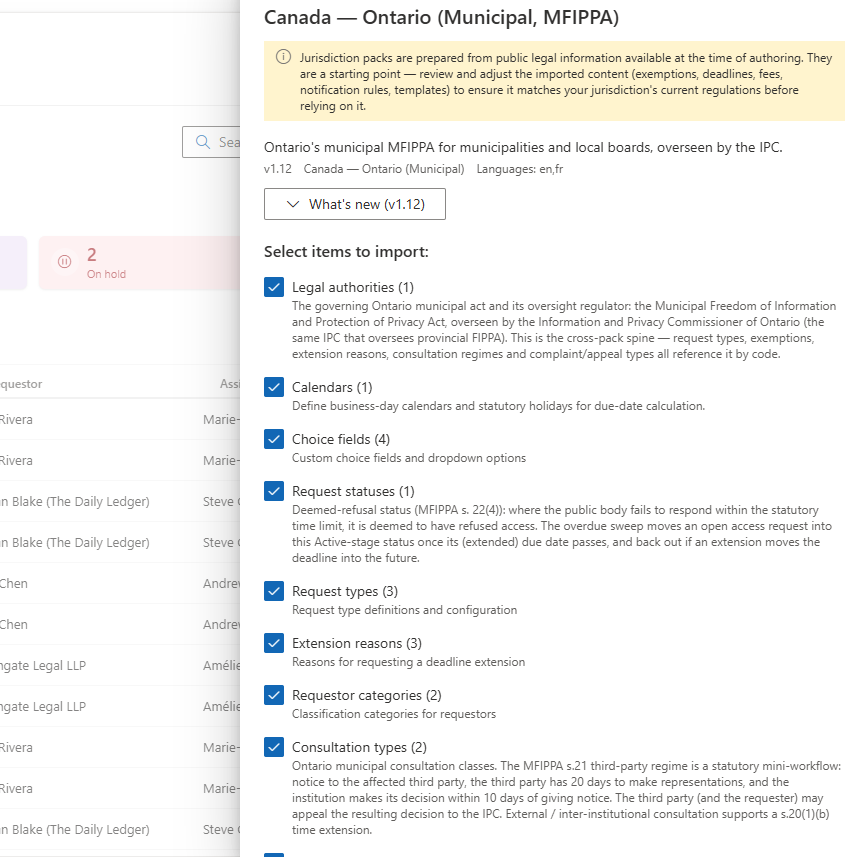
Installing the us-mn-gdpa jurisdiction pack seeds your tenant with everything this regime needs. It is a starting point built from public information about the legislation, not legal advice — your legal counsel validates and adjusts it for your tenant.
Pack content last reviewed: 2026-07-24
Related guide: FOI Workflow Quick Check- The Minnesota Government Data Practices Act (Minn. Stat. Ch. 13) as the legal-authority and citation spine
- The Minnesota state-holiday calendar and the prompt-access and ten-day data-subject due-date rules
- The § 13.02 data classifications — public, private, confidential, nonpublic, and protected nonpublic — applied to every data element and colour-coded
- Chapter 13 charges — up to 25 cents per page for 100 or fewer letter/legal pages, actual cost beyond that (§ 13.03, subd. 3)
- The IPAD advisory-opinion workflow — requesting and tracking the Commissioner's opinion under § 13.072
- The district-court and Office of Administrative Hearings enforcement paths (§§ 13.08, 13.085)
- Minnesota timeliness tracking for both public-data and data-subject requests
- Data Practices correspondence templates with statutory wording, including data-subject responses
Minnesota Questions
How fast must a Minnesota government entity respond?
What makes Minnesota different — the data-classification model?
What can a government entity charge?
Where does data reside?
Go deeper
Flat annual pricing, published in full. Every feature in every size — access requests, privacy impact assessments, breach response, complaints, video & audio redaction, and AI Assist. No per-user or per-module fees.
- Under 500 employees$2,990/yr
- 500–2,000 employees$7,990/yr
- Over 2,000 employees$14,990/yr
Run the Minnesota Data Practices Act in One Platform
Try AccessPoint free for 30 days, pre-configured for Minnesota. No credit card required.