
Connecticut · Freedom of Information Act
Connecticut FOIA, backed by a Commission that issues binding orders
AccessPoint manages Freedom of Information Act requests under C.G.S. § 1-200 et seq. — prompt production, the § 1-210(b) exemptions, and the Freedom of Information Commission's binding orders and civil penalties — pre-configured for Connecticut and running inside your own Microsoft 365 tenant.
Connecticut at a glance
- Response standard
- Promptly during regular business hours; a failure to respond within 4 business days is deemed a denial (§§ 1-210(a), 1-206(a))
- Appeal
- To the Freedom of Information Commission within 30 days of denial; a binding order after hearing (§ 1-206(b))
- Exemptions
- The twenty-five categories of § 1-210(b) — including privacy, law-enforcement, preliminary-draft, and trade-secret records
- Charges
- Copies up to 25 cents per page (state agencies) or 50 cents per page (other public agencies) (§ 1-212)
- Oversight
- Freedom of Information Commission — binding orders and civil penalties up to $5,000, enforceable in Superior Court
- Languages
- English
Built for Connecticut
One platform for the whole access-and-privacy mandate, pre-configured for this regime and running in your own Microsoft 365 tenant.
FOIA request lifecycle
Intake to release under the Freedom of Information Act (C.G.S. § 1-200 et seq.) — prompt production, written denials, and appeals — all on Microsoft 365.
The Freedom of Information Commission
A requester denied access appeals to the Commission within 30 days. After ombudsman mediation and a contested-case hearing, the Commission issues a binding order to produce — enforceable in Superior Court. AccessPoint tracks the 30-day window and assembles the appeal file.
The prompt-response clock
Produce records promptly during business hours; a denial must be in writing, and a failure to respond within four business days is deemed a denial (§ 1-206(a)) — computed and reminded for you.
Exemptions and redaction
Apply the twenty-five § 1-210(b) exemptions line by line on a colour-coded, audit-trailed redaction record — privacy, law-enforcement, preliminary-draft, and trade-secret categories each keyed to their subdivision.
Copy-fee charges
Charge copies at up to 25 cents per page for state agencies or 50 cents per page for other public agencies (§ 1-212) — with an itemized total on request.
In your own tenant
Every request and record stays inside your own Microsoft 365 and Azure tenant — no third-party cloud, no cross-border transfers, and no per-user fees.
The Freedom of Information Commission
In Connecticut, the Commission doesn't just advise — it orders disclosure and fines officials.
Many states leave a denied requester with only a lawsuit. Connecticut gives them the Freedom of Information Commission. Appeal within thirty days of a denial, and the Commission assigns an ombudsman to mediate; if that fails, it holds a contested-case hearing and issues a binding order to produce the records. When a denial was without reasonable grounds it may fine the official, and a pattern of obstruction or wilful misconduct raises the civil penalty to as much as five thousand dollars. Its orders are enforceable in Superior Court. AccessPoint tracks the thirty-day window and builds the appeal file.
Configured out of the box
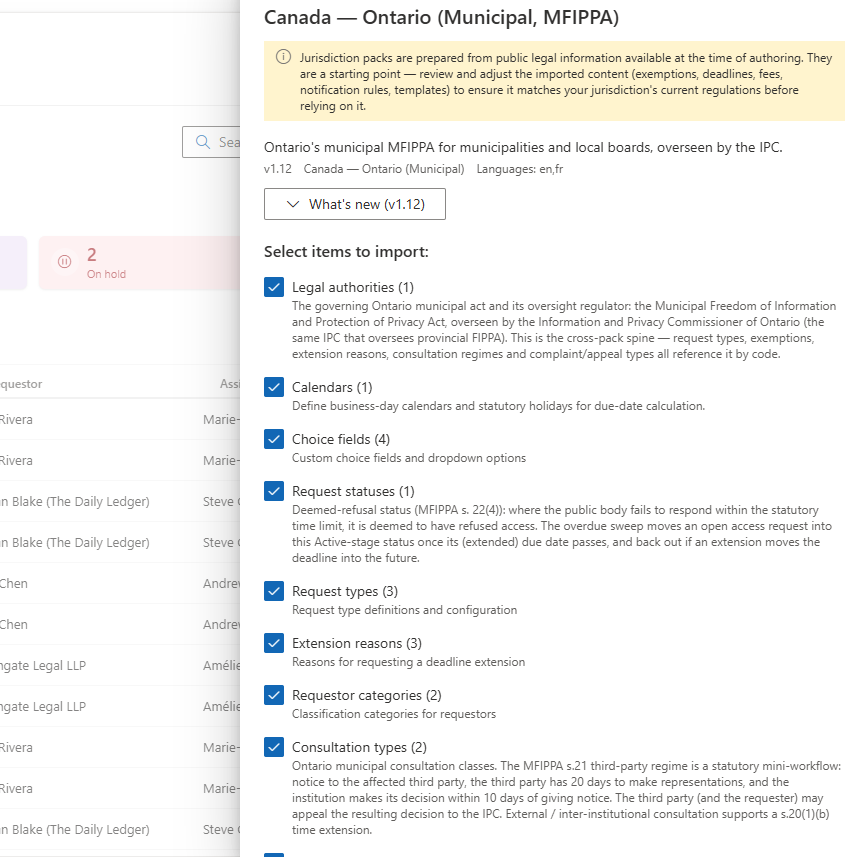
Installing the us-ct-foia jurisdiction pack seeds your tenant with everything this regime needs. It is a starting point built from public information about the legislation, not legal advice — your legal counsel validates and adjusts it for your tenant.
Pack content last reviewed: 2026-07-24
Related guide: FOI Workflow Quick Check- The Connecticut Freedom of Information Act (C.G.S. § 1-200 et seq.) as the legal-authority and citation spine
- The Connecticut state-holiday calendar and the prompt-response and four-business-day deemed-denial rules
- The twenty-five § 1-210(b) exemptions, colour-coded for redaction
- Section 1-212 copy-fee charges — 25 cents per page for state agencies, 50 cents for other public agencies
- The Freedom of Information Commission appeal workflow — the 30-day window, ombudsman mediation, and the hearing file (§ 1-206)
- Civil-penalty and binding-order tracking, including Superior Court enforcement
- Connecticut timeliness tracking and the prompt-production standard
- FOIA correspondence templates with statutory wording
Connecticut Questions
When must a Connecticut public agency respond?
What makes Connecticut different — the Freedom of Information Commission?
What can a public agency charge?
Where does data reside?
Go deeper
Flat annual pricing, published in full. Every feature in every size — access requests, privacy impact assessments, breach response, complaints, video & audio redaction, and AI Assist. No per-user or per-module fees.
- Under 500 employees$2,990/yr
- 500–2,000 employees$7,990/yr
- Over 2,000 employees$14,990/yr
Run the Connecticut Freedom of Information Act in One Platform
Try AccessPoint free for 30 days, pre-configured for Connecticut. No credit card required.