
Tasmania · RTI Act 2009 and PIP Act 2004
Tasmanian RTI, on the clock and through to the Ombudsman
For Tasmanian departments, councils, and public authorities — AccessPoint runs assessed disclosure applications on the 20-working-day clock, supports the routine and required disclosure categories, and covers PIP Act personal information protection.
Australia — Tasmania at a glance
- Decision deadline
- 20 working days, extendable where the Act allows
- Disclosure routes
- Required, routine, active, and assessed disclosure
- Application fee
- The statutory fee for assessed disclosure; personal information applications free
- Exemptions
- Part 3, most subject to a public interest test
- Review
- Internal review, then Ombudsman external review
- Languages
- English
Built for Australia — Tasmania
One platform for the whole access-and-privacy mandate, pre-configured for this regime and running in your own Microsoft 365 tenant.
20 working days
Computed on receipt over the Tasmanian public-holiday calendar, with extensions and any agreed variation recorded, and third-party consultation tracked within the period.
Four disclosure routes, not one
Tasmania's Act distinguishes required, routine, active, and assessed disclosure. Log releases under each so an application is only made where it is genuinely needed, and the authority's full disclosure record is visible.
The public interest test
Most Tasmanian exemptions apply only where disclosure would be contrary to the public interest. The assessment is recorded against the specific information, which is what an Ombudsman review examines.
Decisions that carry their reasons
Each exemption ships as a citable ground applied to specific passages, carried onto the redaction and into the notice of decision.
PIP Act personal information
Run personal information protection principles and privacy complaints on the same platform as RTI, with one audit ledger across both.
In your own tenant
Information, applications, and audit history stay inside your own Microsoft 365 and Azure tenant — no third-party cloud and no vendor access.
The application you shouldn't have needed
Tasmania built four ways to release information. Most authorities only use the slowest one.
The RTI Act sets out required disclosure, routine disclosure, active disclosure, and assessed disclosure — and puts assessed disclosure last on purpose. The intent is that information reaches the public through the faster routes wherever possible, with a formal application reserved for what genuinely needs assessment. In practice, authorities without a system default everything into the formal route, because it is the only one anybody tracks. The result is a slower service, a larger backlog, and statistics that make the authority look less open than it is. AccessPoint logs releases under every route, so routine and active disclosure are visible work rather than invisible goodwill — and the formal queue holds only what belongs there.
Configured out of the box
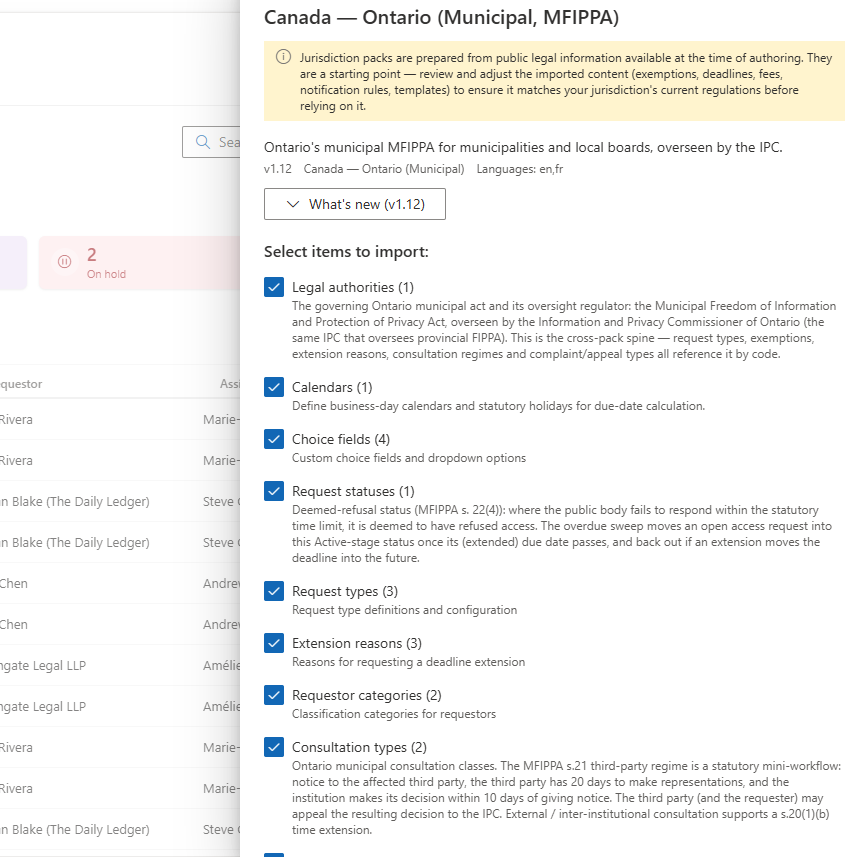
Installing the au-tas jurisdiction pack seeds your tenant with everything this regime needs. It is a starting point built from public information about the legislation, not legal advice — your legal counsel validates and adjusts it for your tenant.
Pack content last reviewed: 2026-08-10
Related guide: FOI Workflow Quick Check- The Tasmanian RTI Act 2009 as the legal-authority spine, with the PIP Act 2004 alongside
- The 20-working-day decision clock with Tasmanian public holidays and the Act's extensions
- Required, routine, active, and assessed disclosure as distinct, logged routes
- The Part 3 exemptions with public interest assessment recorded per item
- Third-party consultation as a tracked stage within the period
- Application fees and charges on the statutory basis, with personal applications free
- Internal review and Ombudsman external review tracking with grounds and outcomes
- PIP Act personal information protection principles and complaint handling
Australia — Tasmania Questions
What is the Tasmanian RTI deadline?
What are the four disclosure routes?
Who reviews an RTI decision?
Where does the information reside?
Go deeper
Flat annual pricing, published in full. Every feature in every size — access requests, privacy impact assessments, breach response, complaints, video & audio redaction, and AI Assist. No per-user or per-module fees.
- Under 500 employees$2,990/yr
- 500–2,000 employees$7,990/yr
- Over 2,000 employees$14,990/yr
Run Tasmanian RTI in Your Own Tenant
Try AccessPoint free for 30 days, configured for Tasmania. No credit card required.