
Queensland · RTI Act 2009 and IP Act 2009
Queensland's push model, run the way the Act intends
For Queensland departments, councils, universities, and hospital and health services — AccessPoint runs RTI applications on the 25-business-day clock, IP Act privacy under the QPPs, and the Chapter 3A mandatory data breach scheme.
Australia — Queensland at a glance
- Decision deadline
- 25 business days, extendable where the Act allows
- Model
- Push model — administrative access first, formal application as a last resort
- Application fee
- The statutory RTI application fee; personal-information applications under the IP Act are free
- Breach scheme
- Chapter 3A, reaching local government from 1 July 2026
- Review
- Internal review, OIC external review, then QCAT
- Languages
- English
Built for Australia — Queensland
One platform for the whole access-and-privacy mandate, pre-configured for this regime and running in your own Microsoft 365 tenant.
25 business days
Computed on receipt over the Queensland public-holiday calendar, with processing-period extensions and any agreed variation recorded on the file.
The push model, supported properly
Queensland intends most information to be released administratively, with a formal RTI application as the last resort. Log administrative releases alongside formal applications so the agency's real disclosure record is visible.
Chapter 3A data breaches
Run the mandatory notification scheme — the eligible-breach assessment, notification to the Information Commissioner and affected individuals, and the register — with local government coming into scope on 1 July 2026.
Two access paths, correctly separated
An application for your own personal information runs under the IP Act; everything else runs under the RTI Act. The pack keeps the fee, the scope, and the vocabulary right for each rather than treating them as one queue.
External review to the OIC
Track internal review, OIC external review, and QCAT appeals with their filing windows, correspondence, and outcomes linked to the originating application.
In your own tenant
Documents, applications, and audit history stay inside your own Microsoft 365 and Azure tenant — no third-party cloud and no vendor access.
1 July 2026
Queensland councils are about to acquire a breach-notification duty they have never had.
Chapter 3A of the IP Act brought mandatory data breach notification to Queensland state agencies, and it extends to local government from 1 July 2026. For a council that has run privacy as an occasional policy question, that is a genuine operational change: an eligible data breach must be assessed against a defined threshold within a defined period, the Information Commissioner and affected individuals must be notified, and a register must be maintained and, in part, published. None of that survives being handled by email. The work is not large in volume, but it is time-bound and evidentiary — exactly the shape that goes wrong without a system. Councils putting RTI on a platform this year should bring the breach scheme onto the same one, because the deadline is fixed and it is close.
Configured out of the box
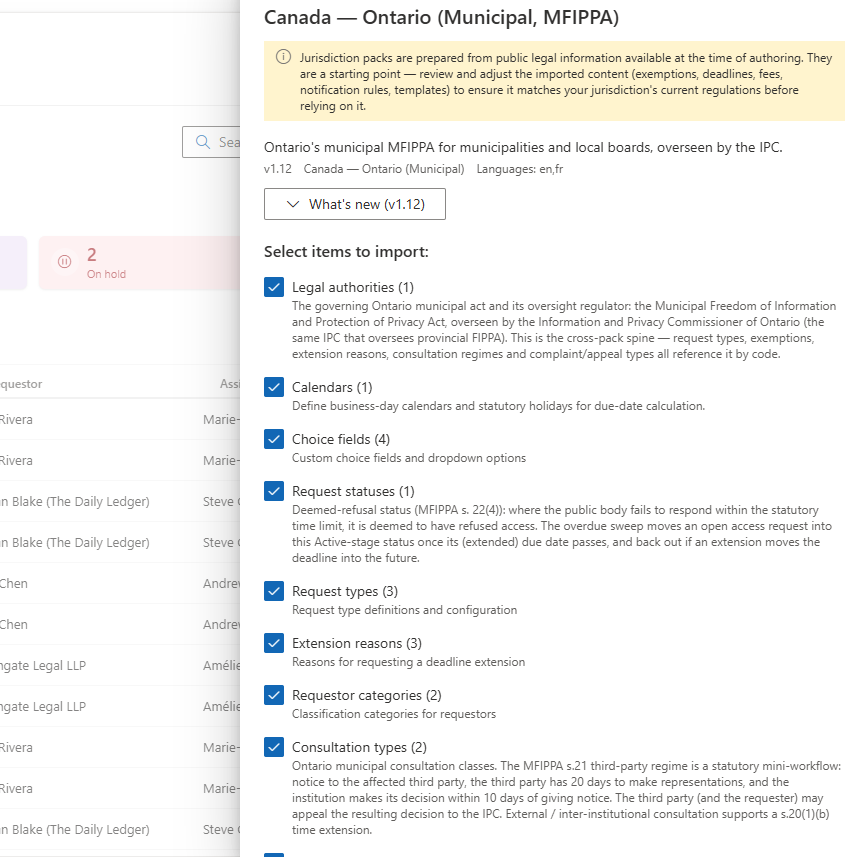
Installing the au-qld jurisdiction pack seeds your tenant with everything this regime needs. It is a starting point built from public information about the legislation, not legal advice — your legal counsel validates and adjusts it for your tenant.
Pack content last reviewed: 2026-08-10
Related guide: FOI Workflow Quick Check- The RTI Act 2009 and IP Act 2009 as the legal-authority spine
- The 25-business-day processing period with Queensland public holidays and the Act's extensions
- Separate RTI and IP Act access paths with the correct fees, scope, and vocabulary for each
- Administrative-access logging to support the push model
- The RTI Act exemptions and public interest factors, colour-coded for redaction
- Internal review, OIC external review, and QCAT tracking
- The Chapter 3A mandatory data breach scheme with assessment, notification, and register
- The Queensland Privacy Principles and privacy complaint handling
Australia — Queensland Questions
What is the Queensland RTI deadline?
When does the data breach scheme apply to councils?
How do RTI and IP Act applications differ?
Where do documents reside?
Go deeper
Flat annual pricing, published in full. Every feature in every size — access requests, privacy impact assessments, breach response, complaints, video & audio redaction, and AI Assist. No per-user or per-module fees.
- Under 500 employees$2,990/yr
- 500–2,000 employees$7,990/yr
- Over 2,000 employees$14,990/yr
Run Queensland RTI in Your Own Tenant
Try AccessPoint free for 30 days, configured for Queensland. No credit card required.