
United States · Privacy Act of 1974
The Privacy Act of 1974: the right to see, and correct, your own federal record
AccessPoint runs first-party access and amendment under the Privacy Act of 1974 (5 U.S.C. § 552a) — acknowledgment within 10 working days, review of a refusal, and the statement of disagreement that travels with the record — pre-configured for federal systems of records and running inside your own Microsoft 365 tenant.
United States — Privacy Act at a glance
- Access & amendment
- Access records about yourself and request amendment (5 U.S.C. § 552a(d)(1)-(2))
- Amendment acknowledgment
- Acknowledged in writing within 10 working days; review of a refusal within 30 working days (§ 552a(d)(2)-(3))
- If amendment is refused
- File a statement of disagreement, noted on the record and disclosed with it (§ 552a(d)(3)-(4))
- Exemptions
- General exemptions (§ 552a(j)) and specific exemptions (§ 552a(k))
- Charges
- Copying costs only — no fee to search for or review the record (§ 552a(f)(5))
- Oversight & remedies
- DOJ Office of Privacy and Civil Liberties (OPCL) guidance; civil action in US district court (§ 552a(g))
- Languages
- English
Built for United States — Privacy Act
One platform for the whole access-and-privacy mandate, pre-configured for this regime and running in your own Microsoft 365 tenant.
First-party access and amendment
Run an individual's request to see and correct records about themselves in a federal system of records (§ 552a(d)) — the access, the amendment request, and the agency's decision — all on Microsoft 365.
Statement of disagreement
When an agency refuses to amend, run the § 552a(d)(3) review and capture the individual's concise statement of disagreement, which § 552a(d)(4) requires be noted on the record and sent to prior and future recipients.
The working-day clock
Acknowledge an amendment request within 10 working days and complete a review of a refusal within 30 working days (§ 552a(d)(2)-(3)) — computed and reminded for you.
(j) and (k) exemptions
Apply the general exemptions of § 552a(j) — CIA and criminal law-enforcement systems — and the specific exemptions of § 552a(k) line by line, on a colour-coded, audit-trailed redaction record.
FOIA / Privacy Act dual processing
Because § 552a(t) bars using a FOIA exemption to deny Privacy Act access — and the reverse — AccessPoint processes a first-party request under both statutes and records which one grants each release, for the broadest access.
In your own tenant
Every request and record stays inside your own Microsoft 365 and Azure tenant — no third-party cloud, no vendor access, and no cross-border transfers.
Access, amendment, and the statement of disagreement
The Privacy Act doesn't just let people see their federal records — it lets them correct them, and be heard when you say no.
The Privacy Act gives an individual the right to access records about themselves in a federal system of records and to request that records that are inaccurate, irrelevant, untimely, or incomplete be amended. The agency must acknowledge the request within ten working days and, if it refuses, review that refusal. If it still refuses, the individual may file a concise statement of disagreement — and § 552a(d)(4) requires the agency to note the disputed portion and disclose that statement to anyone who receives the record thereafter. AccessPoint runs that full chain and records every step.
Configured out of the box
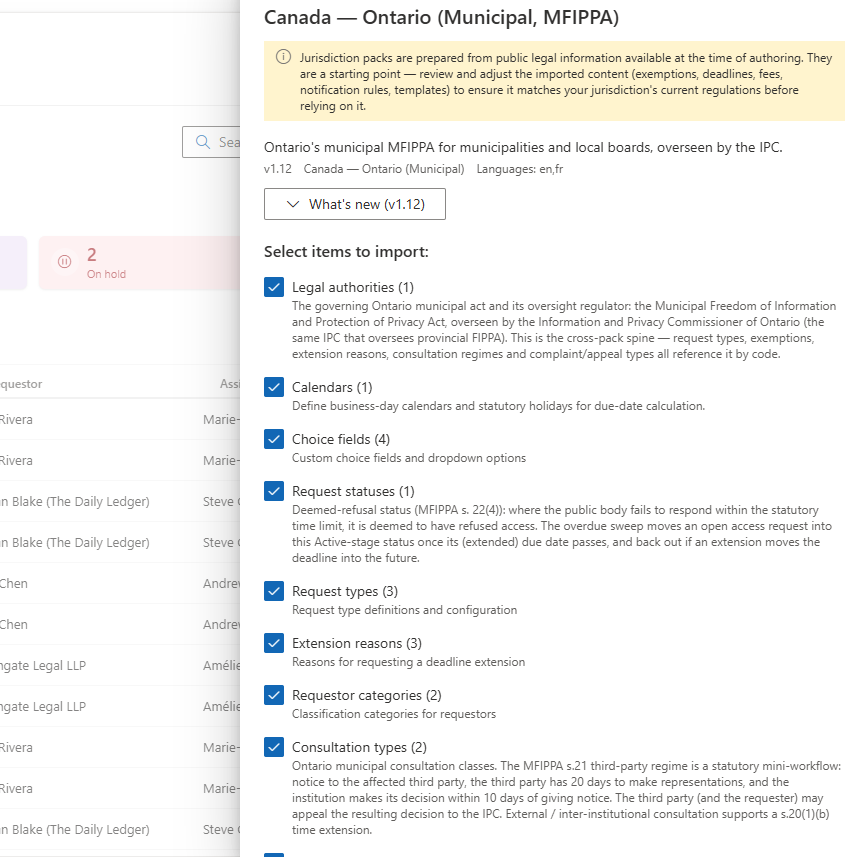
Installing the us-privacy-act jurisdiction pack seeds your tenant with everything this regime needs. It is a starting point built from public information about the legislation, not legal advice — your legal counsel validates and adjusts it for your tenant.
Pack content last reviewed: 2026-07-24
Related guide: FOI Workflow Quick Check- The Privacy Act of 1974 (5 U.S.C. § 552a) as the legal-authority and citation spine
- The federal-holiday calendar and the working-day clocks — 10 working days to acknowledge an amendment request, 30 to review a refusal
- The access, amendment, review, and statement-of-disagreement workflow of § 552a(d), with the disputed-record notation and downstream-recipient notices
- The general (§ 552a(j)) and specific (§ 552a(k)) exemptions, colour-coded for redaction
- FOIA / Privacy Act dual-processing under § 552a(t), recording which statute grants each release
- System-of-records handling — routing a first-party request to records retrieved by the individual's name or identifier (§ 552a(a)(5))
- Privacy Act correspondence templates — acknowledgment, amendment decision, review, and statement-of-disagreement letters
- Timeliness tracking and an audit trail built for a § 552a(g) civil action or an OPCL review
United States — Privacy Act Questions
How quickly must a federal agency act on a Privacy Act amendment request?
What makes the Privacy Act different — the statement of disagreement?
What can an agency charge?
Where does data reside?
Go deeper
Flat annual pricing, published in full. Every feature in every size — access requests, privacy impact assessments, breach response, complaints, video & audio redaction, and AI Assist. No per-user or per-module fees.
- Under 500 employees$2,990/yr
- 500–2,000 employees$7,990/yr
- Over 2,000 employees$14,990/yr
Run the Privacy Act of 1974 in One Platform
Try AccessPoint free for 30 days, pre-configured for the United States Privacy Act. No credit card required.