
United Kingdom · Data Protection Act 2018, Part 3
Run law-enforcement processing on the regime that actually governs it
For police forces, prosecutors, and other competent authorities — AccessPoint runs s.45 subject access on the strict one-month clock, the case-by-case s.45(4) restrictions and neither-confirm-nor-deny, sensitive-processing policy documents, s.62 logging, and 72-hour breach notification.
United Kingdom — DPA 2018 Part 3 at a glance
- Access deadline
- One month under s. 54, with the s. 54(3A) two-month extension for complex or numerous requests and the s. 54(3C) clarification stop (both in force since 5 February 2026)
- Restrictions
- s.45(4) applied case by case, with the reason recorded and the data subject informed unless that would prejudice the purpose
- NCND
- Neither confirm nor deny, where confirming would itself prejudice a law-enforcement purpose
- Sensitive processing
- An appropriate policy document in place and reviewed
- Breach
- 72 hours to the ICO where the duty is engaged
- Languages
- English
Built for United Kingdom — DPA 2018 Part 3
One platform for the whole access-and-privacy mandate, pre-configured for this regime and running in your own Microsoft 365 tenant.
s.45 subject access
Run the Part 3 right of access on the one-month clock — a tighter regime than UK GDPR, with far less room to extend — and produce a response that identifies what was restricted and on what basis.
Case-by-case s.45(4) restrictions
Part 3 restrictions are not exemptions to be claimed wholesale. Each one is applied to a specific piece of information for a stated reason, recorded on the file — which is precisely what an ICO complaint asks to see.
Neither confirm nor deny
Where confirming that information exists would itself prejudice a law-enforcement purpose, record the NCND decision, its authoriser, and its rationale, and issue a response consistent with it.
s.62 logging
Part 3 requires logs of consultation and disclosure in automated systems. AccessPoint's hash-chained audit ledger records who accessed what and when, in a form that can be produced rather than asserted.
Appropriate policy documents
Keep the sensitive-processing policy document current, versioned, and linked to the processing it authorises, with review dates that surface before they lapse.
In your own tenant
Law-enforcement data stays inside your own Microsoft 365 and Azure tenant — a material consideration when the data concerns live operations.
Part 3 is not UK GDPR
Running law-enforcement subject access on a UK GDPR workflow is the most common way to get it wrong.
Competent authorities frequently process under both regimes, and the temptation is to run one process for both. Part 3 does not permit that. Its clock runs from s. 54, and since 5 February 2026 it carries the s. 54(3A) two-month extension and the s. 54(3C) clarification stop. Its restrictions under s.45(4) must be applied to specific information for stated reasons rather than claimed as categories, and the data subject must generally be told that a restriction was applied — unless saying so would itself cause the prejudice. It carries a logging duty under s.62 that UK GDPR does not, and an appropriate policy document requirement for sensitive processing. AccessPoint ships Part 3 as its own pack with its own clock, vocabulary, and restriction model, so a force running both regimes runs each correctly instead of averaging them.
Configured out of the box
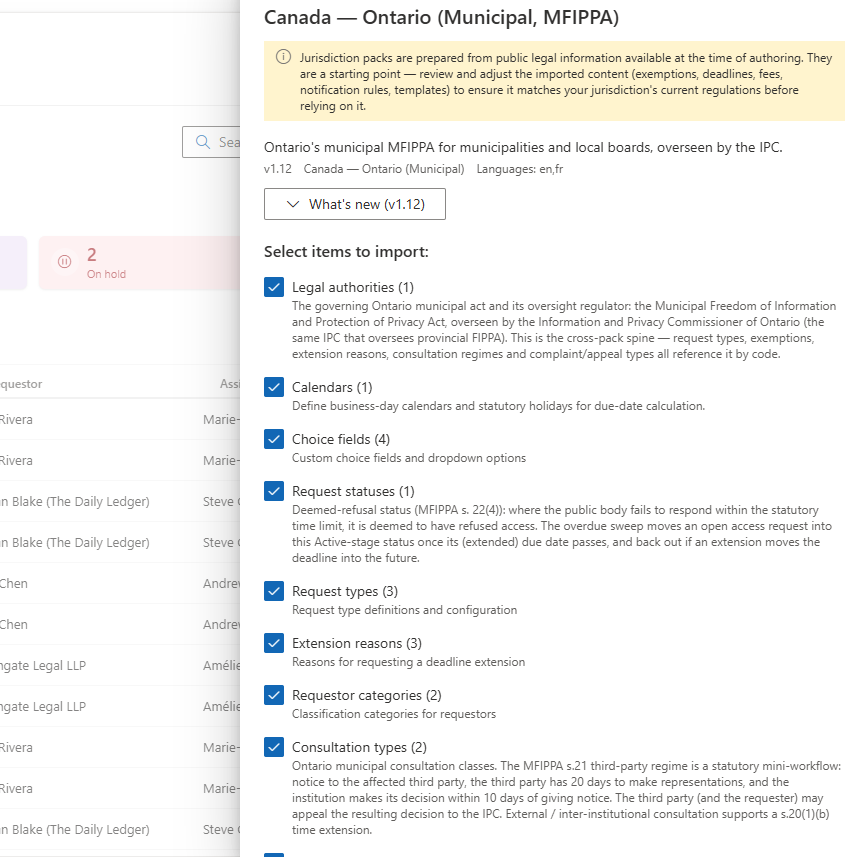
Installing the uk-dpa-le jurisdiction pack seeds your tenant with everything this regime needs. It is a starting point built from public information about the legislation, not legal advice — your legal counsel validates and adjusts it for your tenant.
Pack content last reviewed: 2026-09-07
Related guide: FOI Workflow Quick Check- DPA 2018 Part 3 as the legal-authority spine, distinct from the UK GDPR pack
- The s. 45 one-month access clock with the s. 54(3A) extension and s. 54(3C) clarification stop
- The s.45(4) restrictions modelled per item, with reasons recorded and notification handling
- Neither-confirm-nor-deny decisions with authoriser and rationale
- Appropriate policy document management for sensitive processing, versioned and review-dated
- s.62 logging of consultation and disclosure via the hash-chained audit ledger
- 72-hour ICO breach notification and data-subject communication workflows
- Response templates carrying Part 3 wording rather than UK GDPR wording
United Kingdom — DPA 2018 Part 3 Questions
Who processes under Part 3 rather than UK GDPR?
How are s.45(4) restrictions different from FOIA exemptions?
Does AccessPoint satisfy the s.62 logging duty?
Where does law-enforcement data reside?
Go deeper
Flat annual pricing, published in full. Every feature in every size — access requests, privacy impact assessments, breach response, complaints, video & audio redaction, and AI Assist. No per-user or per-module fees.
- Under 500 employees$2,990/yr
- 500–2,000 employees$7,990/yr
- Over 2,000 employees$14,990/yr
Run DPA 2018 Part 3 in Your Own Tenant
Try AccessPoint free for 30 days, configured for law-enforcement processing. No credit card required.