
United Kingdom · Access to Health Records Act 1990
The one health-records regime UK GDPR does not cover
Data protection rights end at death. For NHS trusts, health boards, GP practices, and independent providers, the Access to Health Records Act 1990 governs applications for a deceased patient's records — on its own clocks, with its own limits.
United Kingdom — Access to Health Records Act 1990 at a glance
- Who may apply
- The patient's personal representative, and any person with a claim arising from the death
- Deadline
- 21 days where the record was added to in the last 40 days; otherwise 40 days
- Scope for claimants
- Only information relevant to the claim
- Limits
- s.5 — serious harm, third-party identification, the patient's recorded objection
- Fees
- No fee for access itself; charges limited to what the Act permits
- Languages
- English
Built for United Kingdom — Access to Health Records Act 1990
One platform for the whole access-and-privacy mandate, pre-configured for this regime and running in your own Microsoft 365 tenant.
Applicant standing, checked first
The Act grants access to a personal representative and to a person with a claim arising from the death — and to nobody else. Capture and verify standing at intake, because the whole scope of the response depends on which of the two the applicant is.
The 21 and 40-day clocks
Which deadline applies depends on whether the record was added to in the preceding 40 days. AccessPoint asks the question at intake and sets the right clock, rather than defaulting everyone to 40 days.
Claim-relevance scoping
A claimant is entitled only to information relevant to their claim. Scope the release to that, and record what was excluded as irrelevant and why — a distinction generic SAR tooling does not make.
The s.5 limits
Serious harm, third-party identification, and the patient's own recorded objection each ship as a citable ground applied to specific passages, not to whole records.
Clinical review as a step
Serious-harm decisions need a clinician. Route the record for clinical review as a tracked stage with its own reviewer and recorded opinion, rather than an email to a consultant.
In your own tenant
Patient records stay inside your own Microsoft 365 and Azure tenant — no third-party cloud and no vendor access.
The request that falls between regimes
A bereaved family's request is the one your SAR process cannot handle.
UK GDPR gives living people rights over their own data, and those rights do not survive them. What replaces them is the Access to Health Records Act 1990 — a much older statute with a different applicant test, different clocks, a different scope, and a different set of limits. Requests under it arrive in the same inbox as subject access requests and look superficially similar, which is exactly why they go wrong: logged as a SAR, put on a one-month clock that does not apply, answered in full to someone entitled only to claim-relevant information, or refused by someone with no standing to decide. AccessPoint ships the 1990 Act as its own request type, so the regime is chosen at intake and everything downstream follows from it.
Configured out of the box
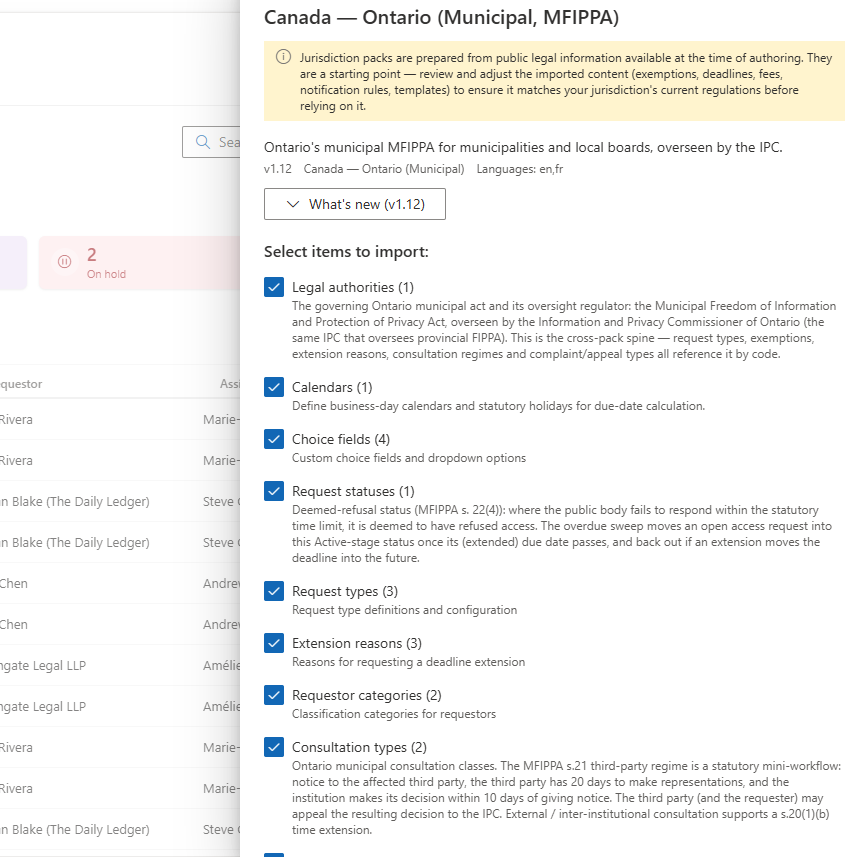
Installing the uk-health-records jurisdiction pack seeds your tenant with everything this regime needs. It is a starting point built from public information about the legislation, not legal advice — your legal counsel validates and adjusts it for your tenant.
Pack content last reviewed: 2026-08-10
Related guide: FOI Workflow Quick Check- The Access to Health Records Act 1990 as the legal-authority spine
- Applicant-standing capture for personal representatives and claim holders, with verification
- The 21-day and 40-day clocks selected from when the record was last added to
- Claim-relevance scoping for claimant applications, with exclusions recorded
- The s.5 limits — serious harm, third-party identification, and the patient's recorded objection — as citable grounds
- Clinical review as a tracked stage with reviewer and recorded opinion
- Complaints tracking through the provider's procedure and beyond
- Response templates carrying the Act's wording rather than UK GDPR wording
United Kingdom — Access to Health Records Act 1990 Questions
Why isn't this just a subject access request?
Which deadline applies, 21 days or 40?
How is a claimant's access limited?
Where do patient records reside?
Go deeper
Flat annual pricing, published in full. Every feature in every size — access requests, privacy impact assessments, breach response, complaints, video & audio redaction, and AI Assist. No per-user or per-module fees.
- Under 500 employees$2,990/yr
- 500–2,000 employees$7,990/yr
- Over 2,000 employees$14,990/yr
Run the Access to Health Records Act in Your Own Tenant
Try AccessPoint free for 30 days, configured for deceased patients' records. No credit card required.