
European Union · Regulation (EU) 2018/1725
The GDPR that applies to the institutions themselves
For EU institutions, bodies, offices, and agencies — AccessPoint runs the Articles 17–20 data subject rights on the one-month clock, Article 25 restrictions grounded in internal rules, 72-hour EDPS breach notification, and Article 39 data protection impact assessments.
European Union — Institutions (2018/1725) at a glance
- Rights deadline
- One month, extendable by two further months where justified by complexity or volume
- Restrictions
- Art. 25 — available only where internal rules provide for them
- Breach
- 72 hours to the EDPS; communication to data subjects where the risk is high
- DPIA
- Art. 39, before processing likely to result in a high risk
- Oversight
- European Data Protection Supervisor
- Languages
- English, French
Built for European Union — Institutions (2018/1725)
One platform for the whole access-and-privacy mandate, pre-configured for this regime and running in your own Microsoft 365 tenant.
Articles 17–20 rights
Access, rectification, erasure, and restriction run on the one-month clock with the two-month extension where complexity or volume justifies it, and the justification recorded rather than assumed.
Article 25 restrictions
An institution may restrict rights only where it has adopted internal rules providing for it. AccessPoint links each restriction to the internal rule relied on, so a restriction is traceable to its legal basis instead of asserted.
72-hour EDPS notification
Log a personal data breach, assess the risk, and work the notification to the EDPS and, where the risk is high, communication to the data subjects — on a live checklist against the clock.
Article 39 DPIAs
Run data protection impact assessments as full cases before high-risk processing begins, with risks, mitigations, DPO involvement, and a dated sign-off.
The DPO in the workflow
The Regulation gives the data protection officer a defined role. Route assessments, restrictions, and breach decisions through the DPO as a tracked step with a recorded opinion.
In your own tenant
Personal data stays inside the institution's own Microsoft 365 and Azure tenant, under its own controls — no third-party cloud and no vendor access.
Two regimes, one institution
An EU body owes documents under 1049/2001 and personal data under 2018/1725 — often on the same file.
The two obligations arrive together far more often than either regime's guidance suggests. A request for documents under Regulation 1049/2001 turns up personal data that must be assessed before release; a subject access request under 2018/1725 turns up documents whose disclosure is governed by the access regime. Institutions running the two in separate systems end up making inconsistent decisions about the same material, and discovering it when a complaint reaches the Ombudsman or the EDPS. AccessPoint runs both packs in one tenant on one audit ledger, so the same document assessed twice is assessed consistently — and the record shows it was.
Configured out of the box
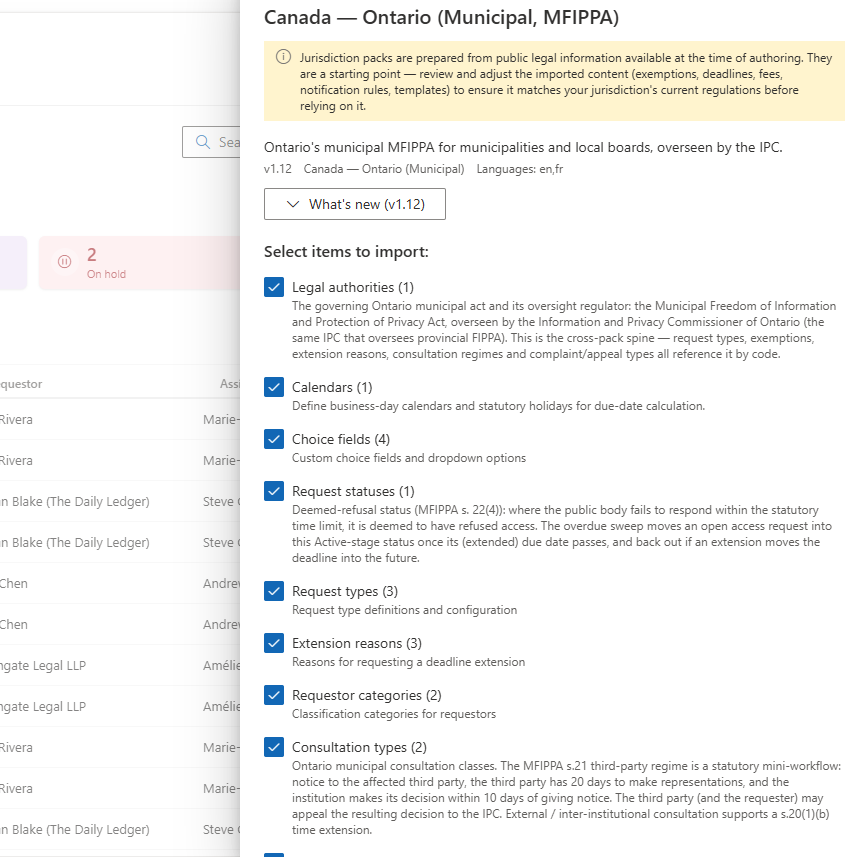
Installing the eu-edps-1725 jurisdiction pack seeds your tenant with everything this regime needs. It is a starting point built from public information about the legislation, not legal advice — your legal counsel validates and adjusts it for your tenant.
Pack content last reviewed: 2026-08-10
Related guide: FOI Workflow Quick Check- Regulation (EU) 2018/1725 as the legal-authority spine
- The Articles 17–20 rights on the one-month clock with the two-month extension and its justification
- Article 25 restrictions linked to the institution's adopted internal rules
- 72-hour EDPS breach notification and high-risk communication to data subjects
- Article 39 data protection impact assessments with DPO involvement and sign-off
- Records of processing operations and the DPO's register
- EDPS complaint and investigation tracking with grounds and outcomes
- Bilingual correspondence templates carrying the Regulation's wording
European Union — Institutions (2018/1725) Questions
How does 2018/1725 differ from the GDPR?
Can we run it alongside the institutions access regime?
How are Article 25 restrictions handled?
Where does personal data reside?
Go deeper
Flat annual pricing, published in full. Every feature in every size — access requests, privacy impact assessments, breach response, complaints, video & audio redaction, and AI Assist. No per-user or per-module fees.
- Under 500 employees$2,990/yr
- 500–2,000 employees$7,990/yr
- Over 2,000 employees$14,990/yr
Run Regulation 2018/1725 in Your Own Tenant
Try AccessPoint free for 30 days, configured for EU institutions. No credit card required.