
United Kingdom · Freedom of Information
The Freedom of Information Act 2000, public-interest test and Tribunal appeals included
AccessPoint manages Freedom of Information Act 2000 requests — the 20-working-day clock, the absolute and qualified exemptions with the public-interest test, the section 12 cost limit, and internal review through to ICO decision notices and First-tier Tribunal appeals — pre-configured for the United Kingdom and running inside your own Microsoft 365 tenant.
United Kingdom — FOIA at a glance
- Response standard
- 20 working days from receipt (section 10)
- Appeal route
- Internal review → ICO decision notice (s.50) → First-tier Tribunal (ss.57–58)
- Exemptions
- Part II absolute and qualified exemptions (ss.21–44); qualified ones subject to the public-interest test (s.2)
- Charges
- No fee for standard requests; refuse over the section 12 appropriate limit — £600 central government, £450 other authorities
- Oversight
- Information Commissioner's Office (ICO); appeals to the First-tier Tribunal
- Languages
- English, with Welsh and other languages configurable
Built for United Kingdom — FOIA
One platform for the whole access-and-privacy mandate, pre-configured for this regime and running in your own Microsoft 365 tenant.
FOIA request lifecycle
Intake to disclosure under the Freedom of Information Act 2000 — the 20-working-day clock, the Part II exemptions, the public-interest test, and internal review — all on Microsoft 365.
The public-interest test
For every qualified exemption, weigh the public interest in maintaining it against the public interest in disclosure (section 2) — reasoned, recorded, and Tribunal-ready.
The 20-working-day clock
Respond within 20 working days of receipt (section 10) on a UK working-day calendar — with the limited extension to weigh the public interest tracked and reminded for you.
Exemptions and redaction
Apply the Part II exemptions (ss.21–44) line by line — separating absolute from qualified — on a colour-coded, audit-trailed redaction record.
Section 12 cost limit
Estimate the cost of compliance against the appropriate limit — £600 for central government, £450 for other authorities, at £25 an hour — and issue a fees notice or refusal when it is exceeded.
In your own tenant
Every request and record stays inside your own Microsoft 365 and Azure tenant — no third-party cloud, no cross-border transfers, and no per-user fees.
The public-interest test and the appeal chain
In the UK, a qualified exemption only holds if the public interest says so — and the ICO can overrule you.
The Freedom of Information Act 2000 makes disclosure the default. Many of its Part II exemptions are 'qualified': the authority may withhold only if, in all the circumstances, the public interest in maintaining the exemption outweighs the public interest in disclosure (section 2). A dissatisfied requester escalates to internal review, then to the Information Commissioner, whose section 50 decision notice binds the authority. Either side may appeal to the First-tier Tribunal. AccessPoint records the public-interest balance, runs the internal review, and manages the file through the ICO and the Tribunal.
Configured out of the box
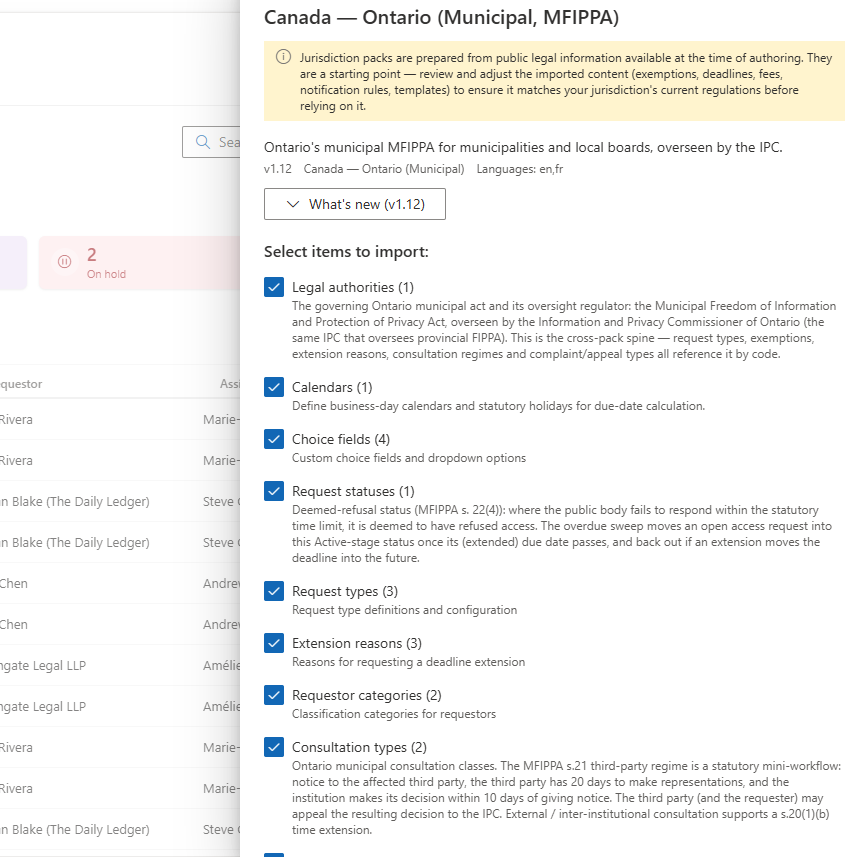
Installing the uk-foia jurisdiction pack seeds your tenant with everything this regime needs. It is a starting point built from public information about the legislation, not legal advice — your legal counsel validates and adjusts it for your tenant.
Pack content last reviewed: 2026-07-24
Related guide: UK FOI time limits: Section 10 and ICO backlog enforcement- The Freedom of Information Act 2000 (c. 36) as the legal-authority and citation spine
- The UK bank-holiday calendar and the 20-working-day due-date rules (section 10)
- The Part II exemptions (ss.21–44), colour-coded and split into absolute and qualified
- The section 2 public-interest test recorded for every qualified exemption
- Section 12 appropriate-limit handling — £600 / £450 at £25 an hour — with fees notices
- Internal review, then ICO decision-notice and First-tier Tribunal appeal workflows
- UK timeliness tracking against the 20-working-day standard
- FOIA correspondence templates with statutory wording
United Kingdom — FOIA Questions
When must a UK public authority respond to an FOI request?
What makes FOIA distinctive — the public-interest test and the appeal chain?
What can a public authority charge?
Where does data reside?
Go deeper
Flat annual pricing, published in full. Every feature in every size — access requests, privacy impact assessments, breach response, complaints, video & audio redaction, and AI Assist. No per-user or per-module fees.
- Under 500 employees$2,990/yr
- 500–2,000 employees$7,990/yr
- Over 2,000 employees$14,990/yr
Run the Freedom of Information Act in One Platform
Try AccessPoint free for 30 days, pre-configured for the United Kingdom. No credit card required.