
Solutions · By capability
AI governance for the public sector, run as a program
Algorithmic Impact Assessments scored, tiered, and reviewed on a real assessment engine; an AI systems register your leadership can read; and every AI decision — including the platform's own — on an auditable trail.
Public-sector AI governance stopped being optional the moment the mandates arrived: Canada's Directive on Automated Decision-Making requires Algorithmic Impact Assessments for federal automated decision systems, and Ontario's Bill 194 brought the first provincial public-sector AI rules alongside its mandatory PIAs. The practical question for institutions isn't whether to govern AI — it's where that governance will live, and whether it will survive an audit.
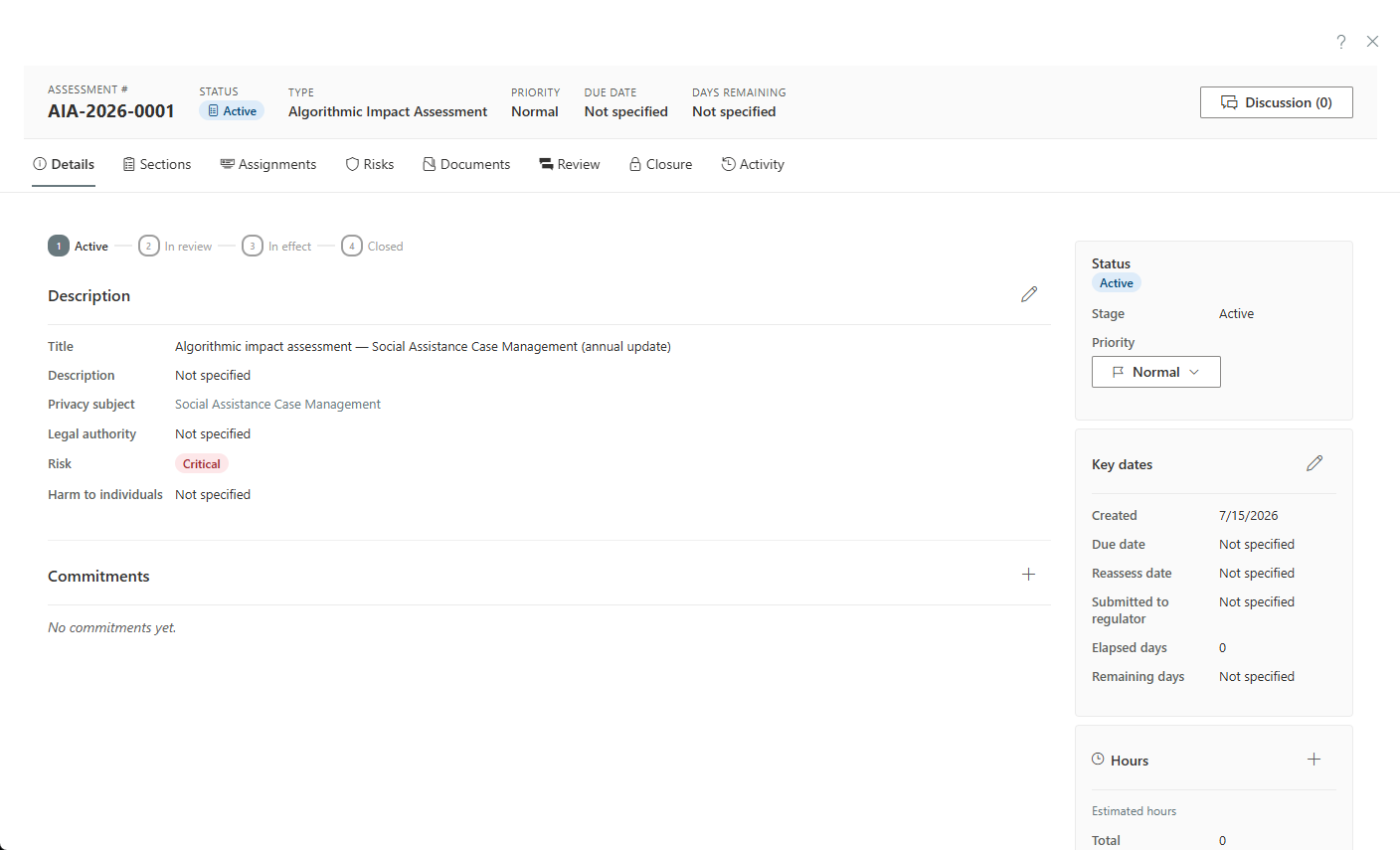
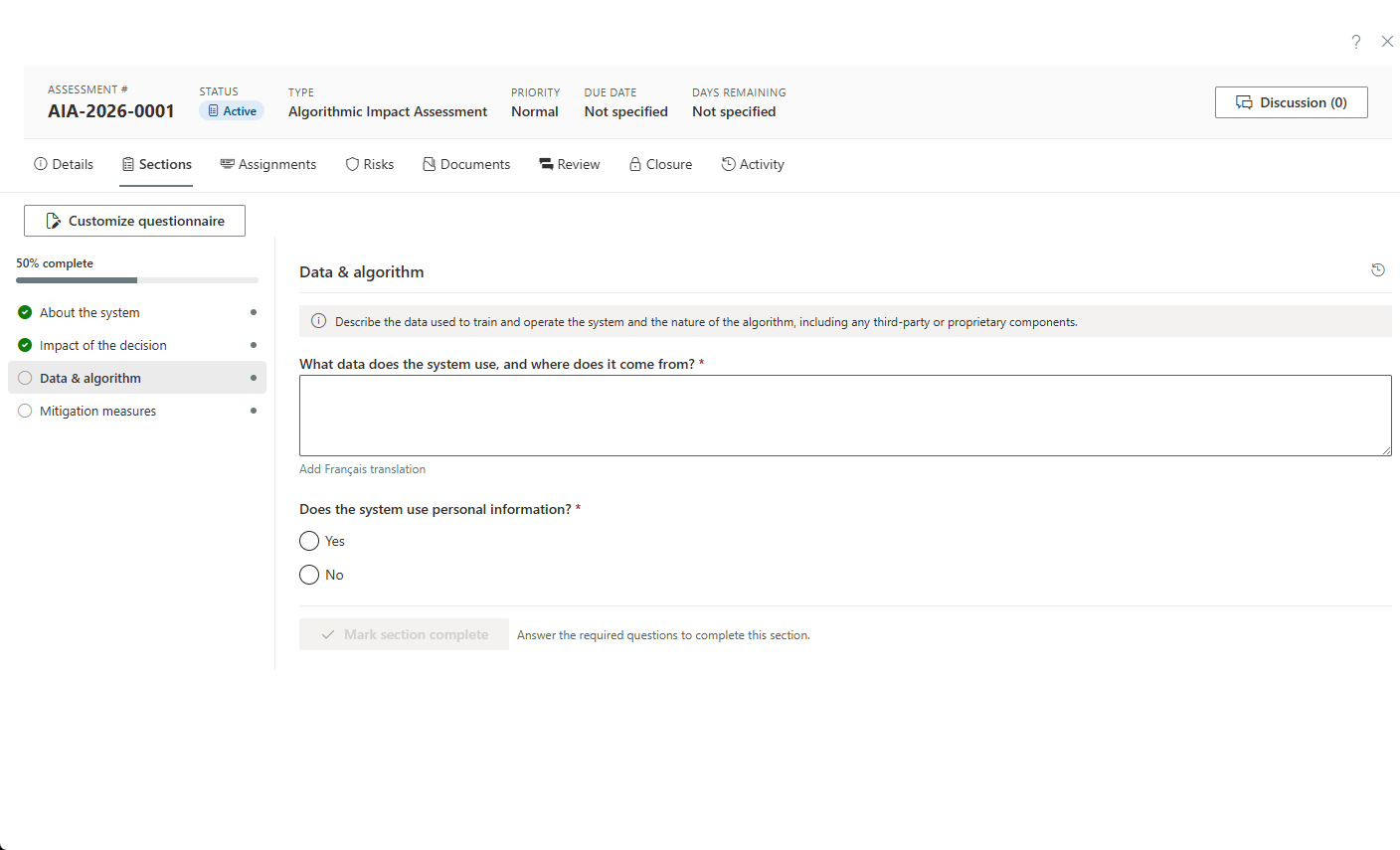
AccessPoint's answer is to run AI governance on the same machinery that already governs privacy. The assessment engine that runs your PIAs runs your AIAs — screeners, typed questionnaires, impact scoring and tiering, section assignment to the experts who actually understand the system, an embedded risk register, and review sign-off with a full trail. Each assessed system is a durable privacy subject carrying its automated-decision profile, its assessments, its risks, and its incidents over time, and an AI Systems Register report rolls the whole estate up with deployment status and risk classifications.
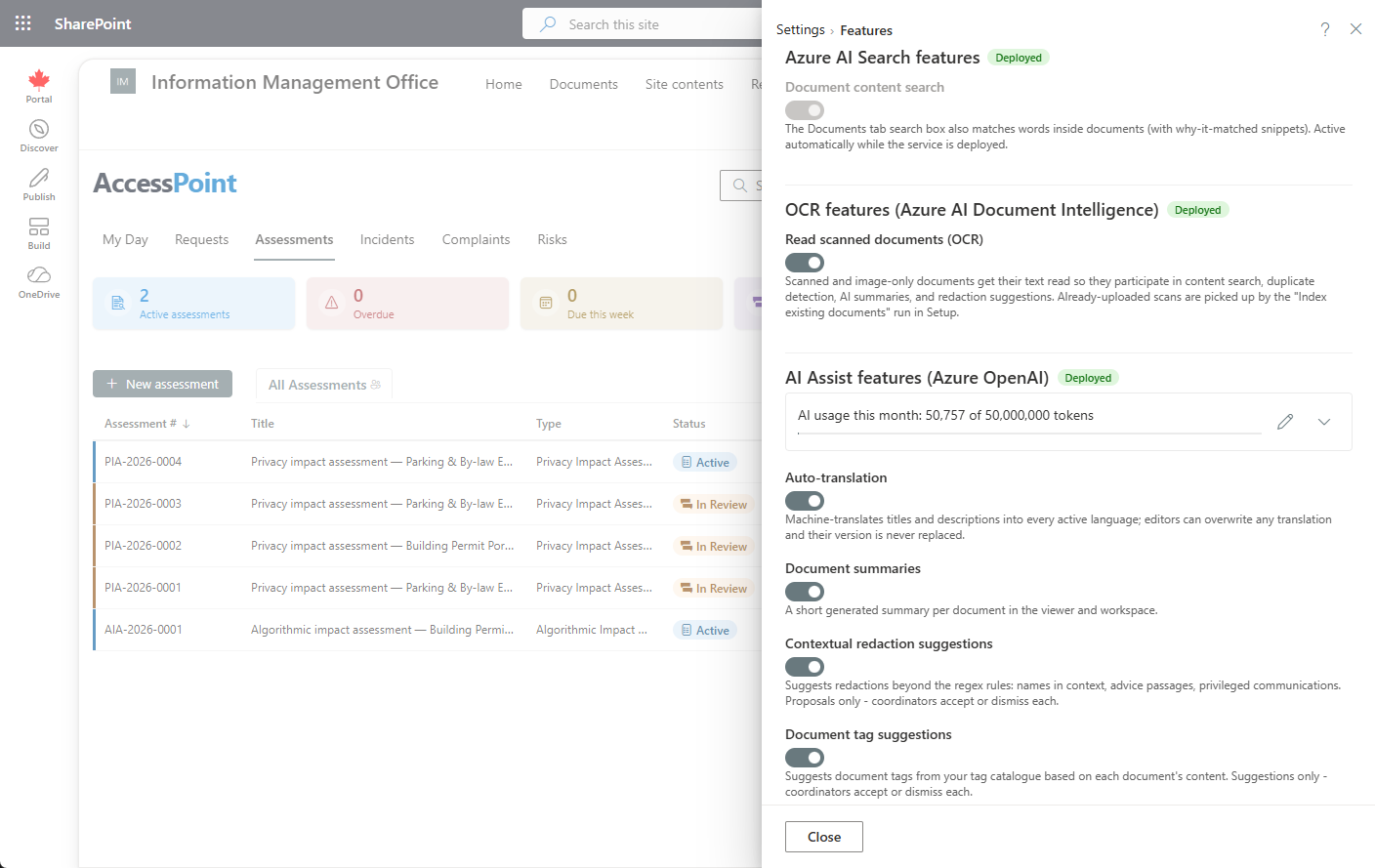
There's also a second layer most vendors skip: governing the AI inside your own tooling. AccessPoint's optional AI Assist is built responsible-by-design — it runs on Azure OpenAI inside your own tenant, every output is a suggestion a person decides on, prompts and responses are never stored, a token budget you control caps spend, each case's activity feed discloses the AI calls made on it, and case audit exports disclose AI involvement. Your AI governance program and your AI-assisted casework meet the same standard.
Sound familiar?
The mandates arrived before the machinery — three gaps every new AI governance program hits.
The inventory that doesn't exist
The deputy asks which systems use AI to make decisions about people, and the honest answer is an all-staff email and a spreadsheet started that afternoon. An estate nobody can enumerate can't be governed — and that audit finding writes itself.
Assessed at launch, never again
The AIA was completed for go-live, filed, and never touched. Since then the model retrained, the vendor shipped new features, and a second program adopted the system. The assessment on record — sign-off included — describes software that no longer exists.
Deployed first, assessed later
A program area switches on an AI feature inside software it already licenses, and the privacy office learns about it from a helpdesk ticket. Now the assessment happens retroactively, under scrutiny, for a system already making decisions about real people.
What public-sector AI governance software needs to do
The mandates differ by jurisdiction, but the working requirements converge on the same list.
How AccessPoint governs AI
One engine for the assessments, one register for the estate, one ledger under all of it.
AIAs on the PIA engine
Assess automated decision-making systems against the directive or framework that applies to you — public-sector AI directives, your own responsible-AI policy, or both — scored, tiered, reviewed, and published with an auditable trail.
AI systems register
ADM-flagged subjects carry their automated-decision profile, and the AI Systems Register report lists the estate with deployment status, risk classification, and the derived approval position.
Experts answer their part
Section assignment sends technical questionnaire sections to the people who built or operate the system; answers autosave and merge on coordinator approval.
Algorithmic risk, managed
Risks from AIAs land in the ISO 31000 register with inherent and residual scoring, treatments, KRIs, and governed acceptance that expires — beside the privacy risks they belong with.
Responsible by design, itself
AccessPoint's own AI Assist runs in your Azure tenant: person-decided outputs, no prompt storage, per-feature switches, a monthly token budget, your choice of inference data zone, and per-case AI disclosure.
Reporting for the oversight you face
Assessment throughput, the AI systems estate, and outstanding commitments — reportable from the same data, with Report Studio for the questions specific to your governance framework.
See it in AccessPoint
Real screens from the product, running in a Microsoft 365 tenant. Click any one to enlarge.
The mandate wave
AIAs went from best practice to law — and more is coming
The federal Directive on Automated Decision-Making made Algorithmic Impact Assessments mandatory for government ADM systems; Ontario's Bill 194 added provincial public-sector AI rules. Institutions that stand up AIA capacity on governed infrastructure now won't be improvising when the next obligation lands.
Go deeper
AI Governance & AIA Software Questions
What is algorithmic impact assessment software?
Does AccessPoint support the TBS Directive on Automated Decision-Making?
How do we keep track of all the AI systems across our organization?
Our privacy team owns AI governance. Is that the right home?
AccessPoint itself uses AI. How is that governed?
Flat annual pricing, published in full. Every feature in every size — access requests, privacy impact assessments, breach response, complaints, video & audio redaction, and AI Assist. No per-user or per-module fees.
- Under 500 employees$2,990/yr
- 500–2,000 employees$7,990/yr
- Over 2,000 employees$14,990/yr
Govern AI Before It Governs Your Audit Findings.
Try AccessPoint free for 30 days in your own Microsoft 365 tenant — AIA templates configured by your jurisdiction pack.