
Alberta · Personal Information Protection Act
Run Alberta PIPA, including Canada's oldest breach-notification duty
For private-sector organizations, non-profits, and associations operating in Alberta — AccessPoint manages access and correction on the 45-day clock, and the s.34.1 duty to notify the Commissioner of a breach posing a real risk of significant harm.
Alberta — PIPA at a glance
- Access deadline
- 45 days, with an extension in the circumstances PIPA allows
- Correction
- Correction, or annotation where the organization declines
- Breach duty
- s.34.1 — notify the Commissioner without unreasonable delay where there is a real risk of significant harm
- Who is covered
- Private-sector organizations, non-profits, and associations operating in Alberta
- Oversight
- OIPC of Alberta — order-making
- Languages
- English, French
Built for Alberta — PIPA
One platform for the whole access-and-privacy mandate, pre-configured for this regime and running in your own Microsoft 365 tenant.
The s.34.1 breach duty
Alberta required breach reporting to its Commissioner long before the rest of Canada. Log the incident, assess whether there is a real risk of significant harm, and produce the report with its reasoning intact — including the decisions not to notify.
Access requests on the 45-day clock
Run an individual's access request end to end, covering the information held, how it was used, and to whom it was disclosed, with PIPA's exceptions applied and cited.
Correction and annotation
Manage correction requests, and where the organization declines to correct, record the annotation so the individual's disagreement travels with the record.
Consent, purpose, and disclosure
Record the purpose and authority behind each collection, use, and disclosure, so the basis for holding information can be explained years later.
Built for an order-making regulator
The OIPC of Alberta can order an organization to act. Every request and incident carries a timestamped trail of what was decided, by whom, and on what ground.
In your own tenant
Personal information stays inside your own Microsoft 365 and Azure tenant — no third-party cloud, no vendor access, and no cross-border transfers.
The decision not to notify
s.34.1 turns on a judgment call — and the judgment is what gets reviewed.
Alberta's breach-notification duty is triggered by a standard, not a threshold: an organization must report to the Commissioner where an incident involves a real risk of significant harm to an individual. Most incidents are genuinely below that line, and deciding so is a legitimate outcome. What organizations get wrong is the record. When the OIPC later asks why an incident was not reported, an email thread and a recollection are a weak answer; a dated assessment naming the information involved, the sensitivity, the probability of misuse, and the person who made the call is a strong one. AccessPoint runs every incident through the same assessment whether or not it ends in a report — so the file is equally defensible in both directions.
Configured out of the box
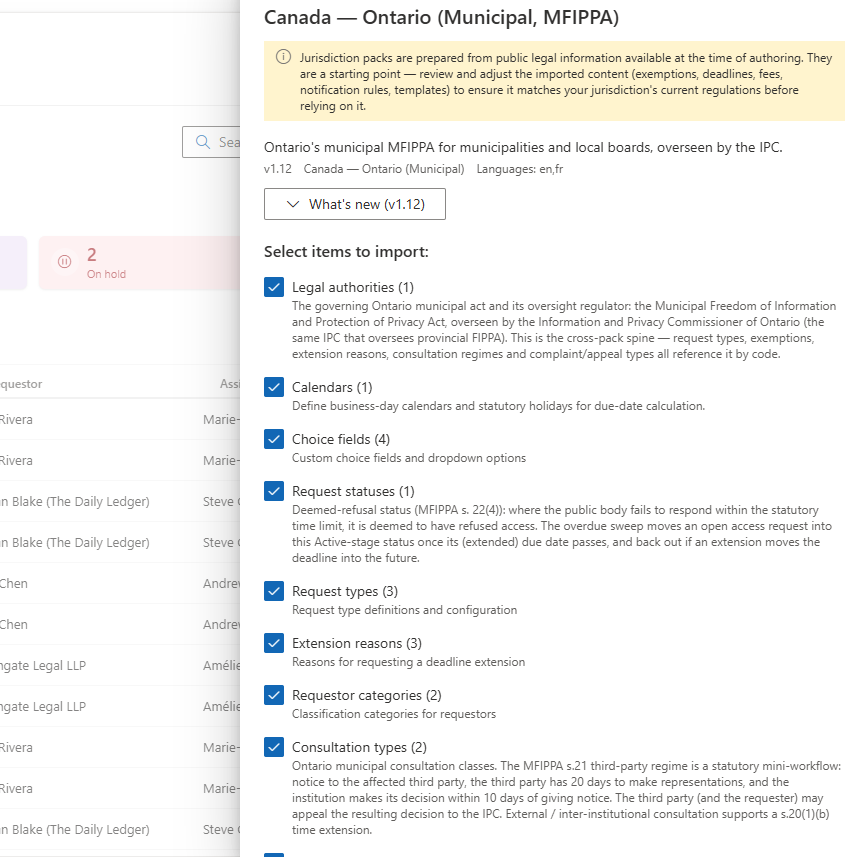
Installing the ca-ab-pipa jurisdiction pack seeds your tenant with everything this regime needs. It is a starting point built from public information about the legislation, not legal advice — your legal counsel validates and adjusts it for your tenant.
Pack content last reviewed: 2026-08-10
Related guide: FOI Workflow Quick Check- Alberta PIPA as the legal-authority spine, with access and correction as the workflow
- The 45-day access clock with PIPA's extension grounds and Alberta's statutory-holiday calendar
- Access responses covering the information held, its uses, and its disclosures
- PIPA's exceptions to access, colour-coded for redaction and citable line by line
- Correction requests and the annotation path where the organization declines
- The s.34.1 real-risk-of-significant-harm assessment driving Commissioner notification
- Individual notification workflows where the Commissioner requires them
- OIPC Alberta complaint and inquiry tracking with grounds and dispositions
Alberta — PIPA Questions
Does PIPA or PIPEDA apply to my organization?
What triggers the s.34.1 duty to notify the Commissioner?
How is Alberta's clock different from BC's?
Where does personal information reside?
Go deeper
Flat annual pricing, published in full. Every feature in every size — access requests, privacy impact assessments, breach response, complaints, video & audio redaction, and AI Assist. No per-user or per-module fees.
- Under 500 employees$2,990/yr
- 500–2,000 employees$7,990/yr
- Over 2,000 employees$14,990/yr
Run Alberta PIPA in Your Own Tenant
Try AccessPoint free for 30 days, configured for Alberta's private-sector privacy law. No credit card required.