
Redacting body-worn camera and 911 audio for FOI: what regulators now expect
The request that arrives as eleven hours of footage. What information commissioners have actually ordered — obscuring, temporal severance, distorted voices, and a citation at the place in the record — how long the work measurably takes, who may charge for it, and a release checklist an adjudicator will accept.
For twenty years, "redaction" in an access office meant black boxes on pages. The record that now dominates a police service's request queue is a recording: body-worn and in-car video, CCTV exports, dispatch and 911 audio, interview-room footage. The statute counts the days for a recording exactly as it does for a memo, but the review does not scale the same way, and the tools most offices inherited were built for paper. This guide sets out what the regulators expect a video or audio release to look like, drawing on the orders and guidance that have accumulated since about 2018, and what that implies for how the work is organized.
The effort problem, measured
The first thing to know is that the hours-per-hour ratio is not folklore. Four independent measurements, from different countries and different methods, land in the same band.
| Source | What was measured |
|---|---|
| Canada Border Services Agency, Innovative Solutions Canada challenge on automated video redaction (2019) | "Between four to six hours of work for an Access to Information and Privacy Analyst for the editing and the rendering of one hour of video"; approximately 1,800 person-days a year across the agency |
| Spokane County, Washington, body-worn camera fee resolution, March 2026 | A fee of $0.78 per minute of Public Records Specialist time, on the county's estimate that five minutes of footage takes about 25 minutes to redact |
| Veritone, Escondido Police Department customer story | "An hour of video often took 5–10 hours to process" before the department adopted a purpose-built tool |
| National Lawyers Guild v. City of Hayward, Supreme Court of California, 2020 | 35.3 hours of staff time editing exempt material out of six hours of body-worn camera footage with a desktop video editor — a ratio of roughly 5.9 to 1; the city collects more than 1,000 hours of body-worn video a month |
A November 2024 Madison Police Department memo put the same problem in one sentence: the redactions for a set of records requests had required the real-time viewing of 85 hours of video and more than 180 hours of staff time. Over-redaction is the visible failure mode. In February 2026, Connecticut's Freedom of Information Commission fined the New Haven Police Department $1,250 for "a clear disregard" of a requester's rights: ordered to release body-worn footage, the department sent a completely redacted file with no sound or picture, then a re-redacted cut eight months later. A workflow that depends on watching every second, twice, cannot meet a statutory clock at those ratios; the orders below assume it can.
What regulators have ordered
Obscure, don't withhold
The clearest line of authority is Ontario's. In Order PO-3905 (2018), a correctional-facility video, the Information and Privacy Commissioner directed severance both temporally and spatially: the first three minutes and seventeen seconds withheld outright because they did not show the appellant, and "obscuring technology" used from 03:18 to the end to sever the layout of the facility while the footage of the appellant's restraint was released. In Order MO-4566 (2024), a Toronto Police body-worn camera case, the adjudicator wrote that she would "order the police to obscure the images of all individuals other than the police officers and the appellant, prior to disclosing the video footage to the appellant." The principle is that the personal information of bystanders is exempt, the encounter is not, and the technology to separate them exists.
Distort, don't delete
Two 911 cases settled the audio equivalent. Order MO-3961 (2020, Durham Regional Police) ordered the call disclosed on the condition that "the voice of the 911 caller is to be distorted," and Order PO-4190 (2021, Ministry of the Solicitor General) explained why that is enough: "With the voice distorted, I find that the individual would not be identifiable and, therefore, the audio recording would not contain that individual's personal information." Distortion keeps the words — what was reported, when, to whom — while removing what identifies the speaker. Mute and bleep remain the tools for words that are themselves exempt. Washington's Public Records Act reaches the same place from the fee side, naming "redacting, altering, distorting, pixelating, suppressing, or otherwise obscuring" as the recognized methods.
The standard is not perfection, and it has a limit
Two principles bracket the duty. In PHIPA Decision 117 (2020), a hospital surveillance case, the adjudicator wrote: "this office routinely makes orders for the release of severed video footage … The standard for severing cannot be perfection. In my view, it would be too high of a bar to require that severing be 100% foolproof." That protects an office that has made a reasonable, documented effort from a claim that one missed frame invalidates the release. The other edge is the Commissioner's long-standing position that severance is not required where what would remain is only disconnected snippets with no informational value. That is the ground for withholding a recording in full — a finding about the record, made after the attempt, not a policy about the format.
Capacity is not an excuse
British Columbia's Commissioner closed the door on the argument that the office simply cannot do it. The OIPC's Public sector surveillance guidelines of January 14, 2026 state that "a public body must have the means to blur or otherwise obfuscate the identity of other individuals on a recording before responding to an FOI request, subject to what is reasonable," and that "lacking the capacity to blur or sever information to respond to an FOI request is not a valid reason under FIPPA to excuse a public body from performing this task."
Say what was removed, and why, at the place it was removed
Australia's Office of the Australian Information Commissioner, in Part 3 of its FOI Guidelines (version 1.10, February 2026), directs that where matter is deleted from a recording a sound should be inserted — "a tone or other obvious noise that makes it clear a deletion has been made" — and that "the schedule of documents accompanying the decision should also specify the sound that has been added to identify that matter has been deleted and the basis on which deletion have been made." The US statute is older and, for video, mostly unused: FOIA requires that "if technically feasible, the amount of the information deleted, and the exemption under which the deletion is made, shall be indicated at the place in the record where such deletion is made." The provision is format-neutral. A caption burned into the frame at the span, carrying the citation, is its literal implementation for a recording.
Who may charge for the work
Fees are the least consistent part of the picture, and the inconsistency is itself a finding: an office that serves more than one regime cannot assume a single rule.
| Regime | Redaction time |
|---|---|
| United Kingdom (Fees Regulations 2004, reg. 4(3)) | Only determining whether the information is held, locating, retrieving, and extracting it count toward the cost limit; redaction and considering exemptions do not, so they can neither be charged nor support a section 12 refusal |
| Scotland (Scottish Information Commissioner guidance) | "The actual process of redaction is chargeable, but only once the decision is taken about whether information can be disclosed or not"; time spent deciding whether information is exempt is not |
| Canada, federal (Access to Information Regulations, s. 7, as amended by SOR/2023-156) | Only the $5 application fee is prescribed; no search, preparation, or reproduction fee exists |
| Ontario (Regulation 460, ss. 6 and 6.1) | General requests: $7.50 per 15 minutes of search and of "preparing a record for disclosure, including severing a part of the record"; requests for one's own personal information — most body-worn camera demand — carry no search or preparation charge at all |
| California (National Lawyers Guild v. City of Hayward, 2020) | Redacting exempt material from electronic records is not chargeable "data extraction"; the agency bears its own redaction costs |
| Washington State (RCW 42.56.240(14)(f), body-worn camera recordings) | Requesters outside the statute's exempt classes may be charged "the reasonable costs of redacting, altering, distorting, pixelating, suppressing, or otherwise obscuring any portion of the body worn camera recording," the agency must use "the least costly commercially available method," and "the time spent on redaction of the recording shall not count towards the agency's allocation of, or limitation on, time or costs" |
Washington's is the worked-out model, and it is worth reading even outside Washington because it names the methods a regulator regards as legitimate. Whatever the fee rule, an estimate of the review hours belongs on every request that holds a recording: it is the number the office needs for planning, for an extension request where the statute allows one, and for the conversation with the requester about scope.
The citation that does not survive the handoff
Most request-management platforms do not do video. The ones that offer it integrate a separately licensed specialist tool: GovQA announced its Veritone Redact partnership in October 2020, OPEXUS's FOIAXpress uses the same integration, and JustFOIA followed in 2026. Veritone's own documentation describes the round trip: the request system sends the media out and gets back "the redacted file and audit log." Its redaction codes — the legal justification for each blur or muted span — are "burned into the video over the redacted area" and listed in Veritone's audit log and redaction report. What the case file holds afterwards is a rendered file and another product's log. The time-based index of what was withheld from a recording, from when to when, under which provision, lives in the video tool's report, outside the request file's own redaction record. That is exactly the record the orders above assume exists, and the record an adjudicator asks for first.
A defensible release, step by step
- Keep the original untouched. Every playback copy, transcript, and release is a derived file; the evidentiary original is never modified.
- Transcribe before you review. A time-coded, speaker-labelled transcript lets a reviewer find every spoken name and address by search, then confirm it at the timestamp, instead of listening in real time.
- Detect, then decide. Run face and on-screen text detection to propose regions; accept or dismiss each proposal. Detection that runs where the footage is stored keeps the evidence inside the organization.
- Sever by span and region. Obscure a person for the span they appear; track the region so one mark covers the appearance. Distort a voice where the words should remain; mute or bleep where the words are exempt. Withhold the whole recording only on an intertwining finding.
- Cite the exemption on every mark, with alternates, and route the marks through the same approval as a page redaction.
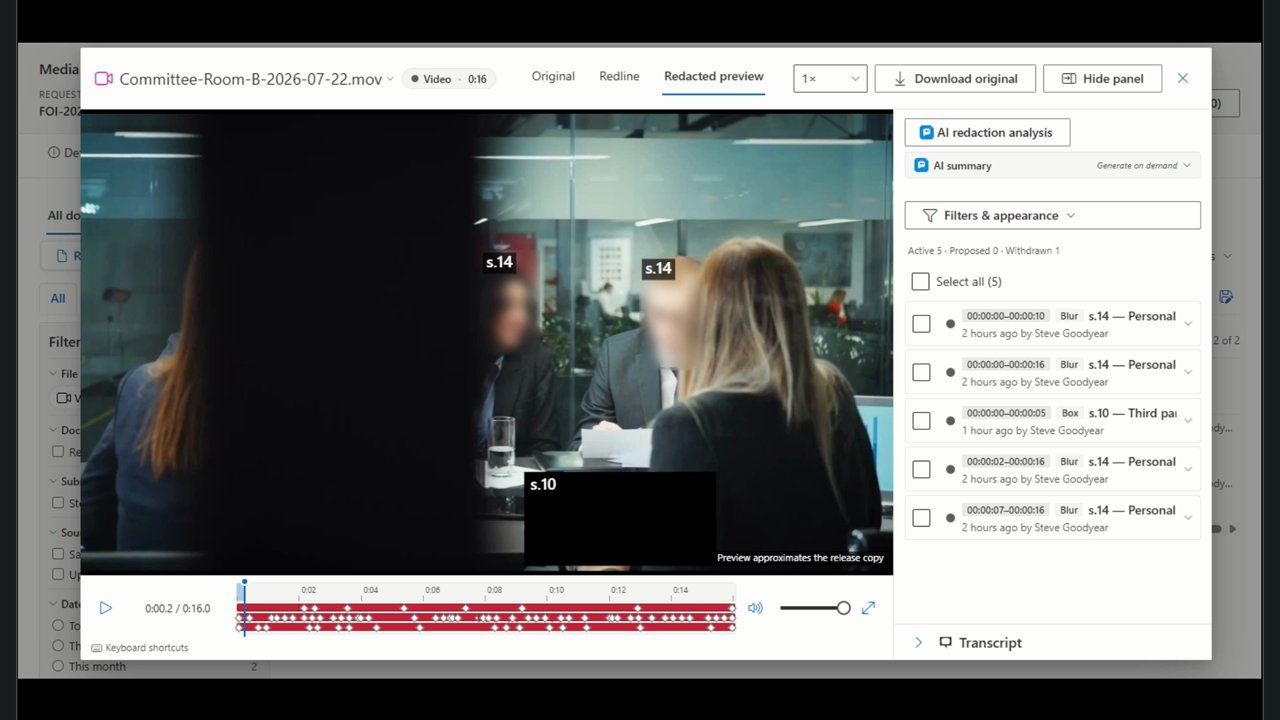
- Preview the release as the requester will receive it before it is generated.
- Release a rendered copy with proof. The burned MP4 or MP3, a manifest of every file's hash, a redaction index and per-span log, and a disposition per recording — disclosed in full, in part, or withheld.
- Record the effort. Log the review hours against the recording so the annual report, the fee decision, and the next request all rest on measured time.
How AccessPoint does it
AccessPoint treats a recording as a document in the same workspace as the PDFs. Footage up to 50 GB per file uploads through a resumable queue into the organization's own storage account, or is captured straight from Axon Evidence through the Axon Evidence connector; Azure AI Speech transcribes it in the organization's own subscription; face detection and region tracking run on the organization's own App Service. Marks are made by span and region with box, blur, pixelate, mute, bleep, or voice distortion, each carrying its exemption, alternates, approval, and audit entry. The Redacted preview plays the release before it exists, and the response package renders the MP4 or MP3 with the citation captioned in the frame at the span, a manifest of hashes, and a redaction log listing every span, effect, and authority. The Fees panel estimates review time from the recording's duration — four reviewer-hours per recorded hour by default — and pre-fills the fee line where the jurisdiction pack's schedule allows a charge.
See AccessPoint for police services Book a 30-minute demo
Last reviewed: September 2026.
Sources
- Order PO-3905 (November 28, 2018), Order MO-3961 (October 2, 2020), Order PO-4190 (September 27, 2021), Order MO-4566 (September 18, 2024), and PHIPA Decision 117 (April 17, 2020) — Information and Privacy Commissioner of Ontario (accessed September 2026).
- Public sector surveillance guidelines (January 14, 2026) — Office of the Information and Privacy Commissioner for British Columbia (accessed September 2026).
- FOI Guidelines, Part 3: Processing and deciding on requests for access (version 1.10, February 2026) — Office of the Australian Information Commissioner (accessed September 2026).
- RCW 42.56.240(14)(f) — Washington State Legislature (accessed September 2026).
- 5 U.S.C. § 552(b) — Legal Information Institute, Cornell.
- Freedom of Information and Data Protection (Appropriate Limit and Fees) Regulations 2004, regulation 4(3) — legislation.gov.uk; Charging a fee or refusing to comply with a request on excessive cost grounds — Scottish Information Commissioner.
- Access to Information Regulations, section 7 (as amended by SOR/2023-156) and Ontario Regulation 460, sections 6 and 6.1 — Justice Laws Canada; Ontario e-Laws.
- National Lawyers Guild v. City of Hayward, S252445 (Cal. May 28, 2020) — Supreme Court of California (accessed September 2026).
- Automated redaction of video recordings for the purposes of Access to Information requests (Innovative Solutions Canada challenge, Canada Border Services Agency) — Innovation, Science and Economic Development Canada (accessed September 2026).
- Resolution 26-0159, body-worn camera public records request fee — Spokane County, Washington (March 2026); reported by The Spokesman-Review and The Center Square.
- Veritone Redact (Escondido Police Department customer story); Redact Integrations and Redaction Codes — Veritone support documentation (accessed September 2026).
- Veritone and GovQA Forge Strategic Relationship — Business Wire, October 21, 2020; Veritone integration — JustFOIA (accessed September 2026).
- Madison Police Department inter-departmental correspondence on body-worn camera records requests (November 2024, as published by Tone Madison); City Hit With FOI Fine, Plans Appeal — New Haven Independent, April 7, 2026.
Related reading on this site: AccessPoint for police services and public safety; video and audio redaction software and what to look for in any tool; the Axon Evidence connector for footage already in Axon; the companion guide on Teams meeting recordings as records; the Washington Public Records Act guide; or book a demo to see a body-worn clip redacted and released.