
India · RTI & DPDP
Right to information and data protection for India, in one platform
AccessPoint manages Right to Information Act 2005 requests and the Digital Personal Data Protection Act 2023's obligations — the 30-day RTI clock, CIC and SIC appeals, and data-principal rights — pre-configured for India and running inside your own Microsoft 365 tenant.
India at a glance
- Response deadline
- 30 days from receipt by the Public Information Officer (RTI Act)
- Expedited
- 48 hours where the request concerns a person's life or liberty
- Fees
- A nominal application fee (e.g. Rs 10 for central-government bodies; state fees vary), with BPL applicants exempt
- DPDP data-principal rights
- Access (s 11), correction and erasure (s 12), and grievance redressal (s 13)
- Breach notification
- Notify the Data Protection Board and affected data principals of a personal-data breach
- Oversight
- Information Commissions (RTI) and the Data Protection Board of India (DPDP)
Built for India
One platform for the whole access-and-privacy mandate, pre-configured for this regime and running in your own Microsoft 365 tenant.
RTI request lifecycle
Intake to decision on the RTI Act's 30-day clock — with the 48-hour life-or-liberty rule, the section 8 exemptions, fee and copying charges, and a deemed-refusal safeguard, all built on Microsoft 365.
CIC and SIC appeals
Track first appeals and second appeals to the Central or State Information Commission — each with its own clock, an investigation workspace, and a guided path through to disclosure orders or penalties on information officers.
DPDP data-principal requests
Handle DPDP access (s 11), correction and erasure (s 12), and grievance-redressal requests as the Act's obligations phase in, on a guided questionnaire engine with an embedded risk register.
DPDP breach notification
Log a personal-data breach and get a live checklist of what the DPDP Act requires — notice to the Data Protection Board of India and to each affected data principal — with a full audit trail.
Data-protection impact assessments
Run the impact assessments the DPDP framework expects of Significant Data Fiduciaries, using the same assessment engine — with screeners, section delegation, and a risk register — that scores and reviews your other governance work.
In your own tenant
Every request, assessment, and record stays inside your own Microsoft 365 and Azure tenant — no third-party cloud, no cross-border transfers, no per-user fees.
From transparency to data protection
India built one of the world's largest right-to-information systems. Now data protection arrives. AccessPoint runs both.
For two decades the Right to Information Act has given citizens a powerful claim on what public authorities hold. The Digital Personal Data Protection Act 2023 adds the other half — rights for individuals over their own personal data, duties for the organisations that process it, and a Data Protection Board to enforce them, with rules finalised in 2025 and obligations phasing in through 2027. AccessPoint operates both on one platform, in your own tenant, so RTI requests, data-principal requests, and breach notifications are handled by one system instead of being bolted on as the new law lands.
Configured out of the box
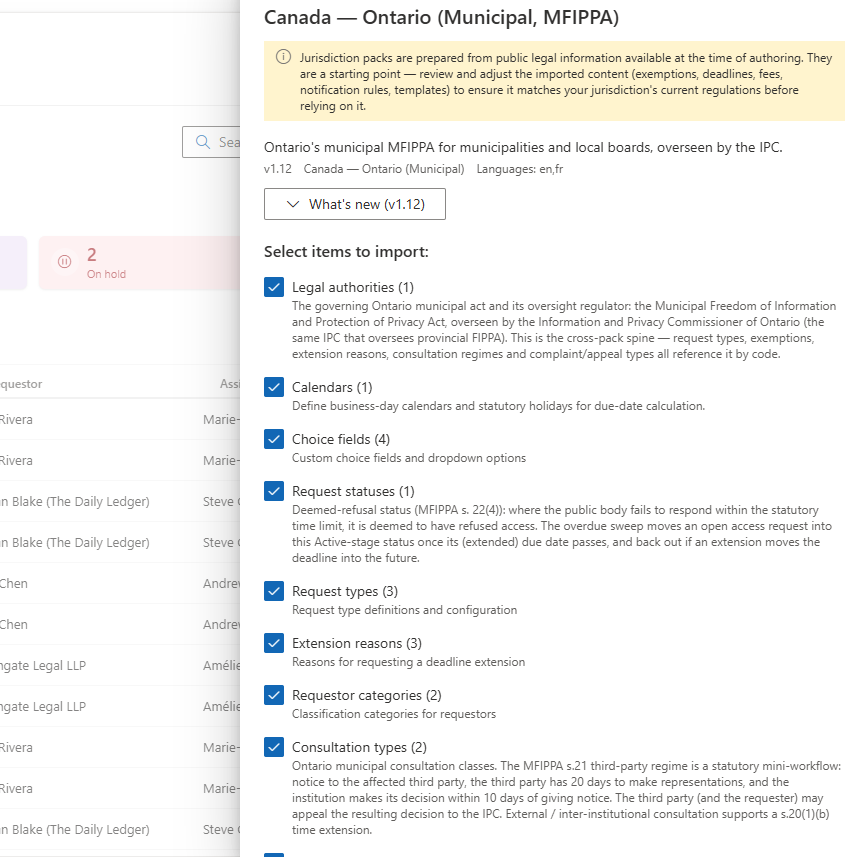
Installing the in-rti-dpdp jurisdiction pack seeds your tenant with everything this regime needs. It is a starting point built from public information about the legislation, not legal advice — your legal counsel validates and adjusts it for your tenant.
Pack content last reviewed: 2026-07-13
Related guide: FOI Workflow Quick Check- The RTI Act 2005 and the DPDP Act 2023 as the legal-authority spine
- Indian public-holiday calendar and RTI due-date rules, including the 48-hour life-or-liberty clock
- The RTI section 8 exemptions, colour-coded for redaction
- RTI application-fee and copying-charge categories, with the BPL exemption
- CIC and SIC first-appeal and second-appeal grounds and dispositions
- DPDP data-principal request types — access, correction, erasure, and grievance redressal
- DPDP breach-notification rules for the Data Protection Board of India
- Correspondence templates with RTI and DPDP wording
India Questions
Does AccessPoint cover both the RTI Act and the DPDP Act?
Is the DPDP Act in force yet?
How does it handle RTI appeals?
Where does Indian data reside?
Go deeper
Flat annual pricing, published in full. Every feature in every size — access requests, privacy impact assessments, breach response, complaints, video & audio redaction, the public portal, repository connectors, and AI Assist. No per-user or per-module fees.
- Under 500 employees$2,990/yr
- 500–1,999 employees$7,990/yr
- 2,000–9,999 employees$14,990/yr
- 10,000+ employees$29,990/yr
Run RTI and DPDP in One Platform
Try AccessPoint free for 30 days, pre-configured for India. No credit card required.