
European Union · Access to Documents
Public access to EU documents under Regulation 1049/2001
AccessPoint runs requests for European Parliament, Council and Commission documents on the 15-working-day clock — with confirmatory applications, the Article 4 exceptions, and a record ready for the Ombudsman or the Court — inside your own Microsoft 365 tenant.
European Union — Institutions at a glance
- Response deadline
- 15 working days from registration of the application (Article 7)
- Extensions
- A further 15 working days in exceptional cases — very long or very numerous documents (Article 7(3))
- Confirmatory application
- Within 15 working days of a refusal; the institution replies within 15 working days, extendable by 15 (Article 8)
- Exceptions
- The Article 4 exceptions, most subject to an overriding-public-interest test
- Fee
- On-site consultation and copies below a threshold are free; a charge only for larger copy volumes (Article 10)
- Oversight
- European Ombudsman and the General Court (CJEU)
- Languages
- Any EU official language; ships English and French
Built for European Union — Institutions
One platform for the whole access-and-privacy mandate, pre-configured for this regime and running in your own Microsoft 365 tenant.
The 1049/2001 request lifecycle
Intake to disclosure on the 15-working-day clock, with the Article 7(3) exceptional extension, the Article 4 exception catalogue, and a record ready for Ombudsman or Court review — all built on Microsoft 365.
Confirmatory applications
Track the two-stage process — the initial reply, the applicant's confirmatory application within 15 working days, and the institution's reconsidered decision on its own statutory clock — as linked records.
The Article 4 exceptions
Apply the mandatory and discretionary exceptions — public security, defence, international relations, financial and economic policy, personal privacy, commercial interests, court proceedings, investigations, and internal decision-making — each weighed against the overriding public interest.
Third-party and member-state consultation
Where a document originates with a third party or a member state, run the consultation the Regulation requires before deciding on disclosure (Article 4(4) and (5)).
Document register and proactive publication
Keep the public register the Regulation expects and move routine categories to proactive publication, so fewer documents need a formal request at all.
In your own tenant
Every request, document, and decision stays inside your own Microsoft 365 and Azure tenant — no third-party cloud and no vendor access to your data.
From request to confirmatory review
Every refusal can be reconsidered — then reviewed by the Ombudsman or the Court. AccessPoint tracks the whole path.
Regulation 1049/2001 gives anyone the right to documents held by the Parliament, Council and Commission, answered within 15 working days. A refusal is not the end: the applicant can file a confirmatory application asking the institution to reconsider, and if that fails, complain to the European Ombudsman or bring the matter before the General Court. AccessPoint runs the initial application, the confirmatory stage, and the oversight track on one platform — each with its own clock and a complete, exportable record.
Configured out of the box
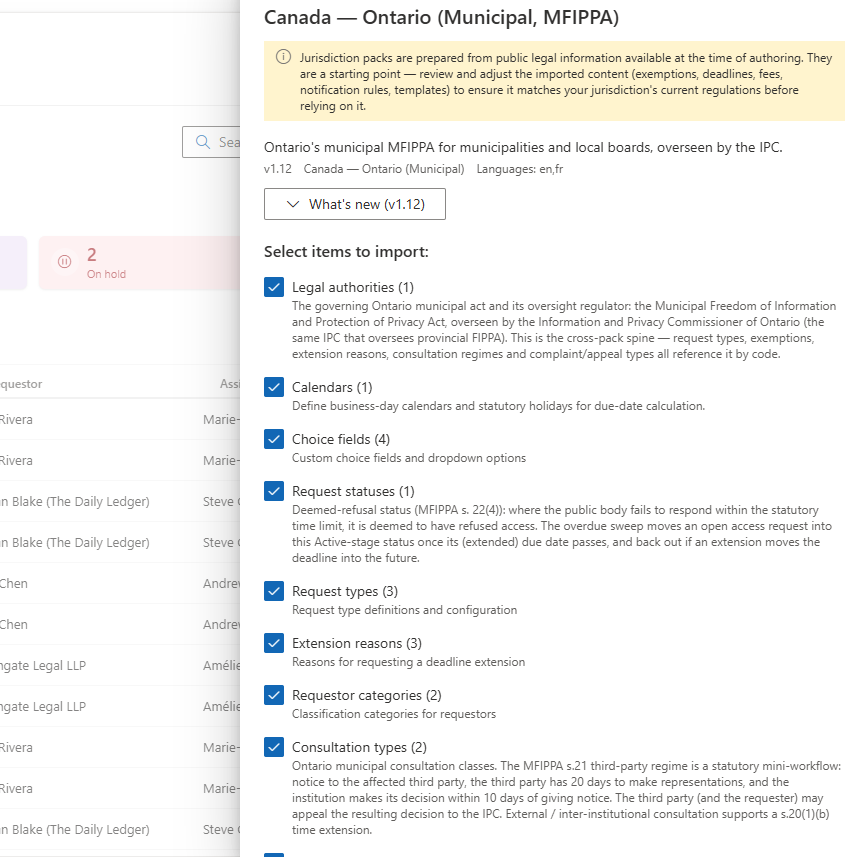
Installing the eu-institutions-foi jurisdiction pack seeds your tenant with everything this regime needs. It is a starting point built from public information about the legislation, not legal advice — your legal counsel validates and adjusts it for your tenant.
Pack content last reviewed: 2026-07-13
Related guide: FOI Workflow Quick Check- Regulation (EC) No 1049/2001 as the legal-authority and citation spine
- The 15-working-day clock and the Article 7(3) exceptional extension
- Confirmatory-application handling on its own statutory clock (Article 8)
- The Article 4 exception catalogue with the public-interest balancing test
- Third-party and member-state consultation regimes (Article 4(4) and (5))
- Fee rules for copies above the free threshold (Article 10)
- European Ombudsman and General Court review tracking
- Correspondence templates in English and French, extendable to any EU official language
European Union — Institutions Questions
What deadline does Regulation 1049/2001 set?
How does the confirmatory application work?
Which exceptions can justify a refusal?
Where does document data reside?
Go deeper
Flat annual pricing, published in full. Every feature in every size — access requests, privacy impact assessments, breach response, complaints, video & audio redaction, the public portal, repository connectors, and AI Assist. No per-user or per-module fees.
- Under 500 employees$2,990/yr
- 500–1,999 employees$7,990/yr
- 2,000–9,999 employees$14,990/yr
- 10,000+ employees$29,990/yr
Run Access to Documents on One Platform
Try AccessPoint free for 30 days, pre-configured for Regulation 1049/2001. No credit card required.